Energy concerns weighed on the yen, and coupled with policy divergence, the USD/JPY pair remained range-bound at high levels.
2026-04-21 11:31:57
On Tuesday during Asian trading hours, the USD/JPY pair continued its rebound, rising to around 159.00 and recovering some of the previous day's losses. However, overall, the exchange rate remains within the trading range established over the past month, and the market direction remains unclear.

From a fundamental perspective, the yen has been under relative pressure recently, mainly due to uncertainties in energy supply. Continued tensions in the Middle East are disrupting key shipping routes; the Strait of Hormuz handles approximately 20% of global seaborne crude oil transport , posing a potential shock to the Japanese economy. As an economy heavily reliant on energy imports, Japan faces imported inflation and rising costs, thus weakening the yen and supporting the USD/JPY exchange rate.
However, the downside potential of the yen is limited by several factors. First, the Bank of Japan's policy expectations are gradually shifting towards a tighter stance. Although the market generally expects the Bank of Japan to keep interest rates unchanged at its April meeting, rising energy prices are pushing up inflation, and the policy front has signaled a possible future rate hike, especially with the possibility of a policy adjustment in June. This expectation provides some support for the yen.
Secondly, Japanese authorities remain highly vigilant regarding exchange rate fluctuations. Recent statements have repeatedly emphasized that they will not tolerate excessive volatility and are prepared to take decisive measures, making the market wary of potential intervention. When the exchange rate approaches key highs, expectations of intervention often dampen bullish sentiment, thus limiting further upside potential for the USD/JPY exchange rate.
Meanwhile, support for the US dollar is relatively limited. Although the dollar is supported to some extent by safe-haven demand, it remains close to its previous lows. Market expectations for further interest rate hikes by the Federal Reserve have cooled, resulting in insufficient upward momentum for the dollar. Against this backdrop, the logic of widening interest rate differentials between the US and Japan has not yet strengthened significantly, weakening its driving effect on the exchange rate.
Overall, the USD/JPY pair is currently experiencing a typical range-bound trading pattern due to the dual influence of "weak yen fundamentals" and "tightening policy expectations and intervention risks."
From a technical perspective, the daily chart shows the exchange rate maintaining a sideways consolidation structure, with prices oscillating repeatedly within a high-level range. The area around 160.00 forms a key psychological resistance level , which has been tested multiple times without a significant breakthrough, indicating strong selling pressure above. On the downside, 157.50 forms important support ; a break below this level could lead to a further decline to the 155.00 area . In terms of momentum indicators, the MACD is flattening, suggesting insufficient trend momentum.
From a 4-hour chart perspective, the short-term trend shows a slightly bullish but lacking continuity. After the price rebounded to around 159, the upward momentum gradually weakened, and the moving average system tended to converge, indicating that the market lacks a clear direction. The RSI is in the neutral zone, without any extreme signals, suggesting that the price will continue to fluctuate within a range. If it breaks through the 160 level, it may open up upward potential; if it falls below 158, the short-term trend may weaken.
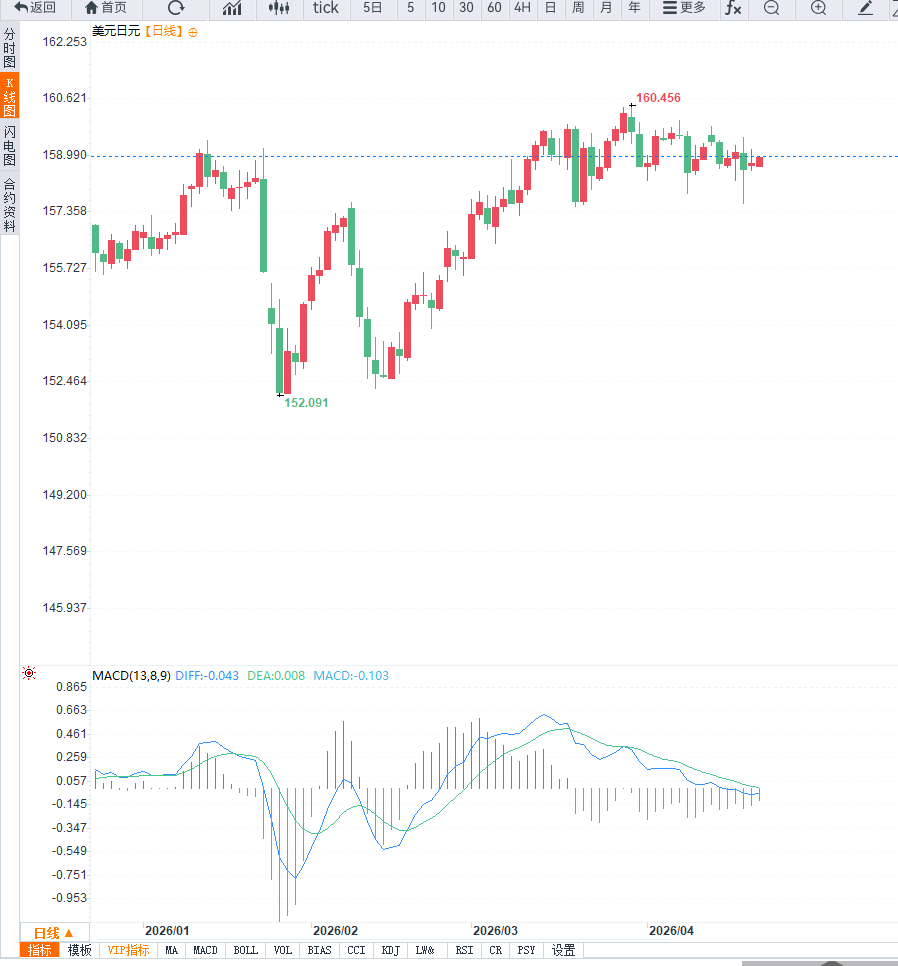
Overall, given the interplay of policy divergence, energy risks, and expectations of intervention, the USD/JPY exchange rate is unlikely to form a unilateral trend in the short term.
Editor's Summary:
The USD/JPY pair is currently caught in a tug-of-war among multiple factors. Energy risks are putting pressure on the Japanese economy, which is bearish for the yen in the short term, but expectations of potential interest rate hikes and intervention by the Bank of Japan limit its depreciation potential. Meanwhile, the Federal Reserve's policy expectations are trending towards a more dovish stance, also weakening the dollar's upward momentum. Overall, the exchange rate is expected to remain range-bound, awaiting new directional guidance from policy or data. Investors should pay close attention to whether the 160 level and the 157.50 support level are breached to determine the next phase of the trend.
From a fundamental perspective, the yen has been under relative pressure recently, mainly due to uncertainties in energy supply. Continued tensions in the Middle East are disrupting key shipping routes; the Strait of Hormuz handles approximately 20% of global seaborne crude oil transport , posing a potential shock to the Japanese economy. As an economy heavily reliant on energy imports, Japan faces imported inflation and rising costs, thus weakening the yen and supporting the USD/JPY exchange rate.
However, the downside potential of the yen is limited by several factors. First, the Bank of Japan's policy expectations are gradually shifting towards a tighter stance. Although the market generally expects the Bank of Japan to keep interest rates unchanged at its April meeting, rising energy prices are pushing up inflation, and the policy front has signaled a possible future rate hike, especially with the possibility of a policy adjustment in June. This expectation provides some support for the yen.
Secondly, Japanese authorities remain highly vigilant regarding exchange rate fluctuations. Recent statements have repeatedly emphasized that they will not tolerate excessive volatility and are prepared to take decisive measures, making the market wary of potential intervention. When the exchange rate approaches key highs, expectations of intervention often dampen bullish sentiment, thus limiting further upside potential for the USD/JPY exchange rate.
Meanwhile, support for the US dollar is relatively limited. Although the dollar is supported to some extent by safe-haven demand, it remains close to its previous lows. Market expectations for further interest rate hikes by the Federal Reserve have cooled, resulting in insufficient upward momentum for the dollar. Against this backdrop, the logic of widening interest rate differentials between the US and Japan has not yet strengthened significantly, weakening its driving effect on the exchange rate.
Overall, the USD/JPY pair is currently experiencing a typical range-bound trading pattern due to the dual influence of "weak yen fundamentals" and "tightening policy expectations and intervention risks."
From a technical perspective, the daily chart shows the exchange rate maintaining a sideways consolidation structure, with prices oscillating repeatedly within a high-level range. The area around 160.00 forms a key psychological resistance level , which has been tested multiple times without a significant breakthrough, indicating strong selling pressure above. On the downside, 157.50 forms important support ; a break below this level could lead to a further decline to the 155.00 area . In terms of momentum indicators, the MACD is flattening, suggesting insufficient trend momentum.
From a 4-hour chart perspective, the short-term trend shows a slightly bullish but lacking continuity. After the price rebounded to around 159, the upward momentum gradually weakened, and the moving average system tended to converge, indicating that the market lacks a clear direction. The RSI is in the neutral zone, without any extreme signals, suggesting that the price will continue to fluctuate within a range. If it breaks through the 160 level, it may open up upward potential; if it falls below 158, the short-term trend may weaken.
Overall, given the interplay of policy divergence, energy risks, and expectations of intervention, the USD/JPY exchange rate is unlikely to form a unilateral trend in the short term.
Editor's Summary:
The USD/JPY pair is currently caught in a tug-of-war among multiple factors. Energy risks are putting pressure on the Japanese economy, which is bearish for the yen in the short term, but expectations of potential interest rate hikes and intervention by the Bank of Japan limit its depreciation potential. Meanwhile, the Federal Reserve's policy expectations are trending towards a more dovish stance, also weakening the dollar's upward momentum. Overall, the exchange rate is expected to remain range-bound, awaiting new directional guidance from policy or data. Investors should pay close attention to whether the 160 level and the 157.50 support level are breached to determine the next phase of the trend.
- Risk Warning and Disclaimer
- The market involves risk, and trading may not be suitable for all investors. This article is for reference only and does not constitute personal investment advice, nor does it take into account certain users’ specific investment objectives, financial situation, or other needs. Any investment decisions made based on this information are at your own risk.