New Zealand's first-quarter CPI unexpectedly remained stable, and the Reserve Bank may raise interest rates earlier than expected in July.
2026-04-21 13:39:08
According to APP, New Zealand's CPI rose 3.1% year-on-year in the first quarter, exactly the same as the increase in the fourth quarter of last year, and higher than economists' general expectation of 2.9%; the quarter-on-quarter increase was 0.9%, also exceeding the market forecast of 0.8%. This data indicates that New Zealand's inflation rate has unexpectedly remained above the target range of 1% to 3% before the fuel and other cost increases caused by the war with Iran have fully passed on.
Housing and household goods prices were the main drivers of inflation, with electricity prices surging 12.5% year-on-year and local government fees rising 8.8%, together contributing 3.4% to the housing and utilities group's increase. Food prices rose 4.0% year-on-year, with meat and poultry prices particularly prominent; transportation prices accelerated to 3.3% year-on-year, with significant increases in private transportation services and supplies. These structural pressures indicate that inflation is not a short-term fluctuation, but rather the result of accumulated costs across multiple sectors.
The Reserve Bank of New Zealand (RBNZ) initially estimates that inflation will accelerate to 4.2% in the second quarter, while some local economists predict the peak could be even higher, warning that inflation could become deeply entrenched in the economy and remain above the target range until 2027. In response to this risk, the market widely expects the RBNZ to begin raising interest rates sooner than previously anticipated, with investors currently pricing in a rate hike as early as July.
Recently, Reserve Bank of New Zealand Governor Anna Brehman explicitly stated that if a surge in oil prices triggered by a war with Iran leads to sustained inflation, the central bank may raise interest rates, but short-term fluctuations can be "ignored." This statement further reinforced market expectations of policy tightening.
To clearly compare key data, the following table shows the actual performance this period, market expectations, and previous values:
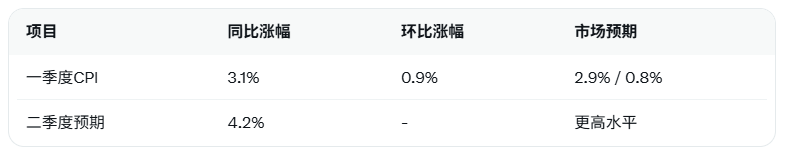
The above comparison highlights the extent to which the data exceeded expectations, with a particularly significant month-on-month acceleration, indicating that the cost transmission chain has begun to accelerate.
At a deeper level, the disruptions to the global energy supply chain caused by the Iran war are rapidly escalating to New Zealand through imported fuel prices. Gasoline and diesel prices hit record highs in March, directly increasing travel and logistics costs for residents and potentially triggering a second wage-price spiral. If inflation expectations continue to rise, the Reserve Bank of New Zealand's room for maintaining low interest rates will be significantly reduced. Raising interest rates ahead of schedule is not only to anchor the inflation target but also to prevent damage to long-term growth potential.
Overall, this round of inflation has been more resilient than initially anticipated, driven by both external supply shocks and persistently high domestic costs such as housing and electricity. Future policy paths will heavily depend on fuel price trends. If geopolitical tensions ease, inflation may gradually fall back to the target level by 2027; conversely, the interest rate hike cycle may be prolonged, exacerbating pressures on economic slowdown.
Editor's Summary : Latest data shows that New Zealand inflation exhibited greater-than-expected stickiness before the fuel cost shock from the Iran war, with housing and energy prices being the core drivers. The risk of an acceleration in the second quarter is clear, and the market's pricing in a July rate hike reflects the dilemma policymakers face: addressing deep-seated price pressures while avoiding premature tightening that could hinder the recovery. Future trends will depend on geopolitical developments and domestic demand resilience; close monitoring of the Fed's meeting signals and fuel price dynamics is crucial.
Housing and household goods prices were the main drivers of inflation, with electricity prices surging 12.5% year-on-year and local government fees rising 8.8%, together contributing 3.4% to the housing and utilities group's increase. Food prices rose 4.0% year-on-year, with meat and poultry prices particularly prominent; transportation prices accelerated to 3.3% year-on-year, with significant increases in private transportation services and supplies. These structural pressures indicate that inflation is not a short-term fluctuation, but rather the result of accumulated costs across multiple sectors.
The Reserve Bank of New Zealand (RBNZ) initially estimates that inflation will accelerate to 4.2% in the second quarter, while some local economists predict the peak could be even higher, warning that inflation could become deeply entrenched in the economy and remain above the target range until 2027. In response to this risk, the market widely expects the RBNZ to begin raising interest rates sooner than previously anticipated, with investors currently pricing in a rate hike as early as July.
Recently, Reserve Bank of New Zealand Governor Anna Brehman explicitly stated that if a surge in oil prices triggered by a war with Iran leads to sustained inflation, the central bank may raise interest rates, but short-term fluctuations can be "ignored." This statement further reinforced market expectations of policy tightening.
To clearly compare key data, the following table shows the actual performance this period, market expectations, and previous values:
The above comparison highlights the extent to which the data exceeded expectations, with a particularly significant month-on-month acceleration, indicating that the cost transmission chain has begun to accelerate.
At a deeper level, the disruptions to the global energy supply chain caused by the Iran war are rapidly escalating to New Zealand through imported fuel prices. Gasoline and diesel prices hit record highs in March, directly increasing travel and logistics costs for residents and potentially triggering a second wage-price spiral. If inflation expectations continue to rise, the Reserve Bank of New Zealand's room for maintaining low interest rates will be significantly reduced. Raising interest rates ahead of schedule is not only to anchor the inflation target but also to prevent damage to long-term growth potential.
Overall, this round of inflation has been more resilient than initially anticipated, driven by both external supply shocks and persistently high domestic costs such as housing and electricity. Future policy paths will heavily depend on fuel price trends. If geopolitical tensions ease, inflation may gradually fall back to the target level by 2027; conversely, the interest rate hike cycle may be prolonged, exacerbating pressures on economic slowdown.
Editor's Summary : Latest data shows that New Zealand inflation exhibited greater-than-expected stickiness before the fuel cost shock from the Iran war, with housing and energy prices being the core drivers. The risk of an acceleration in the second quarter is clear, and the market's pricing in a July rate hike reflects the dilemma policymakers face: addressing deep-seated price pressures while avoiding premature tightening that could hinder the recovery. Future trends will depend on geopolitical developments and domestic demand resilience; close monitoring of the Fed's meeting signals and fuel price dynamics is crucial.
- Risk Warning and Disclaimer
- The market involves risk, and trading may not be suitable for all investors. This article is for reference only and does not constitute personal investment advice, nor does it take into account certain users’ specific investment objectives, financial situation, or other needs. Any investment decisions made based on this information are at your own risk.