April 23 Financial Breakfast: US-Iran negotiations stalled with no timetable for resolution! Gold prices tested the $4700 mark, while oil prices rose by over 3%.
2026-04-23 07:26:49
On Thursday (April 23, Beijing time) in early Asian trading, spot gold was trading around $4,730 per ounce, and may test the $4,700 per ounce level during the day. Uncertainty remains regarding whether the US-Iran peace talks can be restarted, and Federal Reserve Chairman nominee Warsh stated that he has not committed to interest rate cuts to Trump, limiting the rise in gold prices. US crude oil was trading around $92.50 per barrel, with oil prices rising more than 3% on Wednesday, boosted by the situation in the Middle East. Trump stated that there is currently "no timetable" for when the conflict with Iran will end.

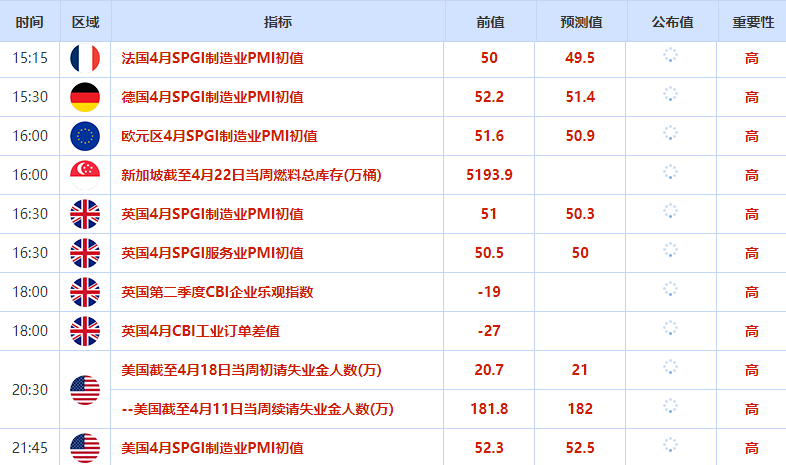
U.S. stocks rose on Wednesday, with the S&P 500 and Nasdaq closing at record highs, mainly boosted by President Trump's announcement of an indefinite extension of the ceasefire agreement with Iran and strong corporate earnings reports.
The Dow Jones Industrial Average rose 0.69% to 49,490.03 points, the S&P 500 rose 1.05% to 7,137.90 points, and the Nasdaq Composite rose 1.64% to 24,657.57 points.
Trump stated that the ceasefire extension was at the request of the Pakistani mediators, but the US naval blockade of Iranian ports remains in effect, and Iran has seized two ships in the Strait of Hormuz, with the unimpeded passage of the waterway remaining a major sticking point in the negotiations.
The market anticipated a peace agreement, but the Nasdaq had previously ended a 13-day winning streak. Corporate earnings were strong, with first-quarter earnings growth reportedly around 14%. GE Vernova's stock surged 13.75% after raising its annual revenue forecast, Boston Scientific jumped 8.99%, and Boeing became the Dow Jones' biggest gainer with a 5.53% increase due to a smaller-than-expected quarterly loss. United Airlines, however, fell 5.58% due to lower-than-expected profit forecasts.
The S&P 500 Technology Index rose approximately 2.31%, while the Philadelphia Semiconductor Index rose for the 16th consecutive trading day, setting a new record for the longest winning streak.
Gold prices rebounded on Wednesday on bargain hunting as investors closely watched news of a possible resumption of peace talks between the US and Iran. Spot gold rose 0.5% to $4,735.65 an ounce, after rising as much as 1% earlier in the session; U.S. gold futures for June delivery settled up 0.7% at $4,753.00.
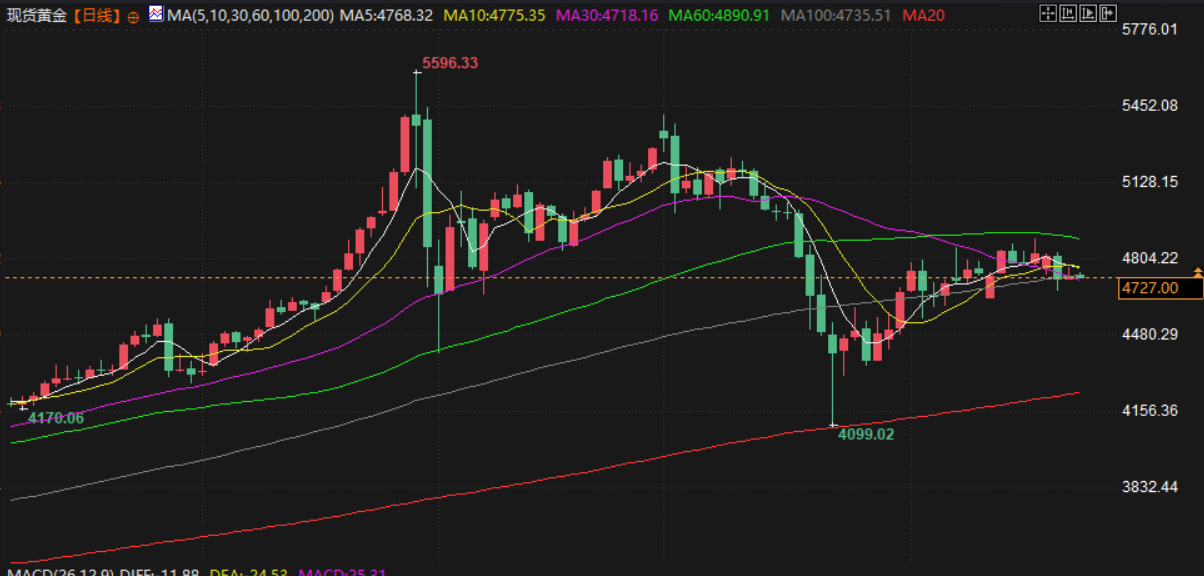
Gold prices recorded their biggest one-day drop since March 26 in the previous trading session, with analysts pointing to bargain hunting following Tuesday's decline. Geopolitically, Iran seized two ships in the Strait of Hormuz that day, while US President Trump stated that the US blockade against Iran would continue. An informed source revealed that he has not yet set a timetable for a ceasefire, and there are currently no signs of restarting peace negotiations.
Meanwhile, Israeli drone strikes in Lebanon also put pressure on the ceasefire agreement. Although gold is seen as an inflation hedge, rising interest rates have dampened demand for this non-yielding metal. Furthermore, Federal Reserve Chairman nominee Warsh stated that he has not committed to interest rate cuts to Trump and emphasized that he will act independently.
In other precious metals, spot silver rose 1.4% to $77.80, platinum rose 2.1% to $2,079.80, and palladium rose 1.3% to $1,553.43.
Oil prices rose more than $3 on Wednesday, mainly driven by a decline in U.S. gasoline and distillate inventories and escalating tensions in the Strait of Hormuz. Brent crude futures settled up 3.48% at $101.91 a barrel, while U.S. crude futures rose 3.67% to $92.96 a barrel, after rising more than $4 at one point during the session.
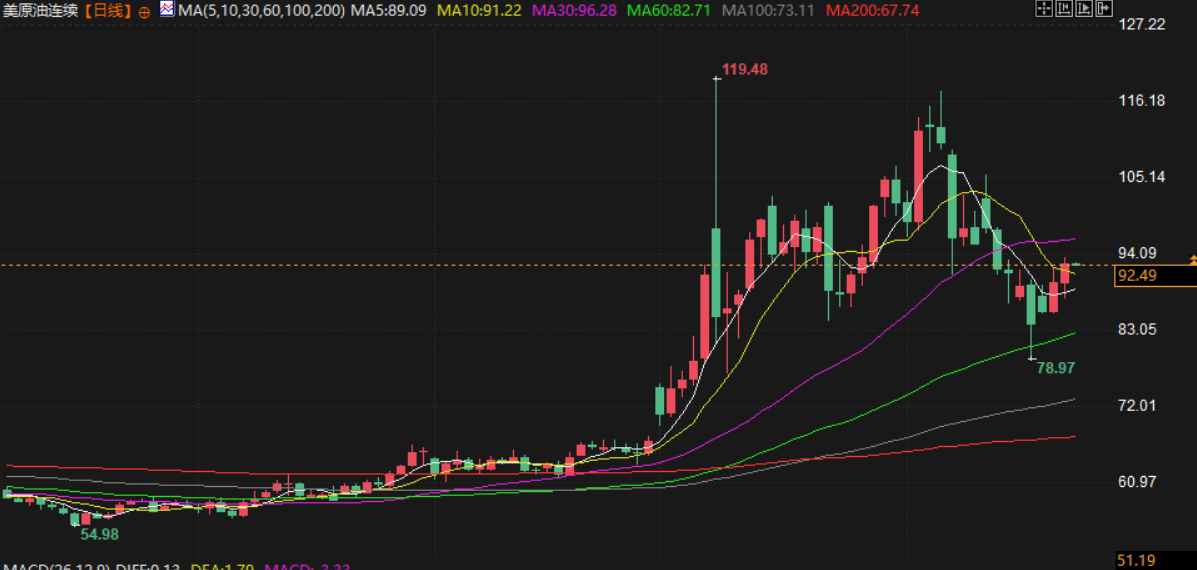
Data from the U.S. Energy Information Administration (EIA) shows that for the week ending April 17, U.S. crude oil inventories unexpectedly increased by 1.9 million barrels to 465.7 million barrels, while gasoline inventories decreased by 4.6 million barrels to 228.4 million barrels (expected decrease of 1.5 million barrels), and distillate fuel inventories decreased by 3.4 million barrels to 108.1 million barrels (expected decrease of 2.5 million barrels).
Geopolitically, at least three container ships in the Strait of Hormuz were shot at, and the Iranian Revolutionary Guard seized two ships and moved them to the Iranian coast on the grounds of "maritime violations." Although US President Trump announced an indefinite extension of the ceasefire agreement with Iran, neither side participated in the peace talks held in Pakistan. Iranian Parliament Speaker and chief negotiator Ghalibaf stated that a comprehensive ceasefire would only be meaningful if the US lifted its blockade of Iranian ports, and that reopening the Strait of Hormuz was impossible.
In addition, Russian Deputy Prime Minister Novak announced that starting May 1, oil supplies originally planned to be transported to Germany via the "Friendship" pipeline would be diverted to other routes, while US Treasury Secretary Bessenter extended the sanctions exemption period for Russian seaborne crude oil by 30 days.
The dollar rose on Wednesday, influenced by the ongoing conflict between the US, Israel, and Iran. The dollar index rose 0.21% to 98.58, the euro fell 0.28% to $1.1709, and the yen dipped slightly by 0.04% to 159.45 against the dollar.
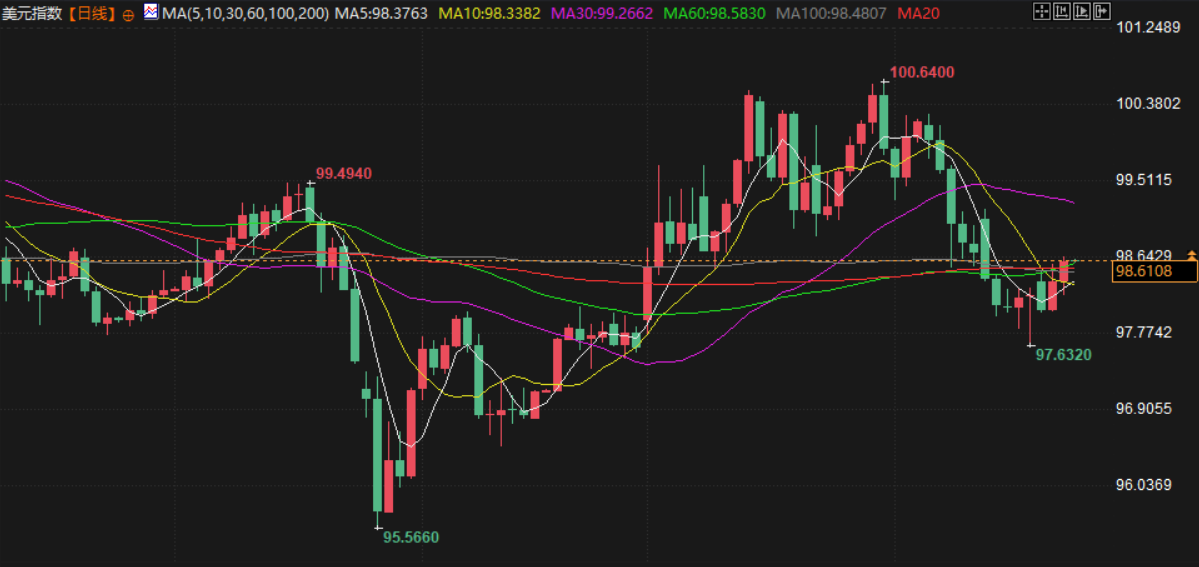
Despite US President Trump's indefinite extension of the ceasefire agreement to give Tehran more time to come up with a unified solution, Iran's seizure of two ships in the Strait of Hormuz on the same day further escalated tensions, causing market sentiment to fluctuate between expectations of peace and the possibility of a protracted conflict.
The head of foreign exchange strategy at Nomura Securities stated that both sides prefer progress to further escalation. Regarding interest rates, market expectations for a Federal Reserve rate cut this year are low due to the potential for war to push up inflation; federal funds futures indicate a 28% probability of only one rate cut by the end of 2026.
Federal Reserve Chairman nominee Warsh stated that he has not committed to interest rate cuts to Trump and emphasized that he will act independently. US Treasury Secretary Bessant advised the Fed to "wait and see" regarding the situation in Iran.
The market expects the Federal Reserve, the European Central Bank, the Bank of Japan, the Bank of England, and the Bank of Canada to hold rates steady next week, while the European Central Bank, the Bank of Japan, and the Bank of England may raise rates in June.
Trump: There is currently "no timetable" for ending the conflict with Iran.
U.S. President Donald Trump said in an interview with Fox News on the 22nd that there is currently "no timetable" for ending the conflict with Iran, and there is no need to rush. Trump said, "Some people say I'm rushing to end this conflict for the midterm elections, but that's absolutely not true." He also said that previous reports about a "3- to 5-day window" for extending the ceasefire were "untrue," and that there is "no time pressure" on the ceasefire. Regarding the Iranian military firing on and seizing ships in the Strait of Hormuz, Trump said, "Those were not American ships." He added that he would closely monitor the situation. Earlier that day, the U.S. news website Axios reported that Trump was willing to extend the ceasefire for another 3 to 5 days "to let the Iranian side sort things out," but the ceasefire would not be extended indefinitely. (Xinhua)
US media: US military needs 6 months to complete mine clearance in the Strait of Hormuz
The Washington Post reported on the 22nd that the Pentagon disclosed that it would take the U.S. military six months to completely clear the mines laid by the Iranian military in the Strait of Hormuz, and that mine-clearing operations might not begin before the end of the conflict. The report said a senior Pentagon official made this assessment during a classified briefing to members of the House Armed Services Committee. This timeline has frustrated both Democratic and Republican lawmakers, as it means the impact of the current conflict on the U.S. economy, particularly fuel prices, could continue into later this year or even longer. (Xinhua)
Kremlin: Putin is willing to meet with Zelensky during the final stages of the agreement's conclusion.
Russian President Vladimir Putin is willing to meet with Ukrainian President Volodymyr Zelenskyy, but such a meeting would only be productive during the final stages of a Russia-Ukraine peace agreement, President Putin said in a media interview on the 22nd. Peskov stated that such a meeting must have a clear purpose. Russia has not seen any political will from Ukraine to resolve the conflict. (Xinhua)
Zelensky: Russia-Ukraine peace talks unlikely to make progress before the war in Iran ends
Ukrainian President Volodymyr Zelenskyy stated in an interview with US media on the 22nd that he is open to a ceasefire between Russia and Ukraine, but he sees no possibility of progress in peace negotiations until the conflict with Iran ends and the US, Israel, and Iran reach a final ceasefire. According to Ukraine's Interfax news agency, Zelenskyy understood the US focus on Iran, but emphasized that Ukraine is equally important and cannot be ignored; the conflict in Ukraine cannot be "resolved later," and a way to resolve both crises simultaneously must be found. (Xinhua)
US Treasury Secretary: Gulf and Asian allies have requested the establishment of dollar swap lines.
The United States is considering providing currency swap lines to the United Arab Emirates and other Gulf and Asian allies whose economies have been impacted by the effects of Trump's war on Iran. U.S. Treasury Secretary Bessenter, speaking on Wednesday about such financial instruments that ensure access to dollars and help maintain financial stability, said, "Swaps, whether from the Federal Reserve or the Treasury, are about maintaining order in the dollar funding markets and preventing the disorderly sell-off of U.S. assets." Bessenter made these remarks at a hearing before the Senate Appropriations Committee. This came a day after Trump confirmed reports that a swap line with the UAE was being considered. Bessenter stated that any such arrangement would benefit both the UAE and the United States. He did not specify which other countries had made similar requests. UAE Ambassador to Washington, Yousef Al Otaiba, said any suggestion that the UAE needs external financial support was a misinterpretation. A person familiar with the UAE's thinking said the swap line was a "contingency measure." It's about building confidence and demonstrating that the UAE is one of the most trusted economies, like Japan and Europe, a category the U.S. is categorizing the UAE into.
Israeli media: Trump's ceasefire deadline with Iran ends on the 26th.
Israeli media reported on the 22nd that Israel had learned from the United States that the deadline set by US President Trump for extending the ceasefire with Iran would expire on the 26th. (Xinhua)
After a 54-day standoff, both the US and Iran have stated they are ready to resume hostilities.
On March 22, the standoff between the US, Israel, and Iran entered its 54th day, with the US naval blockade of Iran becoming a key obstacle to negotiations. The Iranian armed forces stated they were "100%" ready for combat. Meanwhile, senior US military officials claimed they were prepared to resume military operations against Iran. On the evening of March 21, Iranian missiles, including the "Qader" and "Khorramshahr-4," were displayed in a square in Tehran, demonstrating to the enemy that "Iran's missile capabilities are fully ready." It is reported that Iran has consistently believed over the past two weeks that the possibility of renewed hostilities is high, and accordingly has conducted some military movements and prepared a new list of targets. Iran claims it is prepared. (CCTV News)
The probability of a Federal Reserve rate cut this year has risen slightly to 25.9%, up from 19.8% the previous day.
According to CME's "FedWatch": the probability of the Fed cutting interest rates by a cumulative 25 basis points by December is 25.9% (19.8% the previous day), the probability of keeping interest rates unchanged is 74.1%, and the probability of raising interest rates by 25 basis points has dropped to 0 (4.6% the previous day).
Italy plans to send four ships to the Strait of Hormuz.
On April 22 local time, Italian Navy Chief of Staff Bergato stated that Italy plans to deploy a four-ship task force to the Strait of Hormuz, including two minesweepers, one escort ship, and one logistics support ship. Bergato pointed out that Italy will not act alone but will participate in the operation within the framework of an international coalition. Other European countries will also deploy minesweepers, including France, the United Kingdom, and a joint minesweeping force comprised of the Netherlands and Belgium. (CCTV News)
CITIC Securities: The directive for the low-altitude economy to "get ready to go" has been clearly issued; a trillion-dollar blue ocean market is about to launch.
A research report from CITIC Securities states that, according to a news release from the State-owned Assets Supervision and Administration Commission (SASAC) News Center, on April 15th, the SASAC held a special meeting to promote the development of the low-altitude economy industry among central enterprises. The meeting further studied and planned the working ideas and specific measures for central enterprises to develop the low-altitude economy, aiming to promote better development and a greater role for central enterprises in this field, and provide stronger support for the construction of a modern industrial system. The low-altitude economy is a globally strategic emerging industry, and with the continued support of relevant policies in my country, it has enormous future development potential. We believe that the directive for the low-altitude economy to "get ready to go" is clear, and a trillion-dollar blue ocean is about to launch.
Wang Yi attended the third high-level meeting of the Global Forum on Shared Development.
On April 22, the Third High-Level Meeting of the Global Forum on Shared Development Actions was held in Beijing. Wang Yi, Member of the Political Bureau of the CPC Central Committee and Director of the Office of the Central Foreign Affairs Commission, attended the opening ceremony and delivered a speech. Wang Yi stated that this year marks the 5th anniversary of President Xi Jinping's proposal of the Global Development Initiative. Over the past five years, with the promotion of all parties, the Global Development Initiative has expanded from a Chinese proposition to an international consensus, and from a cooperative concept to rich practical application, providing vitality to the UN 2030 Agenda for Sustainable Development and propelling global development to new heights and achieve new results. Wang Yi emphasized that China is willing to work with all parties to use the implementation of the Global Development Initiative as a platform to pool broad development resources, build a solid foundation for development, adhere to the path of peaceful development, create an open development environment, and continuously move towards the lofty goal of building a community with a shared future for mankind. China will take active action, deepen cooperation, and always act as a promoter and contributor to global development, working with all parties to create a new landscape for global development through pragmatic actions. This meeting was hosted by the China International Development Cooperation Agency, with the theme "Adhering to Action-Oriented Approach to Promote the Building of a Global Community with a Shared Future for Development." Mozambican President Chapo, Ghanaian President Mahama, Pakistani Prime Minister Shahbaz, Lao Deputy Prime Minister Saleumxay Kommasith, East Timorese Deputy Prime Minister Le Phaphan, and UN Deputy Secretary-General Amina Mohamed attended the meeting or delivered video addresses. Representatives from more than 140 countries, international organizations, and other institutions participated both online and offline. (Xinhua)
Key Focus Today
stock market
U.S. stocks rose on Wednesday, with the S&P 500 and Nasdaq closing at record highs, mainly boosted by President Trump's announcement of an indefinite extension of the ceasefire agreement with Iran and strong corporate earnings reports.
The Dow Jones Industrial Average rose 0.69% to 49,490.03 points, the S&P 500 rose 1.05% to 7,137.90 points, and the Nasdaq Composite rose 1.64% to 24,657.57 points.
Trump stated that the ceasefire extension was at the request of the Pakistani mediators, but the US naval blockade of Iranian ports remains in effect, and Iran has seized two ships in the Strait of Hormuz, with the unimpeded passage of the waterway remaining a major sticking point in the negotiations.
The market anticipated a peace agreement, but the Nasdaq had previously ended a 13-day winning streak. Corporate earnings were strong, with first-quarter earnings growth reportedly around 14%. GE Vernova's stock surged 13.75% after raising its annual revenue forecast, Boston Scientific jumped 8.99%, and Boeing became the Dow Jones' biggest gainer with a 5.53% increase due to a smaller-than-expected quarterly loss. United Airlines, however, fell 5.58% due to lower-than-expected profit forecasts.
The S&P 500 Technology Index rose approximately 2.31%, while the Philadelphia Semiconductor Index rose for the 16th consecutive trading day, setting a new record for the longest winning streak.
Gold Market
Gold prices rebounded on Wednesday on bargain hunting as investors closely watched news of a possible resumption of peace talks between the US and Iran. Spot gold rose 0.5% to $4,735.65 an ounce, after rising as much as 1% earlier in the session; U.S. gold futures for June delivery settled up 0.7% at $4,753.00.
Gold prices recorded their biggest one-day drop since March 26 in the previous trading session, with analysts pointing to bargain hunting following Tuesday's decline. Geopolitically, Iran seized two ships in the Strait of Hormuz that day, while US President Trump stated that the US blockade against Iran would continue. An informed source revealed that he has not yet set a timetable for a ceasefire, and there are currently no signs of restarting peace negotiations.
Meanwhile, Israeli drone strikes in Lebanon also put pressure on the ceasefire agreement. Although gold is seen as an inflation hedge, rising interest rates have dampened demand for this non-yielding metal. Furthermore, Federal Reserve Chairman nominee Warsh stated that he has not committed to interest rate cuts to Trump and emphasized that he will act independently.
In other precious metals, spot silver rose 1.4% to $77.80, platinum rose 2.1% to $2,079.80, and palladium rose 1.3% to $1,553.43.
oil market
Oil prices rose more than $3 on Wednesday, mainly driven by a decline in U.S. gasoline and distillate inventories and escalating tensions in the Strait of Hormuz. Brent crude futures settled up 3.48% at $101.91 a barrel, while U.S. crude futures rose 3.67% to $92.96 a barrel, after rising more than $4 at one point during the session.
Data from the U.S. Energy Information Administration (EIA) shows that for the week ending April 17, U.S. crude oil inventories unexpectedly increased by 1.9 million barrels to 465.7 million barrels, while gasoline inventories decreased by 4.6 million barrels to 228.4 million barrels (expected decrease of 1.5 million barrels), and distillate fuel inventories decreased by 3.4 million barrels to 108.1 million barrels (expected decrease of 2.5 million barrels).
Geopolitically, at least three container ships in the Strait of Hormuz were shot at, and the Iranian Revolutionary Guard seized two ships and moved them to the Iranian coast on the grounds of "maritime violations." Although US President Trump announced an indefinite extension of the ceasefire agreement with Iran, neither side participated in the peace talks held in Pakistan. Iranian Parliament Speaker and chief negotiator Ghalibaf stated that a comprehensive ceasefire would only be meaningful if the US lifted its blockade of Iranian ports, and that reopening the Strait of Hormuz was impossible.
In addition, Russian Deputy Prime Minister Novak announced that starting May 1, oil supplies originally planned to be transported to Germany via the "Friendship" pipeline would be diverted to other routes, while US Treasury Secretary Bessenter extended the sanctions exemption period for Russian seaborne crude oil by 30 days.
Foreign exchange market
The dollar rose on Wednesday, influenced by the ongoing conflict between the US, Israel, and Iran. The dollar index rose 0.21% to 98.58, the euro fell 0.28% to $1.1709, and the yen dipped slightly by 0.04% to 159.45 against the dollar.
Despite US President Trump's indefinite extension of the ceasefire agreement to give Tehran more time to come up with a unified solution, Iran's seizure of two ships in the Strait of Hormuz on the same day further escalated tensions, causing market sentiment to fluctuate between expectations of peace and the possibility of a protracted conflict.
The head of foreign exchange strategy at Nomura Securities stated that both sides prefer progress to further escalation. Regarding interest rates, market expectations for a Federal Reserve rate cut this year are low due to the potential for war to push up inflation; federal funds futures indicate a 28% probability of only one rate cut by the end of 2026.
Federal Reserve Chairman nominee Warsh stated that he has not committed to interest rate cuts to Trump and emphasized that he will act independently. US Treasury Secretary Bessant advised the Fed to "wait and see" regarding the situation in Iran.
The market expects the Federal Reserve, the European Central Bank, the Bank of Japan, the Bank of England, and the Bank of Canada to hold rates steady next week, while the European Central Bank, the Bank of Japan, and the Bank of England may raise rates in June.
International News
Trump: There is currently "no timetable" for ending the conflict with Iran.
U.S. President Donald Trump said in an interview with Fox News on the 22nd that there is currently "no timetable" for ending the conflict with Iran, and there is no need to rush. Trump said, "Some people say I'm rushing to end this conflict for the midterm elections, but that's absolutely not true." He also said that previous reports about a "3- to 5-day window" for extending the ceasefire were "untrue," and that there is "no time pressure" on the ceasefire. Regarding the Iranian military firing on and seizing ships in the Strait of Hormuz, Trump said, "Those were not American ships." He added that he would closely monitor the situation. Earlier that day, the U.S. news website Axios reported that Trump was willing to extend the ceasefire for another 3 to 5 days "to let the Iranian side sort things out," but the ceasefire would not be extended indefinitely. (Xinhua)
US media: US military needs 6 months to complete mine clearance in the Strait of Hormuz
The Washington Post reported on the 22nd that the Pentagon disclosed that it would take the U.S. military six months to completely clear the mines laid by the Iranian military in the Strait of Hormuz, and that mine-clearing operations might not begin before the end of the conflict. The report said a senior Pentagon official made this assessment during a classified briefing to members of the House Armed Services Committee. This timeline has frustrated both Democratic and Republican lawmakers, as it means the impact of the current conflict on the U.S. economy, particularly fuel prices, could continue into later this year or even longer. (Xinhua)
Kremlin: Putin is willing to meet with Zelensky during the final stages of the agreement's conclusion.
Russian President Vladimir Putin is willing to meet with Ukrainian President Volodymyr Zelenskyy, but such a meeting would only be productive during the final stages of a Russia-Ukraine peace agreement, President Putin said in a media interview on the 22nd. Peskov stated that such a meeting must have a clear purpose. Russia has not seen any political will from Ukraine to resolve the conflict. (Xinhua)
Zelensky: Russia-Ukraine peace talks unlikely to make progress before the war in Iran ends
Ukrainian President Volodymyr Zelenskyy stated in an interview with US media on the 22nd that he is open to a ceasefire between Russia and Ukraine, but he sees no possibility of progress in peace negotiations until the conflict with Iran ends and the US, Israel, and Iran reach a final ceasefire. According to Ukraine's Interfax news agency, Zelenskyy understood the US focus on Iran, but emphasized that Ukraine is equally important and cannot be ignored; the conflict in Ukraine cannot be "resolved later," and a way to resolve both crises simultaneously must be found. (Xinhua)
US Treasury Secretary: Gulf and Asian allies have requested the establishment of dollar swap lines.
The United States is considering providing currency swap lines to the United Arab Emirates and other Gulf and Asian allies whose economies have been impacted by the effects of Trump's war on Iran. U.S. Treasury Secretary Bessenter, speaking on Wednesday about such financial instruments that ensure access to dollars and help maintain financial stability, said, "Swaps, whether from the Federal Reserve or the Treasury, are about maintaining order in the dollar funding markets and preventing the disorderly sell-off of U.S. assets." Bessenter made these remarks at a hearing before the Senate Appropriations Committee. This came a day after Trump confirmed reports that a swap line with the UAE was being considered. Bessenter stated that any such arrangement would benefit both the UAE and the United States. He did not specify which other countries had made similar requests. UAE Ambassador to Washington, Yousef Al Otaiba, said any suggestion that the UAE needs external financial support was a misinterpretation. A person familiar with the UAE's thinking said the swap line was a "contingency measure." It's about building confidence and demonstrating that the UAE is one of the most trusted economies, like Japan and Europe, a category the U.S. is categorizing the UAE into.
Israeli media: Trump's ceasefire deadline with Iran ends on the 26th.
Israeli media reported on the 22nd that Israel had learned from the United States that the deadline set by US President Trump for extending the ceasefire with Iran would expire on the 26th. (Xinhua)
After a 54-day standoff, both the US and Iran have stated they are ready to resume hostilities.
On March 22, the standoff between the US, Israel, and Iran entered its 54th day, with the US naval blockade of Iran becoming a key obstacle to negotiations. The Iranian armed forces stated they were "100%" ready for combat. Meanwhile, senior US military officials claimed they were prepared to resume military operations against Iran. On the evening of March 21, Iranian missiles, including the "Qader" and "Khorramshahr-4," were displayed in a square in Tehran, demonstrating to the enemy that "Iran's missile capabilities are fully ready." It is reported that Iran has consistently believed over the past two weeks that the possibility of renewed hostilities is high, and accordingly has conducted some military movements and prepared a new list of targets. Iran claims it is prepared. (CCTV News)
The probability of a Federal Reserve rate cut this year has risen slightly to 25.9%, up from 19.8% the previous day.
According to CME's "FedWatch": the probability of the Fed cutting interest rates by a cumulative 25 basis points by December is 25.9% (19.8% the previous day), the probability of keeping interest rates unchanged is 74.1%, and the probability of raising interest rates by 25 basis points has dropped to 0 (4.6% the previous day).
Italy plans to send four ships to the Strait of Hormuz.
On April 22 local time, Italian Navy Chief of Staff Bergato stated that Italy plans to deploy a four-ship task force to the Strait of Hormuz, including two minesweepers, one escort ship, and one logistics support ship. Bergato pointed out that Italy will not act alone but will participate in the operation within the framework of an international coalition. Other European countries will also deploy minesweepers, including France, the United Kingdom, and a joint minesweeping force comprised of the Netherlands and Belgium. (CCTV News)
Domestic News
CITIC Securities: The directive for the low-altitude economy to "get ready to go" has been clearly issued; a trillion-dollar blue ocean market is about to launch.
A research report from CITIC Securities states that, according to a news release from the State-owned Assets Supervision and Administration Commission (SASAC) News Center, on April 15th, the SASAC held a special meeting to promote the development of the low-altitude economy industry among central enterprises. The meeting further studied and planned the working ideas and specific measures for central enterprises to develop the low-altitude economy, aiming to promote better development and a greater role for central enterprises in this field, and provide stronger support for the construction of a modern industrial system. The low-altitude economy is a globally strategic emerging industry, and with the continued support of relevant policies in my country, it has enormous future development potential. We believe that the directive for the low-altitude economy to "get ready to go" is clear, and a trillion-dollar blue ocean is about to launch.
Wang Yi attended the third high-level meeting of the Global Forum on Shared Development.
On April 22, the Third High-Level Meeting of the Global Forum on Shared Development Actions was held in Beijing. Wang Yi, Member of the Political Bureau of the CPC Central Committee and Director of the Office of the Central Foreign Affairs Commission, attended the opening ceremony and delivered a speech. Wang Yi stated that this year marks the 5th anniversary of President Xi Jinping's proposal of the Global Development Initiative. Over the past five years, with the promotion of all parties, the Global Development Initiative has expanded from a Chinese proposition to an international consensus, and from a cooperative concept to rich practical application, providing vitality to the UN 2030 Agenda for Sustainable Development and propelling global development to new heights and achieve new results. Wang Yi emphasized that China is willing to work with all parties to use the implementation of the Global Development Initiative as a platform to pool broad development resources, build a solid foundation for development, adhere to the path of peaceful development, create an open development environment, and continuously move towards the lofty goal of building a community with a shared future for mankind. China will take active action, deepen cooperation, and always act as a promoter and contributor to global development, working with all parties to create a new landscape for global development through pragmatic actions. This meeting was hosted by the China International Development Cooperation Agency, with the theme "Adhering to Action-Oriented Approach to Promote the Building of a Global Community with a Shared Future for Development." Mozambican President Chapo, Ghanaian President Mahama, Pakistani Prime Minister Shahbaz, Lao Deputy Prime Minister Saleumxay Kommasith, East Timorese Deputy Prime Minister Le Phaphan, and UN Deputy Secretary-General Amina Mohamed attended the meeting or delivered video addresses. Representatives from more than 140 countries, international organizations, and other institutions participated both online and offline. (Xinhua)
- Risk Warning and Disclaimer
- The market involves risk, and trading may not be suitable for all investors. This article is for reference only and does not constitute personal investment advice, nor does it take into account certain users’ specific investment objectives, financial situation, or other needs. Any investment decisions made based on this information are at your own risk.