The US dollar continued its rebound, driving the USD/JPY pair to higher levels.
2026-04-23 11:04:56
The USD/JPY pair came under pressure during Thursday's Asian trading session, falling back to around 159.35 . The weakening dollar was the dominant factor, primarily due to the temporary easing of tensions in the Middle East reducing safe-haven demand and causing some funds to flow out of dollar assets, thus pushing the yen to rebound.

The US extension of the ceasefire, pending further negotiations, has reduced the risk of escalation in the short term. Meanwhile, although control of key shipping lanes remains in the region, the market tends to interpret the current situation as "tense but manageable," thus improving overall risk sentiment.
However, at a deeper level, geopolitical risks have not truly disappeared. The Strait of Hormuz remains a sensitive area, handling approximately 20% of global crude oil shipments, and its stability directly impacts the global energy market. Shipping restrictions and potential conflict risks persist, causing repeated fluctuations in market sentiment, which also limits the potential for continued appreciation of the yen.
On another geopolitical level, ceasefire negotiations are still underway in other parts of the Middle East, and the overall market risk environment is easing, which has weakened the safe-haven appeal of the US dollar to some extent. However, due to the complexity of the situation, the market remains somewhat cautious.
Regarding monetary policy, the Bank of Japan maintains a cautious stance. The Bank of Japan governor stated that given the current uncertain environment, there is no rush to raise interest rates in the short term, and the market generally expects policy to remain stable for an extended period. This stance limits the yen's potential for medium-term appreciation. However, market pricing still reflects expectations of future interest rate hikes, which provides some support for the yen.
In contrast, policy expectations in the United States are shifting. Market bets on a Federal Reserve rate cut this year have increased, weakening the dollar's yield advantage and putting pressure on the dollar. This difference in policy expectations has become one of the important factors influencing the USD/JPY exchange rate.
On the data front, the market will focus on the upcoming preliminary PMI data, which will provide clues about the momentum of the US economy. Weak data could further pressure the dollar; conversely, strong data could limit the downside for USD/JPY.
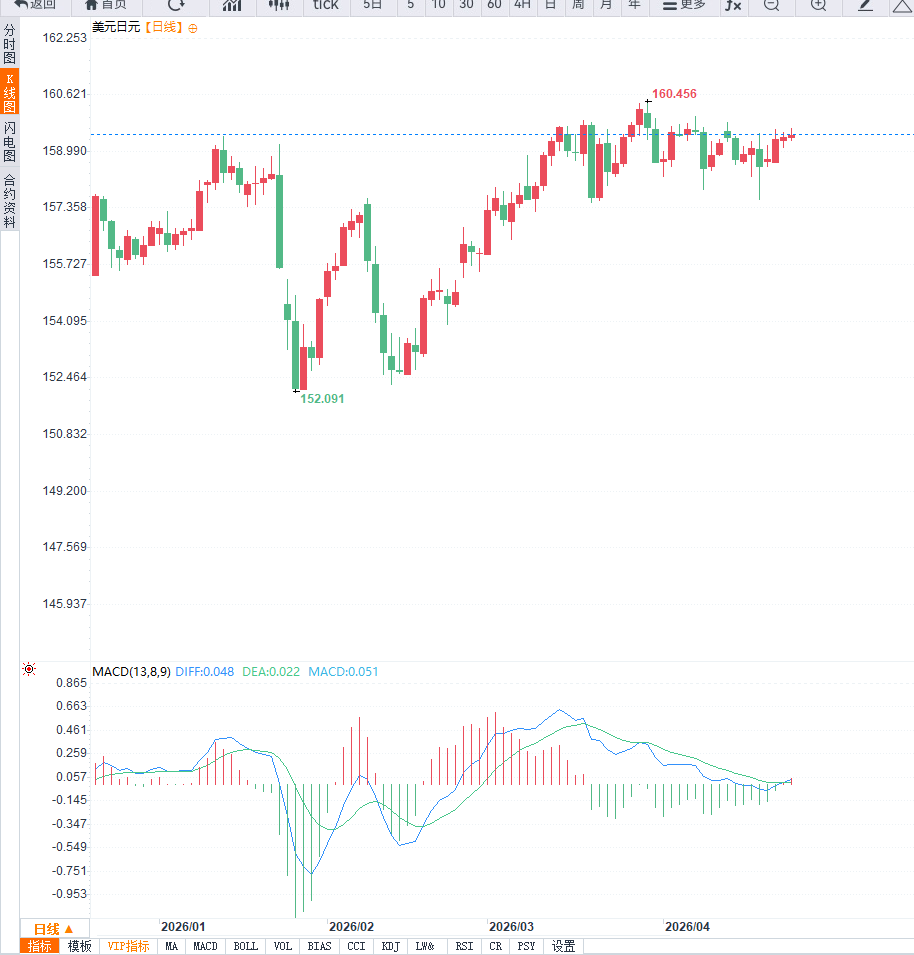
From a technical perspective, the USD/JPY pair is currently in a high-level consolidation phase on the daily chart. While the overall trend remains bullish, upward momentum has clearly weakened. The current price action is facing significant resistance around the 160.00 level; a break above this level would reopen upside potential. On the downside, 158.50 forms key support; a break below this level could lead to a further pullback to the 157.80 area. Momentum indicators suggest weakening bullish strength, indicating the market has entered a correction phase. On the 4-hour chart, the price action shows a downward-trending structure, with short-term moving averages diverging downwards and MACD momentum weakening, indicating a short-term bearish bias. If the pair fails to return above 159.80 , it may continue to test support levels, but as long as 158.50 holds, the overall consolidation pattern at higher levels will remain intact.
Editor's Summary
The USD/JPY pair is currently in a phase influenced by a confluence of factors. Easing tensions in the Middle East have reduced demand for the US dollar as a safe haven, while expectations of a Federal Reserve rate cut are also putting pressure on the dollar, pushing the exchange rate lower in the short term. However, the Bank of Japan's policy remains accommodative, limiting the yen's appreciation potential. Overall, the exchange rate is more likely to maintain a high-level consolidation trend, awaiting new fundamental drivers. Investors should pay close attention to changes in US economic data and policy expectations, as well as the impact of evolving geopolitical situations on market sentiment.
The US extension of the ceasefire, pending further negotiations, has reduced the risk of escalation in the short term. Meanwhile, although control of key shipping lanes remains in the region, the market tends to interpret the current situation as "tense but manageable," thus improving overall risk sentiment.
However, at a deeper level, geopolitical risks have not truly disappeared. The Strait of Hormuz remains a sensitive area, handling approximately 20% of global crude oil shipments, and its stability directly impacts the global energy market. Shipping restrictions and potential conflict risks persist, causing repeated fluctuations in market sentiment, which also limits the potential for continued appreciation of the yen.
On another geopolitical level, ceasefire negotiations are still underway in other parts of the Middle East, and the overall market risk environment is easing, which has weakened the safe-haven appeal of the US dollar to some extent. However, due to the complexity of the situation, the market remains somewhat cautious.
Regarding monetary policy, the Bank of Japan maintains a cautious stance. The Bank of Japan governor stated that given the current uncertain environment, there is no rush to raise interest rates in the short term, and the market generally expects policy to remain stable for an extended period. This stance limits the yen's potential for medium-term appreciation. However, market pricing still reflects expectations of future interest rate hikes, which provides some support for the yen.
In contrast, policy expectations in the United States are shifting. Market bets on a Federal Reserve rate cut this year have increased, weakening the dollar's yield advantage and putting pressure on the dollar. This difference in policy expectations has become one of the important factors influencing the USD/JPY exchange rate.
On the data front, the market will focus on the upcoming preliminary PMI data, which will provide clues about the momentum of the US economy. Weak data could further pressure the dollar; conversely, strong data could limit the downside for USD/JPY.
From a technical perspective, the USD/JPY pair is currently in a high-level consolidation phase on the daily chart. While the overall trend remains bullish, upward momentum has clearly weakened. The current price action is facing significant resistance around the 160.00 level; a break above this level would reopen upside potential. On the downside, 158.50 forms key support; a break below this level could lead to a further pullback to the 157.80 area. Momentum indicators suggest weakening bullish strength, indicating the market has entered a correction phase. On the 4-hour chart, the price action shows a downward-trending structure, with short-term moving averages diverging downwards and MACD momentum weakening, indicating a short-term bearish bias. If the pair fails to return above 159.80 , it may continue to test support levels, but as long as 158.50 holds, the overall consolidation pattern at higher levels will remain intact.
Editor's Summary
The USD/JPY pair is currently in a phase influenced by a confluence of factors. Easing tensions in the Middle East have reduced demand for the US dollar as a safe haven, while expectations of a Federal Reserve rate cut are also putting pressure on the dollar, pushing the exchange rate lower in the short term. However, the Bank of Japan's policy remains accommodative, limiting the yen's appreciation potential. Overall, the exchange rate is more likely to maintain a high-level consolidation trend, awaiting new fundamental drivers. Investors should pay close attention to changes in US economic data and policy expectations, as well as the impact of evolving geopolitical situations on market sentiment.
- Risk Warning and Disclaimer
- The market involves risk, and trading may not be suitable for all investors. This article is for reference only and does not constitute personal investment advice, nor does it take into account certain users’ specific investment objectives, financial situation, or other needs. Any investment decisions made based on this information are at your own risk.