The US-Iran standoff in the Taiwan Strait escalates, but positive news emerges overnight! Gold prices rebound in a V-shape.
2026-04-23 20:52:48
On Thursday (April 23), during the European and American trading sessions, spot gold experienced a significant dip followed by a rebound. It briefly fell below $4700 before recovering to near the flat line, currently trading at $4736 per ounce.
Xinhua News Agency, citing Iranian diplomatic sources, reported on April 23 that Iran and the United States are expected to make a breakthrough in preparations for negotiations in Pakistan "tonight or tomorrow."
This news has injected short-term expectations of easing tensions in the Middle East geopolitical situation. As a traditional safe-haven asset, gold is temporarily affected by sentiment. However, the struggle between the US and Iran over control of the Strait of Hormuz continues to escalate. Coupled with the long-term support of the Federal Reserve's policy mix adjustments and the global central bank gold buying spree, gold prices will maintain a strong position based on geopolitical premiums and fundamental logic.
The current standoff between the US and Iran presents a fierce confrontation involving "military interception" and "blockade of the Taiwan Strait".
On April 22, the U.S. Central Command announced that, as a core measure of the blockade against Iran, it had ordered 29 ships to turn back or return to Iranian ports, while mobilizing forces across the Middle East and surrounding areas to strictly enforce the blockade. The military standoff in the Indian Ocean, where U.S. destroyers escorted Iranian oil tankers, continued to escalate.
In response, Iranian Parliament Speaker Mohammad-Bagael Ghalibaf made it clear that as long as the United States continues to violate the ceasefire agreement (including the maritime blockade), Iran will resolutely not open the Strait of Hormuz, emphasizing that "a ceasefire that is not blocked and does not hold the world economy hostage is of real significance."
The Strait of Hormuz, as the "energy artery" of nearly one-third of the world's maritime oil trade, has become a core bargaining chip in the US-Iran rivalry.
The United States is attempting to curb Iran's energy exports and regional influence through military blockades, while Iran is using the right of way and control of the Strait of Hormuz as a countermeasure, consolidating its actual control through toll collection mechanisms and legislative actions.
This game of "blockade and counter-blockade" has provided sustained geopolitical support for gold in the short term, and this standoff has extended from purely military action to the legal level.
The Iranian parliament has not only secured its first revenue from toll collection on ships transiting the Strait of Hormuz, but is also advancing legislation to institutionalize control over the Strait of Hormuz. Although this move contradicts the spirit of the United Nations Convention on the Law of the Sea, it has significantly increased global shipping insurance costs and geopolitical risk premiums.
However, market patterns show that as the conflict continues, investors will gradually become desensitized to the impact of war, and the pricing logic for gold will eventually return to core fundamentals.
From a long-term fundamental perspective, the Federal Reserve's policy adjustments have become a key variable.
White House National Economic Council Director Hassett revealed that the Federal Reserve may implement a policy of "simultaneous balance sheet reduction and interest rate cuts." If this unconventional combination of measures is implemented, it will significantly change the logic of gold holding costs. Although balance sheet reduction will temporarily withdraw market liquidity, the decline in real interest rates brought about by interest rate cuts will directly reduce the opportunity cost of gold, a non-interest-bearing asset, thus creating a policy benefit.
This policy direction had been foreshadowed in previous Federal Reserve analysis articles on multiple occasions.
Market expectations have already been priced in. CME's "FedWatch" data shows that, as of now, the probability of the Fed cutting interest rates by a cumulative 25 basis points in December has risen from 19.8% to 25.9%, while the probability of a rate hike has dropped to 0, and the expectation of rate cuts throughout the year is steadily increasing.
A stronger support comes from the continued gold-buying activities of central banks around the world.
Data shows that in 2024, central banks around the world made net purchases of gold totaling 1,045 tons, exceeding the 1,000-ton mark for the third consecutive year. In the first quarter of 2025, global official gold reserves increased by another 244 tons, significantly higher than the quarterly average of the past five years.
Against the backdrop of challenges to the dollar's credit system and escalating geopolitical uncertainty, gold has surpassed the euro to become the world's second-largest reserve asset, with 69% of surveyed central banks expecting gold's share in reserves to continue to rise over the next five years.
This regular official demand for gold provides a strong long-term support for gold prices.
In summary, in the short term, geopolitical events such as the US-Iran Strait conflict and the ceasefire extension talks in Lebanon will continue to cause gold price fluctuations, but the market's desensitization to the impact of war will gradually become apparent. In the medium to long term, the expectation of the Federal Reserve's policy combination of "balance sheet reduction + interest rate cuts," the continuously rising probability of interest rate cuts, and the irreversible gold-buying trend of global central banks will jointly constitute the core supporting logic for gold prices.
With the combined effect of geopolitical risk premiums and positive fundamentals, gold will remain an indispensable asset allocation tool for hedging against inflation and risk.
From a technical perspective, spot gold is moving almost exactly along the upward channel, and has tested the important level of 4705 twice. This is a reference price for trading, meaning that the price should move upward from around 4705 in the short term. However, if the price unfortunately returns to 4705 again, we should be wary of the possibility that the price may fall below 4705 and continue to move downward.
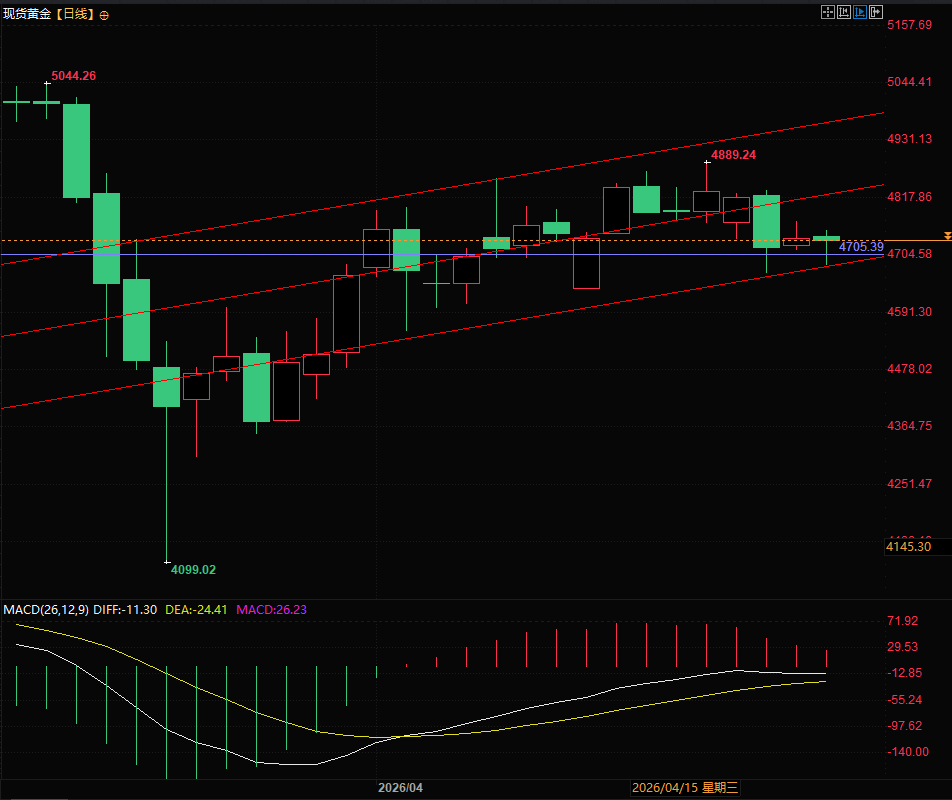
(Spot gold daily chart, source: EasyForex subsidiary)
At 20:51 Beijing time, spot gold is currently trading at $4,736 per ounce.
Xinhua News Agency, citing Iranian diplomatic sources, reported on April 23 that Iran and the United States are expected to make a breakthrough in preparations for negotiations in Pakistan "tonight or tomorrow."
This news has injected short-term expectations of easing tensions in the Middle East geopolitical situation. As a traditional safe-haven asset, gold is temporarily affected by sentiment. However, the struggle between the US and Iran over control of the Strait of Hormuz continues to escalate. Coupled with the long-term support of the Federal Reserve's policy mix adjustments and the global central bank gold buying spree, gold prices will maintain a strong position based on geopolitical premiums and fundamental logic.
The intense standoff between the US and Iran escalates into a struggle for control of the Taiwan Strait.
The current standoff between the US and Iran presents a fierce confrontation involving "military interception" and "blockade of the Taiwan Strait".
On April 22, the U.S. Central Command announced that, as a core measure of the blockade against Iran, it had ordered 29 ships to turn back or return to Iranian ports, while mobilizing forces across the Middle East and surrounding areas to strictly enforce the blockade. The military standoff in the Indian Ocean, where U.S. destroyers escorted Iranian oil tankers, continued to escalate.
In response, Iranian Parliament Speaker Mohammad-Bagael Ghalibaf made it clear that as long as the United States continues to violate the ceasefire agreement (including the maritime blockade), Iran will resolutely not open the Strait of Hormuz, emphasizing that "a ceasefire that is not blocked and does not hold the world economy hostage is of real significance."
The Taiwan Strait becomes the core of the game, with both the US and Iran holding key bargaining chips.
The Strait of Hormuz, as the "energy artery" of nearly one-third of the world's maritime oil trade, has become a core bargaining chip in the US-Iran rivalry.
The United States is attempting to curb Iran's energy exports and regional influence through military blockades, while Iran is using the right of way and control of the Strait of Hormuz as a countermeasure, consolidating its actual control through toll collection mechanisms and legislative actions.
This game of "blockade and counter-blockade" has provided sustained geopolitical support for gold in the short term, and this standoff has extended from purely military action to the legal level.
The Iranian parliament has not only secured its first revenue from toll collection on ships transiting the Strait of Hormuz, but is also advancing legislation to institutionalize control over the Strait of Hormuz. Although this move contradicts the spirit of the United Nations Convention on the Law of the Sea, it has significantly increased global shipping insurance costs and geopolitical risk premiums.
However, market patterns show that as the conflict continues, investors will gradually become desensitized to the impact of war, and the pricing logic for gold will eventually return to core fundamentals.
Market war desensitization gold prices return to fundamentals-driven price movement
From a long-term fundamental perspective, the Federal Reserve's policy adjustments have become a key variable.
White House National Economic Council Director Hassett revealed that the Federal Reserve may implement a policy of "simultaneous balance sheet reduction and interest rate cuts." If this unconventional combination of measures is implemented, it will significantly change the logic of gold holding costs. Although balance sheet reduction will temporarily withdraw market liquidity, the decline in real interest rates brought about by interest rate cuts will directly reduce the opportunity cost of gold, a non-interest-bearing asset, thus creating a policy benefit.
This policy direction had been foreshadowed in previous Federal Reserve analysis articles on multiple occasions.
Market expectations have already been priced in. CME's "FedWatch" data shows that, as of now, the probability of the Fed cutting interest rates by a cumulative 25 basis points in December has risen from 19.8% to 25.9%, while the probability of a rate hike has dropped to 0, and the expectation of rate cuts throughout the year is steadily increasing.
The normalization of central bank gold purchases solidifies the foundation for long-term support.
A stronger support comes from the continued gold-buying activities of central banks around the world.
Data shows that in 2024, central banks around the world made net purchases of gold totaling 1,045 tons, exceeding the 1,000-ton mark for the third consecutive year. In the first quarter of 2025, global official gold reserves increased by another 244 tons, significantly higher than the quarterly average of the past five years.
Against the backdrop of challenges to the dollar's credit system and escalating geopolitical uncertainty, gold has surpassed the euro to become the world's second-largest reserve asset, with 69% of surveyed central banks expecting gold's share in reserves to continue to rise over the next five years.
This regular official demand for gold provides a strong long-term support for gold prices.
Summary and Technical Analysis:
In summary, in the short term, geopolitical events such as the US-Iran Strait conflict and the ceasefire extension talks in Lebanon will continue to cause gold price fluctuations, but the market's desensitization to the impact of war will gradually become apparent. In the medium to long term, the expectation of the Federal Reserve's policy combination of "balance sheet reduction + interest rate cuts," the continuously rising probability of interest rate cuts, and the irreversible gold-buying trend of global central banks will jointly constitute the core supporting logic for gold prices.
With the combined effect of geopolitical risk premiums and positive fundamentals, gold will remain an indispensable asset allocation tool for hedging against inflation and risk.
From a technical perspective, spot gold is moving almost exactly along the upward channel, and has tested the important level of 4705 twice. This is a reference price for trading, meaning that the price should move upward from around 4705 in the short term. However, if the price unfortunately returns to 4705 again, we should be wary of the possibility that the price may fall below 4705 and continue to move downward.
(Spot gold daily chart, source: EasyForex subsidiary)
At 20:51 Beijing time, spot gold is currently trading at $4,736 per ounce.
- Risk Warning and Disclaimer
- The market involves risk, and trading may not be suitable for all investors. This article is for reference only and does not constitute personal investment advice, nor does it take into account certain users’ specific investment objectives, financial situation, or other needs. Any investment decisions made based on this information are at your own risk.