Diverging policy expectations between the US and Canada lead to a continuous rebound in the USD/CAD exchange rate.
2026-04-24 11:40:33
The USD/CAD pair traded in a narrow range around 1.3700 during Friday's Asian session, entering a consolidation phase after three consecutive days of gains. Overall, the pair's stabilization at higher levels reflects a temporary lack of clear direction in the market amid a complex interplay of factors.

The main driver of the dollar's strength remains uncertainty in the Middle East. Tensions surrounding the Strait of Hormuz continue to escalate, with the US tightening restrictions on Iranian maritime transport while Iran issues warnings about shipping safety, fueling market concerns about a potential further escalation of the conflict. This has increased risk aversion, supporting the dollar as the global reserve currency and thus providing upward momentum for USD/CAD.
Meanwhile, the robust fundamentals of the US economy provided additional support for the dollar. Latest data showed that initial jobless claims in the US rose slightly to 215,000, but remained at a low level overall, indicating a resilient labor market. Furthermore, the manufacturing PMI rose to 54.0 and the services PMI to 51.3, both in expansion territory, reinforcing market expectations of steady economic growth. These factors combined to support the dollar's continued strength.
On the other hand, the Canadian dollar was supported by rising oil prices. As a typical commodity currency, the Canadian dollar's performance is highly correlated with crude oil prices. Amidst disruptions to energy supplies, WTI crude oil prices remained high near $95, providing some support for the Canadian dollar. However, this positive factor was partially offset by policy expectations.
Looking at inflation data, Canada's inflation rate rose to 2.4% in April, with rising energy prices being the main driving factor. This data reinforced market expectations that the Bank of Canada might adopt a more hawkish stance. However, at the same time, the high-interest-rate environment and economic resilience in the United States make the US dollar more attractive. Therefore, the USD/CAD exchange rate exhibits a structural game of "a strong US dollar versus support for commodity currencies."
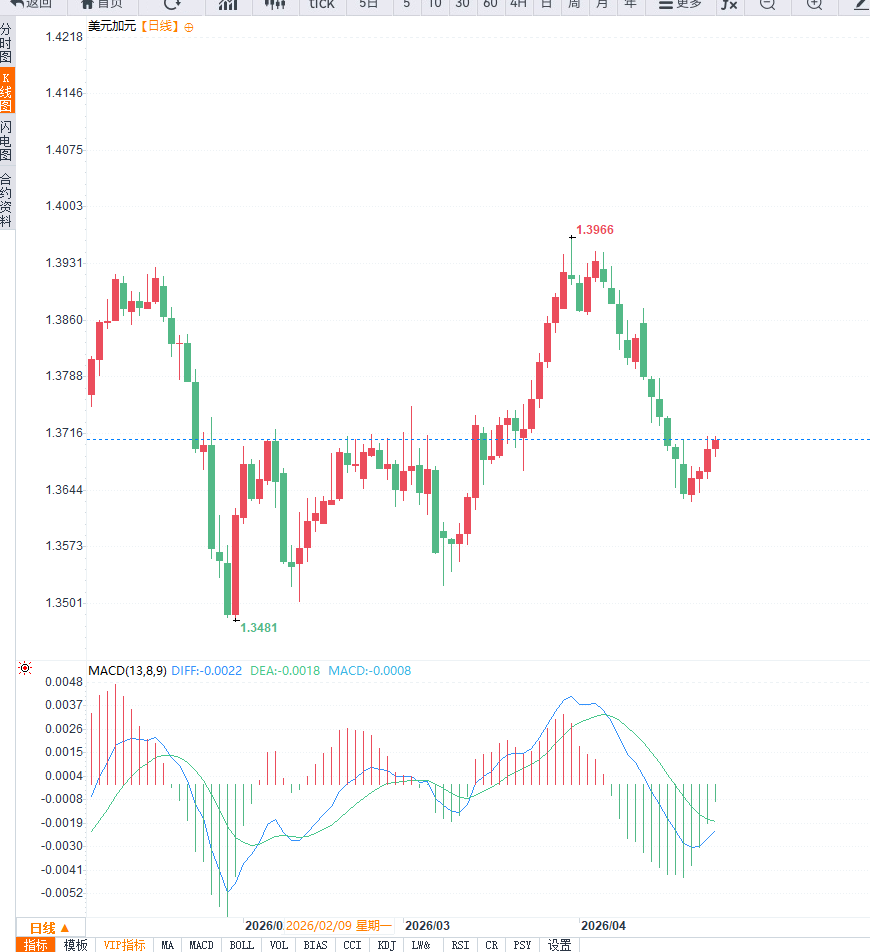
From a technical perspective, on the daily chart, USD/CAD has maintained its high level after breaking through the key resistance at 1.3650, forming a short-term upward trend. The current resistance level is around 1.3750; a break above this level could lead to a further test of the 1.3800 level. Support is at 1.3650, a previous breakout point that provides strong support. Momentum indicators show that bullish forces still dominate, but a short-term consolidation is possible. On the 4-hour chart, the exchange rate maintains a high-level consolidation structure, with short-term support around 1.3680. A break below this level could lead to a retest of the 1.3600 area; if it stabilizes, there is still room for further upward movement.
Editor's Summary : Overall, the current USD/CAD exchange rate is driven by a combination of factors: geopolitical risks, energy prices, and monetary policy expectations. The US dollar remains strong, supported by safe-haven demand and strong economic fundamentals, while the Canadian dollar benefits from rising oil prices but is constrained by policy differences. In the short term, the exchange rate may maintain a high-level consolidation pattern, with future movements depending on the evolution of the Middle East situation, changes in oil prices, and the monetary policy paths of the US and Canada. Investors should closely monitor the interplay between macroeconomic and geopolitical factors.
The main driver of the dollar's strength remains uncertainty in the Middle East. Tensions surrounding the Strait of Hormuz continue to escalate, with the US tightening restrictions on Iranian maritime transport while Iran issues warnings about shipping safety, fueling market concerns about a potential further escalation of the conflict. This has increased risk aversion, supporting the dollar as the global reserve currency and thus providing upward momentum for USD/CAD.
Meanwhile, the robust fundamentals of the US economy provided additional support for the dollar. Latest data showed that initial jobless claims in the US rose slightly to 215,000, but remained at a low level overall, indicating a resilient labor market. Furthermore, the manufacturing PMI rose to 54.0 and the services PMI to 51.3, both in expansion territory, reinforcing market expectations of steady economic growth. These factors combined to support the dollar's continued strength.
On the other hand, the Canadian dollar was supported by rising oil prices. As a typical commodity currency, the Canadian dollar's performance is highly correlated with crude oil prices. Amidst disruptions to energy supplies, WTI crude oil prices remained high near $95, providing some support for the Canadian dollar. However, this positive factor was partially offset by policy expectations.
Looking at inflation data, Canada's inflation rate rose to 2.4% in April, with rising energy prices being the main driving factor. This data reinforced market expectations that the Bank of Canada might adopt a more hawkish stance. However, at the same time, the high-interest-rate environment and economic resilience in the United States make the US dollar more attractive. Therefore, the USD/CAD exchange rate exhibits a structural game of "a strong US dollar versus support for commodity currencies."
From a technical perspective, on the daily chart, USD/CAD has maintained its high level after breaking through the key resistance at 1.3650, forming a short-term upward trend. The current resistance level is around 1.3750; a break above this level could lead to a further test of the 1.3800 level. Support is at 1.3650, a previous breakout point that provides strong support. Momentum indicators show that bullish forces still dominate, but a short-term consolidation is possible. On the 4-hour chart, the exchange rate maintains a high-level consolidation structure, with short-term support around 1.3680. A break below this level could lead to a retest of the 1.3600 area; if it stabilizes, there is still room for further upward movement.
Editor's Summary : Overall, the current USD/CAD exchange rate is driven by a combination of factors: geopolitical risks, energy prices, and monetary policy expectations. The US dollar remains strong, supported by safe-haven demand and strong economic fundamentals, while the Canadian dollar benefits from rising oil prices but is constrained by policy differences. In the short term, the exchange rate may maintain a high-level consolidation pattern, with future movements depending on the evolution of the Middle East situation, changes in oil prices, and the monetary policy paths of the US and Canada. Investors should closely monitor the interplay between macroeconomic and geopolitical factors.
- Risk Warning and Disclaimer
- The market involves risk, and trading may not be suitable for all investors. This article is for reference only and does not constitute personal investment advice, nor does it take into account certain users’ specific investment objectives, financial situation, or other needs. Any investment decisions made based on this information are at your own risk.