Inflation is rising, so why is the Bank of Canada holding back? The Canadian dollar's recent volatility is about to take a turn!
2026-04-29 21:52:53
On Wednesday (April 29), the Bank of Canada announced its latest interest rate decision, maintaining the policy rate at 2.25%. This decision was in line with market expectations, marking the fourth consecutive time the benchmark interest rate has remained unchanged since October 2025. The quarterly Monetary Policy Report (MPR), released concurrently with the decision, showed that the central bank slightly raised its economic growth forecasts for 2026 and 2027, but due to significant fluctuations in global energy prices, the average inflation forecast for 2026 was revised upward from 2.0% to 2.3%.

Prior to the resolution's announcement, concerns about rising inflation and slowing economic growth were intertwined, driven by the continued rise in global energy prices due to the Middle East situation. Data showed that Canada's CPI rose to 2.4% in March, up from 1.8% in February. Meanwhile, the labor market remained weak, with the unemployment rate hovering between 6.5% and 7%.
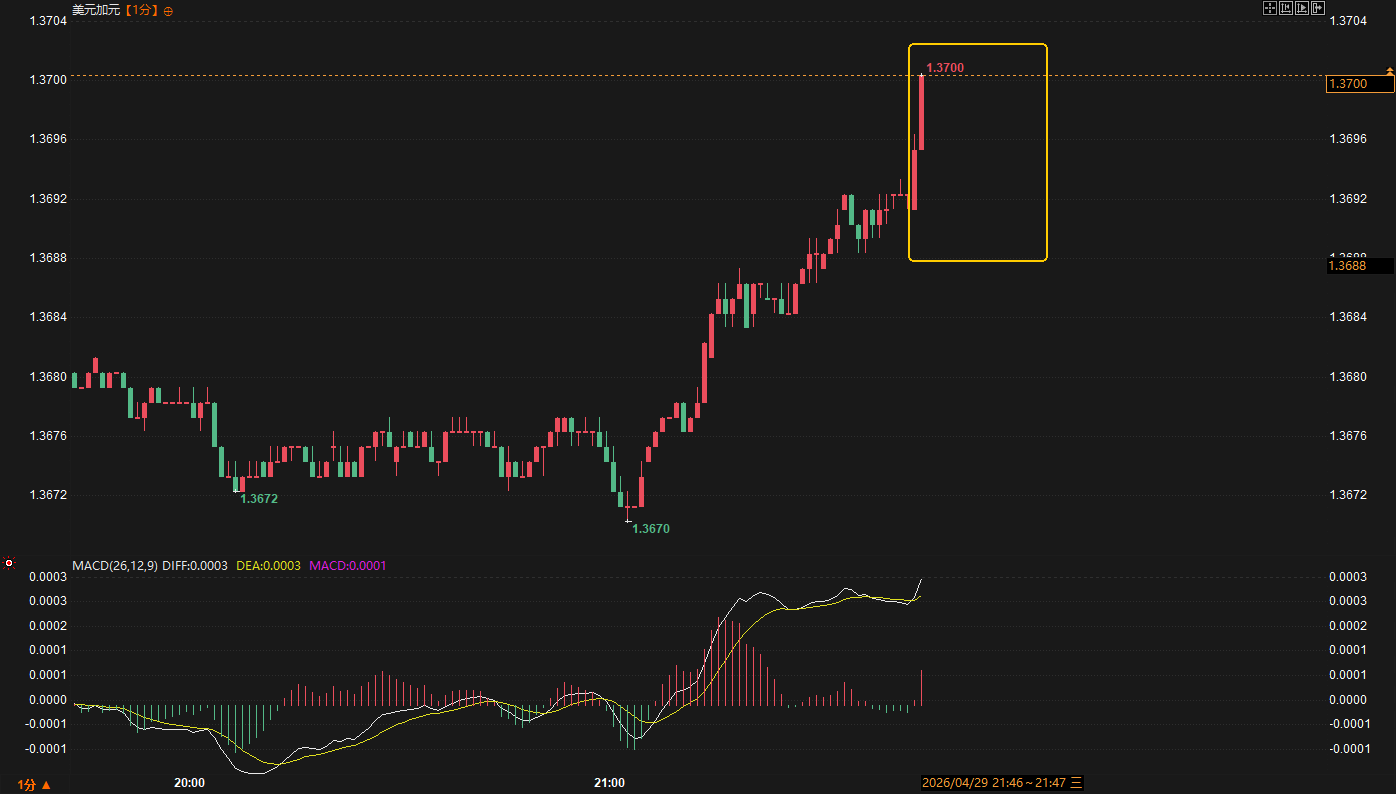
Immediately after the decision was announced, the Canadian dollar fluctuated, with the USD/CAD pair surging to a high of 1.3707 before falling approximately 12 points. In a subsequent statement, Governor Tiff Macklem clearly stated that if the economy largely follows baseline forecasts, future interest rate changes will be minor. However, he also issued a two-pronged warning: on the one hand, if energy prices trigger sustained widespread inflation, consecutive interest rate hikes may be necessary; on the other hand, if the external trade environment deteriorates, further interest rate cuts may be needed to support growth. This flexible and prudent stance reflects the high degree of complexity of the current macroeconomic environment.
From a fundamental perspective, the Bank of Canada is pursuing a strategy of "seeing through" the short-term impact of oil prices. While rising energy export prices can increase trade revenue for Canada, a resource-rich nation, this benefit is partially offset by cost pressures faced by domestic consumers and businesses. The central bank's forecast assumes that oil prices will gradually decline from the current average of around $90 per barrel to $75 per barrel by mid-2027. This assumption is a key premise for maintaining current interest rates. If this logic holds, inflation will peak in April and then return to the 2% target path.
Compared to historical trends, the current interest rate of 2.25% is at the lower end of the nominal neutral interest rate range estimated by the central bank at 2.25% to 3.25%. This means that the current policy is neither a strong stimulus nor an excessive tightening. Compared to the economic contraction expected at the end of 2025, the current growth forecast of 1.2% to 1.6% indicates that the economy is gradually stabilizing. However, technically, the failure of the USD/CAD pair to hold the 1.3700 level suggests that the market lacks confidence in a unilateral depreciation of the Canadian dollar. The policy decision has a relatively balanced impact on related currencies: for the Canadian dollar, although the expectation of an interest rate cut has been postponed, the potential risk of consecutive interest rate hikes limits its downside potential.
On the X platform (formerly Twitter), the perspectives of institutional and retail investors presented an interesting contrast before and after the resolution.
Prior to the decision, analysts from prominent institutions such as Goldman Sachs and Reuters largely adopted a wait-and-see approach, believing that the central bank would emphasize "data dependence" and focus on the stability of core inflation. The general consensus among these institutions was that unless core inflation was seen to spiral out of control, the threshold for raising interest rates would be extremely high.
Retail investors, on the other hand, were more focused on the pressure of the cost of living. Before the decision was announced, there was a strong "hawkish" expectation among retail investors, who believed that the 2.4% inflation rate might force the central bank to change its stance.
Following the announcement of the decision, institutions quickly picked up on the wording regarding "nimbleness" in the statement, interpreting it as the central bank leaving room for uncertain geopolitical and trade policies. In contrast, retail investors reacted more with concerns about the risk of future interest rate hikes. The retail investor expectation bias was mainly reflected in their initial expectation that the central bank would be more inclined to raise interest rates due to rising energy prices; however, Macklem's statement that "interest rates may be cut if trade is restricted" made the market realize that downside risks to the economy should not be ignored.
Looking ahead, the Bank of Canada's policy path will exhibit a distinctly conditional character. First, the actual trajectory of energy prices will directly determine whether inflation will evolve from a short-term shock into a long-term trend. Second, the potential risk of external trade restrictions hangs like a sword of Damocles over the export sector.
Extrapolating from the market logic, if economic data in the coming months confirms that inflation has peaked around 3% and is declining, then the USD/CAD exchange rate may continue to trade within its current range, lacking a strong driver to break through or fall below key resistance levels. If the external environment remains unchanged, the volatility of the Canadian dollar exchange rate may further narrow as the policy path becomes clearer.
Q: What is the core logic behind the Bank of Canada's decision to keep interest rates unchanged?
A: The core logic lies in balancing the current rise in inflation with potential growth risks. The Bank of Canada believes that although energy prices have pushed up nominal CPI, core inflation remains stable and wage growth is under control. Assuming that oil prices will gradually decline, the 2.25% interest rate is considered sufficient to guide inflation back to the target while avoiding excessive tightening in a weak economic environment.
Q: What exactly does the governor mean by "policies need to remain agile"?
A: Policy agility means that the central bank does not pre-determine a fixed path, but rather responds according to the evolution of two extreme risks. If energy prices cause inflation expectations to decouple, the central bank is prepared to raise interest rates consecutively; however, if external trade negotiations severely damage economic growth, the central bank retains the option of further interest rate cuts. This flexibility is to cope with the current exceptionally severe global geopolitical and trade uncertainties.
Q: Why is the impact of rising energy prices on the Canadian economy described as "small"?
A: Rising energy prices are a double-edged sword for Canada. On the one hand, as a major energy exporter, high oil prices increase export value and gross national income; on the other hand, high oil prices increase business production costs and household living expenses. The central bank believes that the offsetting effect of these two factors makes the impact on overall GDP relatively manageable, but it will significantly alter the internal structure of growth.
Q: How does the market interpret the upward revision of growth forecasts in this monetary policy report?
A: The upward revision of the growth forecast (from 1.1% to 1.2% in 2026) mainly reflects the support for the economy from consumption and government spending. Despite trade uncertainties, the central bank believes the output gap will be gradually absorbed, which provides confidence in maintaining interest rates and signals to the market that the economy remains resilient.
Q: What macroeconomic signal does this decision send to ordinary investors?
A: The most important signal is that the policy turning point has not yet arrived. The central bank remains in an observation period and is highly dependent on the external environment. This means that in the near future, fluctuations in macroeconomic data will directly translate into frequent shifts in policy expectations, and market participants should be wary of the risk of sudden policy adjustments triggered by unforeseen global events.
Market Background
Prior to the resolution's announcement, concerns about rising inflation and slowing economic growth were intertwined, driven by the continued rise in global energy prices due to the Middle East situation. Data showed that Canada's CPI rose to 2.4% in March, up from 1.8% in February. Meanwhile, the labor market remained weak, with the unemployment rate hovering between 6.5% and 7%.
Immediately after the decision was announced, the Canadian dollar fluctuated, with the USD/CAD pair surging to a high of 1.3707 before falling approximately 12 points. In a subsequent statement, Governor Tiff Macklem clearly stated that if the economy largely follows baseline forecasts, future interest rate changes will be minor. However, he also issued a two-pronged warning: on the one hand, if energy prices trigger sustained widespread inflation, consecutive interest rate hikes may be necessary; on the other hand, if the external trade environment deteriorates, further interest rate cuts may be needed to support growth. This flexible and prudent stance reflects the high degree of complexity of the current macroeconomic environment.
Deep interconnect analysis
From a fundamental perspective, the Bank of Canada is pursuing a strategy of "seeing through" the short-term impact of oil prices. While rising energy export prices can increase trade revenue for Canada, a resource-rich nation, this benefit is partially offset by cost pressures faced by domestic consumers and businesses. The central bank's forecast assumes that oil prices will gradually decline from the current average of around $90 per barrel to $75 per barrel by mid-2027. This assumption is a key premise for maintaining current interest rates. If this logic holds, inflation will peak in April and then return to the 2% target path.
Compared to historical trends, the current interest rate of 2.25% is at the lower end of the nominal neutral interest rate range estimated by the central bank at 2.25% to 3.25%. This means that the current policy is neither a strong stimulus nor an excessive tightening. Compared to the economic contraction expected at the end of 2025, the current growth forecast of 1.2% to 1.6% indicates that the economy is gradually stabilizing. However, technically, the failure of the USD/CAD pair to hold the 1.3700 level suggests that the market lacks confidence in a unilateral depreciation of the Canadian dollar. The policy decision has a relatively balanced impact on related currencies: for the Canadian dollar, although the expectation of an interest rate cut has been postponed, the potential risk of consecutive interest rate hikes limits its downside potential.
On the X platform (formerly Twitter), the perspectives of institutional and retail investors presented an interesting contrast before and after the resolution.
Prior to the decision, analysts from prominent institutions such as Goldman Sachs and Reuters largely adopted a wait-and-see approach, believing that the central bank would emphasize "data dependence" and focus on the stability of core inflation. The general consensus among these institutions was that unless core inflation was seen to spiral out of control, the threshold for raising interest rates would be extremely high.
Retail investors, on the other hand, were more focused on the pressure of the cost of living. Before the decision was announced, there was a strong "hawkish" expectation among retail investors, who believed that the 2.4% inflation rate might force the central bank to change its stance.
Following the announcement of the decision, institutions quickly picked up on the wording regarding "nimbleness" in the statement, interpreting it as the central bank leaving room for uncertain geopolitical and trade policies. In contrast, retail investors reacted more with concerns about the risk of future interest rate hikes. The retail investor expectation bias was mainly reflected in their initial expectation that the central bank would be more inclined to raise interest rates due to rising energy prices; however, Macklem's statement that "interest rates may be cut if trade is restricted" made the market realize that downside risks to the economy should not be ignored.
Trend Outlook
Looking ahead, the Bank of Canada's policy path will exhibit a distinctly conditional character. First, the actual trajectory of energy prices will directly determine whether inflation will evolve from a short-term shock into a long-term trend. Second, the potential risk of external trade restrictions hangs like a sword of Damocles over the export sector.
Extrapolating from the market logic, if economic data in the coming months confirms that inflation has peaked around 3% and is declining, then the USD/CAD exchange rate may continue to trade within its current range, lacking a strong driver to break through or fall below key resistance levels. If the external environment remains unchanged, the volatility of the Canadian dollar exchange rate may further narrow as the policy path becomes clearer.
Frequently Asked Questions
Q: What is the core logic behind the Bank of Canada's decision to keep interest rates unchanged?
A: The core logic lies in balancing the current rise in inflation with potential growth risks. The Bank of Canada believes that although energy prices have pushed up nominal CPI, core inflation remains stable and wage growth is under control. Assuming that oil prices will gradually decline, the 2.25% interest rate is considered sufficient to guide inflation back to the target while avoiding excessive tightening in a weak economic environment.
Q: What exactly does the governor mean by "policies need to remain agile"?
A: Policy agility means that the central bank does not pre-determine a fixed path, but rather responds according to the evolution of two extreme risks. If energy prices cause inflation expectations to decouple, the central bank is prepared to raise interest rates consecutively; however, if external trade negotiations severely damage economic growth, the central bank retains the option of further interest rate cuts. This flexibility is to cope with the current exceptionally severe global geopolitical and trade uncertainties.
Q: Why is the impact of rising energy prices on the Canadian economy described as "small"?
A: Rising energy prices are a double-edged sword for Canada. On the one hand, as a major energy exporter, high oil prices increase export value and gross national income; on the other hand, high oil prices increase business production costs and household living expenses. The central bank believes that the offsetting effect of these two factors makes the impact on overall GDP relatively manageable, but it will significantly alter the internal structure of growth.
Q: How does the market interpret the upward revision of growth forecasts in this monetary policy report?
A: The upward revision of the growth forecast (from 1.1% to 1.2% in 2026) mainly reflects the support for the economy from consumption and government spending. Despite trade uncertainties, the central bank believes the output gap will be gradually absorbed, which provides confidence in maintaining interest rates and signals to the market that the economy remains resilient.
Q: What macroeconomic signal does this decision send to ordinary investors?
A: The most important signal is that the policy turning point has not yet arrived. The central bank remains in an observation period and is highly dependent on the external environment. This means that in the near future, fluctuations in macroeconomic data will directly translate into frequent shifts in policy expectations, and market participants should be wary of the risk of sudden policy adjustments triggered by unforeseen global events.
- Risk Warning and Disclaimer
- The market involves risk, and trading may not be suitable for all investors. This article is for reference only and does not constitute personal investment advice, nor does it take into account certain users’ specific investment objectives, financial situation, or other needs. Any investment decisions made based on this information are at your own risk.