One chart: The Baltic Dry Index declined slightly, with varying performance in shipping capacity.
2026-04-29 23:41:29
The latest data shows that on April 29, 2026, the Baltic Dry Index (BDI) was 2670 points, a decrease of 0.26% compared to the previous period, marking the largest drop in three days. Looking at the short-term charts, the BDI saw positive growth 8 times, negative growth 3 times, and zero growth 0 times in the last 11 BDI data points. Specifically, the Panamax Freight Index (BPI) was 1979 points, an increase of 0.66% compared to the previous period; the Capesize Freight Index (BCI) was 4283 points, a decrease of 0.46%; and the Supramax Freight Index (BSI) was 1534 points, a decrease of 0.52%. For detailed 720-day and 10-year trend charts of the Baltic Dry Index and its three main sub-indices, please refer to the specially designed charts.
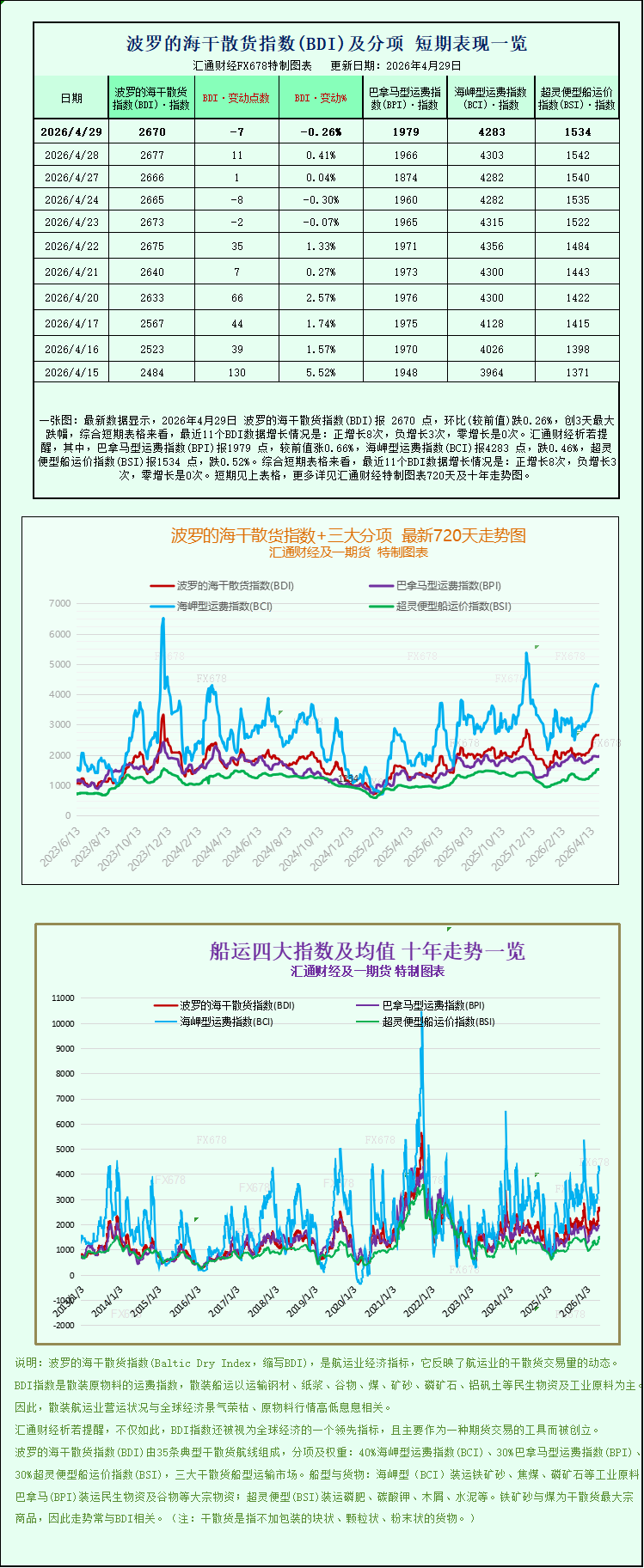
The Baltic Dry Index (BDI), a leading indicator of international dry bulk shipping prices, primarily monitors spot freight rates for vessels transporting dry bulk commodities such as iron ore, coal, and grain. It serves as a barometer of the global dry bulk shipping market and a leading indicator of global trade. The index fell slightly on Wednesday, with the shipping sector showing a clear divergence. The decline in freight rates for Capesize and Supramax vessels offset and exceeded the increase in Panamax vessels, ultimately leading to a slight overall decline in the index.
The Baltic Dry Index, which tracks freight rates for the three major dry bulk shipping categories—Capesize, Panamax, and Supramax—fell slightly by 7 points to close at 2,670, a decrease of approximately 0.26%. It remained within its recent relatively high range, indicating that the overall supply and demand in the dry bulk market is currently in a state of relative balance but with slight pressure. As a core benchmark for the global dry bulk shipping market, this slight fluctuation reflects the complexity and uncertainty of the current international dry bulk shipping market.
Looking specifically at the performance of different ship types, the Capesize market was weak, with the Capesize index falling 21 points to close at 4,283, a decrease of approximately 0.49%. Capesize vessels, as large ships in dry bulk shipping, primarily undertake long-haul trunk line transportation, mainly carrying 150,000 tons of bulk industrial raw materials, including iron ore and coal, and are key transport carriers in the global steel and energy industry supply chains. Affected by this, the average daily revenue of Capesize vessels carrying 150,000 tons of cargo also declined, decreasing by $196 to $35,340, resulting in a slight contraction in shipowners' profit margins.
It is worth noting that the iron ore market, which is closely linked to Capesize vessel freight rates, presents a mixed picture of bullish and bearish forces. On Wednesday, iron ore futures prices rose slightly, mainly due to the recent new guidelines issued by the People's Bank of China to expand lending. This policy move further signaled a moderately loose monetary policy, effectively alleviating concerns among consumers and related enterprises, and providing some support for iron ore prices. However, at the same time, the continued decline in crude steel demand, coupled with the continued increase in global iron ore supply, has created a significant supply-demand imbalance, putting considerable pressure on iron ore prices. This tug-of-war between bullish and bearish forces has also indirectly affected the transportation demand and freight rates for Capesize vessels.
In contrast to the sluggish performance of Capesize vessels, Panamax vessels shone brightly, becoming the only bright spot in the dry bulk market that day. The Panamax index rose 13 points, or approximately 0.7%, to close at 1,979 points, achieving a slight recovery. Panamax vessels are medium-sized dry bulk carriers, typically carrying 60,000 to 70,000 tons of bulk commodities such as coal or grain, mainly serving short- to medium-haul routes. Supported by global grain trade and regional coal transportation demand, their market demand is relatively stable. Correspondingly, the average daily revenue of Panamax vessels increased by $119 to $17,814, resulting in improved profitability for shipowners.
Among smaller vessels, Supramax vessels also performed weakly, with the Supramax Index (.BSIS) falling 8 points, or approximately 0.5%, to close at 1,534 points. Supramax vessels are highly flexible and typically equipped with cranes, primarily serving short-haul transport within Southeast Asia and transporting non-mainstream bulk cargoes such as minerals and fertilizers. The slight decline in freight rates reflects a slight slowdown in demand for small-volume bulk cargo transport in the region and a decrease in market activity.
Overall, the slight decline in the Baltic Dry Index on April 29 was mainly due to the divergent performance of different ship types. The decline in freight rates for large and small dry bulk carriers was the dominant factor, while the rise in freight rates for medium-sized Panamax vessels failed to reverse the overall trend. This also reflects the structural differentiation of the current global dry bulk shipping market, which is affected by multiple factors such as cargo demand, policy environment, and supply and demand.
The Baltic Dry Index (BDI), a leading indicator of international dry bulk shipping prices, primarily monitors spot freight rates for vessels transporting dry bulk commodities such as iron ore, coal, and grain. It serves as a barometer of the global dry bulk shipping market and a leading indicator of global trade. The index fell slightly on Wednesday, with the shipping sector showing a clear divergence. The decline in freight rates for Capesize and Supramax vessels offset and exceeded the increase in Panamax vessels, ultimately leading to a slight overall decline in the index.
The Baltic Dry Index, which tracks freight rates for the three major dry bulk shipping categories—Capesize, Panamax, and Supramax—fell slightly by 7 points to close at 2,670, a decrease of approximately 0.26%. It remained within its recent relatively high range, indicating that the overall supply and demand in the dry bulk market is currently in a state of relative balance but with slight pressure. As a core benchmark for the global dry bulk shipping market, this slight fluctuation reflects the complexity and uncertainty of the current international dry bulk shipping market.
Looking specifically at the performance of different ship types, the Capesize market was weak, with the Capesize index falling 21 points to close at 4,283, a decrease of approximately 0.49%. Capesize vessels, as large ships in dry bulk shipping, primarily undertake long-haul trunk line transportation, mainly carrying 150,000 tons of bulk industrial raw materials, including iron ore and coal, and are key transport carriers in the global steel and energy industry supply chains. Affected by this, the average daily revenue of Capesize vessels carrying 150,000 tons of cargo also declined, decreasing by $196 to $35,340, resulting in a slight contraction in shipowners' profit margins.
It is worth noting that the iron ore market, which is closely linked to Capesize vessel freight rates, presents a mixed picture of bullish and bearish forces. On Wednesday, iron ore futures prices rose slightly, mainly due to the recent new guidelines issued by the People's Bank of China to expand lending. This policy move further signaled a moderately loose monetary policy, effectively alleviating concerns among consumers and related enterprises, and providing some support for iron ore prices. However, at the same time, the continued decline in crude steel demand, coupled with the continued increase in global iron ore supply, has created a significant supply-demand imbalance, putting considerable pressure on iron ore prices. This tug-of-war between bullish and bearish forces has also indirectly affected the transportation demand and freight rates for Capesize vessels.
In contrast to the sluggish performance of Capesize vessels, Panamax vessels shone brightly, becoming the only bright spot in the dry bulk market that day. The Panamax index rose 13 points, or approximately 0.7%, to close at 1,979 points, achieving a slight recovery. Panamax vessels are medium-sized dry bulk carriers, typically carrying 60,000 to 70,000 tons of bulk commodities such as coal or grain, mainly serving short- to medium-haul routes. Supported by global grain trade and regional coal transportation demand, their market demand is relatively stable. Correspondingly, the average daily revenue of Panamax vessels increased by $119 to $17,814, resulting in improved profitability for shipowners.
Among smaller vessels, Supramax vessels also performed weakly, with the Supramax Index (.BSIS) falling 8 points, or approximately 0.5%, to close at 1,534 points. Supramax vessels are highly flexible and typically equipped with cranes, primarily serving short-haul transport within Southeast Asia and transporting non-mainstream bulk cargoes such as minerals and fertilizers. The slight decline in freight rates reflects a slight slowdown in demand for small-volume bulk cargo transport in the region and a decrease in market activity.
Overall, the slight decline in the Baltic Dry Index on April 29 was mainly due to the divergent performance of different ship types. The decline in freight rates for large and small dry bulk carriers was the dominant factor, while the rise in freight rates for medium-sized Panamax vessels failed to reverse the overall trend. This also reflects the structural differentiation of the current global dry bulk shipping market, which is affected by multiple factors such as cargo demand, policy environment, and supply and demand.
- Risk Warning and Disclaimer
- The market involves risk, and trading may not be suitable for all investors. This article is for reference only and does not constitute personal investment advice, nor does it take into account certain users’ specific investment objectives, financial situation, or other needs. Any investment decisions made based on this information are at your own risk.