Easing tensions in the Middle East dampened inflation expectations, causing silver to rebound to $75.70, but uncertainty limited gains.
2026-05-06 14:51:15
Silver prices rebounded to around $75.70 per ounce on Wednesday during Asian trading hours, ending a two-day correction. This recovery was primarily driven by improved market risk sentiment and a decline in energy prices. As tensions in the Middle East showed signs of easing, crude oil prices came under downward pressure, and inflation expectations cooled, thus reducing market bets on continued central bank tightening policies.
The United States announced the end of its offensive operations in the region and reiterated that the ceasefire agreement remains in effect. The U.S. Department of Defense stated that the situation is not yet fully stable and localized conflicts persist.
With inflation expectations cooling, market expectations for persistently high interest rates have weakened, providing support for silver, a non-yielding asset. Previously, soaring energy prices drove inflation upward, leading to widespread expectations that central banks might maintain a high-interest-rate environment for an extended period, thus exerting sustained downward pressure on silver. However, the current decline in oil prices has led to a temporary correction in this logic.
The decline in energy prices has become one of the key factors driving the rebound in silver prices, as it directly affects the inflation path and interest rate expectations, thereby changing the valuation logic of precious metals.
However, silver's upward movement still faces significant constraints. The situation in the Middle East has not yet fully stabilized, and the market remains highly vigilant about potential recurrence of conflict. While the US has stated it will suspend some operations to assess the likelihood of an agreement, restrictions on key shipping routes remain in place, making it difficult for geopolitical risk premiums to fully dissipate.
From a market structure perspective, silver had previously been under continuous downward pressure, mainly due to the combined effects of high inflation and high interest rate expectations. This rebound is more of a sentiment recovery and technical correction than a trend reversal. Funds are making short-term buy-backs at lower levels, leading to a temporary price correction.
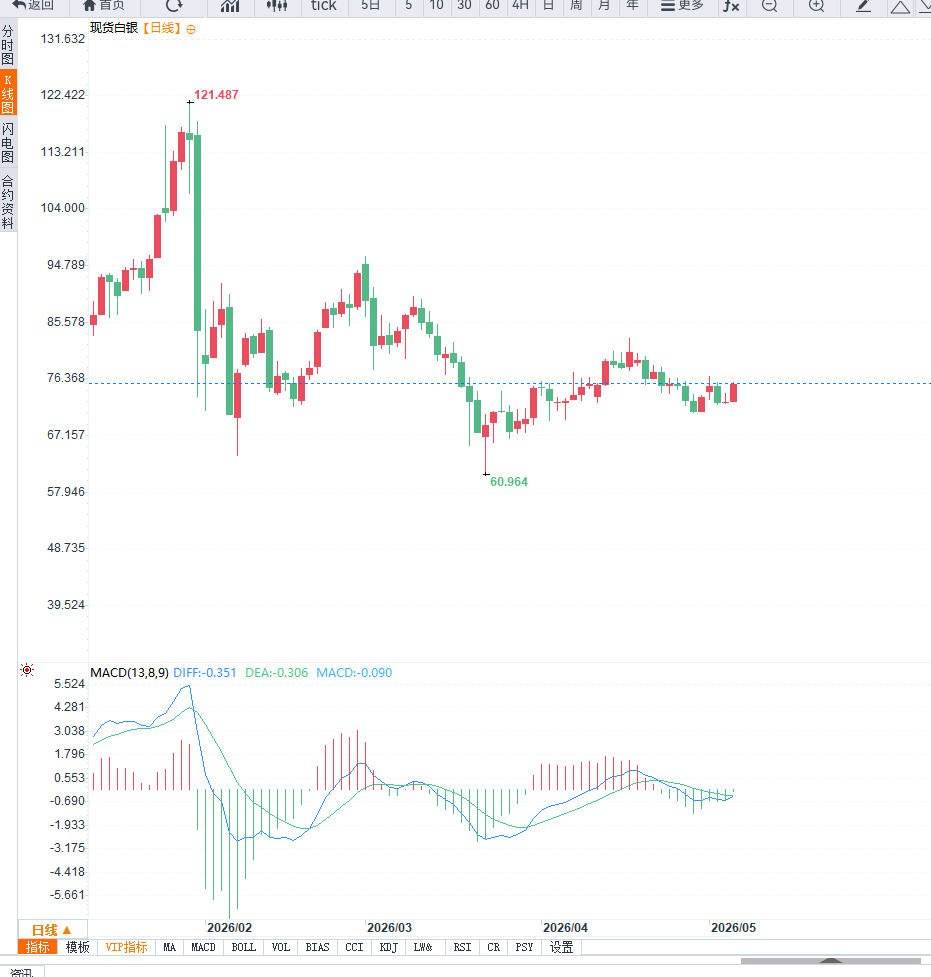
From a technical perspective, silver's daily chart remains in a consolidation phase after a high-level pullback. After a series of declines, the price stabilized above $74, forming a short-term support/rebound structure. Resistance levels to watch are the $76.00 and $77.50 areas; a break above these levels could extend to around $79. Support levels are at $74.00 and $72.50. The RSI indicator has rebounded from oversold territory to the neutral zone, indicating stronger short-term corrective momentum, but the overall trend has not yet reversed. The MACD remains below the zero line, suggesting that medium-term pressure persists.
On the 4-hour chart, silver is exhibiting a low-level consolidation and rebound structure, with short-term moving averages starting to turn upwards, indicating strengthening rebound momentum. The price is gradually rising above the short-term moving average system, suggesting a return of buying pressure. The MACD shows initial signs of a golden cross, but the strength is weak, indicating a clear corrective nature. The RSI remains oscillating around 50, indicating the market is still in a state of equilibrium between bulls and bears. If the price breaks through the $76 resistance, it may further test the $77.50 area; if it falls back below $74, the rebound structure may have ended.
Editor's Summary:
Silver's current price movement is influenced by two core factors: first, the easing of tensions in the Middle East has led to a decline in energy prices, thus alleviating inflationary pressures; second, market expectations for continued central bank tightening have cooled, driving a short-term rebound in precious metals. Inflation expectations and geopolitical risks remain key variables determining silver's medium-term direction. If energy prices continue to fall, silver is expected to continue its recovery; however, if conflicts escalate again or inflation rebounds, it may face renewed pressure. Overall, silver remains in a highly volatile and volatile phase, and the trend is still unclear.
The United States announced the end of its offensive operations in the region and reiterated that the ceasefire agreement remains in effect. The U.S. Department of Defense stated that the situation is not yet fully stable and localized conflicts persist.
With inflation expectations cooling, market expectations for persistently high interest rates have weakened, providing support for silver, a non-yielding asset. Previously, soaring energy prices drove inflation upward, leading to widespread expectations that central banks might maintain a high-interest-rate environment for an extended period, thus exerting sustained downward pressure on silver. However, the current decline in oil prices has led to a temporary correction in this logic.
The decline in energy prices has become one of the key factors driving the rebound in silver prices, as it directly affects the inflation path and interest rate expectations, thereby changing the valuation logic of precious metals.
However, silver's upward movement still faces significant constraints. The situation in the Middle East has not yet fully stabilized, and the market remains highly vigilant about potential recurrence of conflict. While the US has stated it will suspend some operations to assess the likelihood of an agreement, restrictions on key shipping routes remain in place, making it difficult for geopolitical risk premiums to fully dissipate.
From a market structure perspective, silver had previously been under continuous downward pressure, mainly due to the combined effects of high inflation and high interest rate expectations. This rebound is more of a sentiment recovery and technical correction than a trend reversal. Funds are making short-term buy-backs at lower levels, leading to a temporary price correction.
From a technical perspective, silver's daily chart remains in a consolidation phase after a high-level pullback. After a series of declines, the price stabilized above $74, forming a short-term support/rebound structure. Resistance levels to watch are the $76.00 and $77.50 areas; a break above these levels could extend to around $79. Support levels are at $74.00 and $72.50. The RSI indicator has rebounded from oversold territory to the neutral zone, indicating stronger short-term corrective momentum, but the overall trend has not yet reversed. The MACD remains below the zero line, suggesting that medium-term pressure persists.
On the 4-hour chart, silver is exhibiting a low-level consolidation and rebound structure, with short-term moving averages starting to turn upwards, indicating strengthening rebound momentum. The price is gradually rising above the short-term moving average system, suggesting a return of buying pressure. The MACD shows initial signs of a golden cross, but the strength is weak, indicating a clear corrective nature. The RSI remains oscillating around 50, indicating the market is still in a state of equilibrium between bulls and bears. If the price breaks through the $76 resistance, it may further test the $77.50 area; if it falls back below $74, the rebound structure may have ended.
Editor's Summary:
Silver's current price movement is influenced by two core factors: first, the easing of tensions in the Middle East has led to a decline in energy prices, thus alleviating inflationary pressures; second, market expectations for continued central bank tightening have cooled, driving a short-term rebound in precious metals. Inflation expectations and geopolitical risks remain key variables determining silver's medium-term direction. If energy prices continue to fall, silver is expected to continue its recovery; however, if conflicts escalate again or inflation rebounds, it may face renewed pressure. Overall, silver remains in a highly volatile and volatile phase, and the trend is still unclear.
- Risk Warning and Disclaimer
- The market involves risk, and trading may not be suitable for all investors. This article is for reference only and does not constitute personal investment advice, nor does it take into account certain users’ specific investment objectives, financial situation, or other needs. Any investment decisions made based on this information are at your own risk.