Escalating uncertainty surrounding UK local elections has pushed government bond yields to near 30-year highs, potentially triggering a rebound in the euro against the pound.
2026-05-06 15:40:13
The euro traded in a narrow range against the pound in early European trading on Wednesday, hovering around 0.8635. Overall trading was thin, with investors remaining cautious ahead of the UK local elections, awaiting further uncertainty. These elections, which determine the allocation of seats in the Scottish and Welsh Parliaments, are considered a crucial indicator of the current government's support and could have a profound impact on the UK's future fiscal and policy direction.

As the election approaches, market concerns about political risks are gradually intensifying, directly reflected in the bond market. UK government bond yields have recently climbed, reaching near 30-year highs , indicating fluctuating investor confidence in fiscal stability and policy continuity. Against the backdrop of highly sensitive global capital flows, rising yields typically imply a widening risk premium, thus putting downward pressure on the local currency, and consequently, the pound sterling.
Market research indicates that institutions generally believe that if the ruling party performs below expectations in this election, market concerns about policy implementation capabilities will intensify further. Some institutions predict that the euro/pound exchange rate may rise to around 0.8900 in the coming weeks , reflecting a temporary increase in investor preference for euro assets.
Meanwhile, monetary policy divergence has become another key factor driving exchange rates. Both the European Central Bank (ECB) and the Bank of England (BOE) chose to hold rates steady at their April meetings, but their policy signals diverged significantly. The ECB's overall stance leaned towards hawkishness, emphasizing continued focus on inflation, while the BOE preferred to observe the impact of slowing economic growth.
European Central Bank official Joachim Nagel stated, "If inflation does not improve significantly in the coming weeks, a rate hike may need to be considered in June." This statement reinforced market expectations of rising eurozone interest rates, providing support for the euro. In contrast, the UK economy faces the dual pressures of weakening growth momentum and uncertainty surrounding declining inflation, limiting the Bank of England's room for further policy tightening.
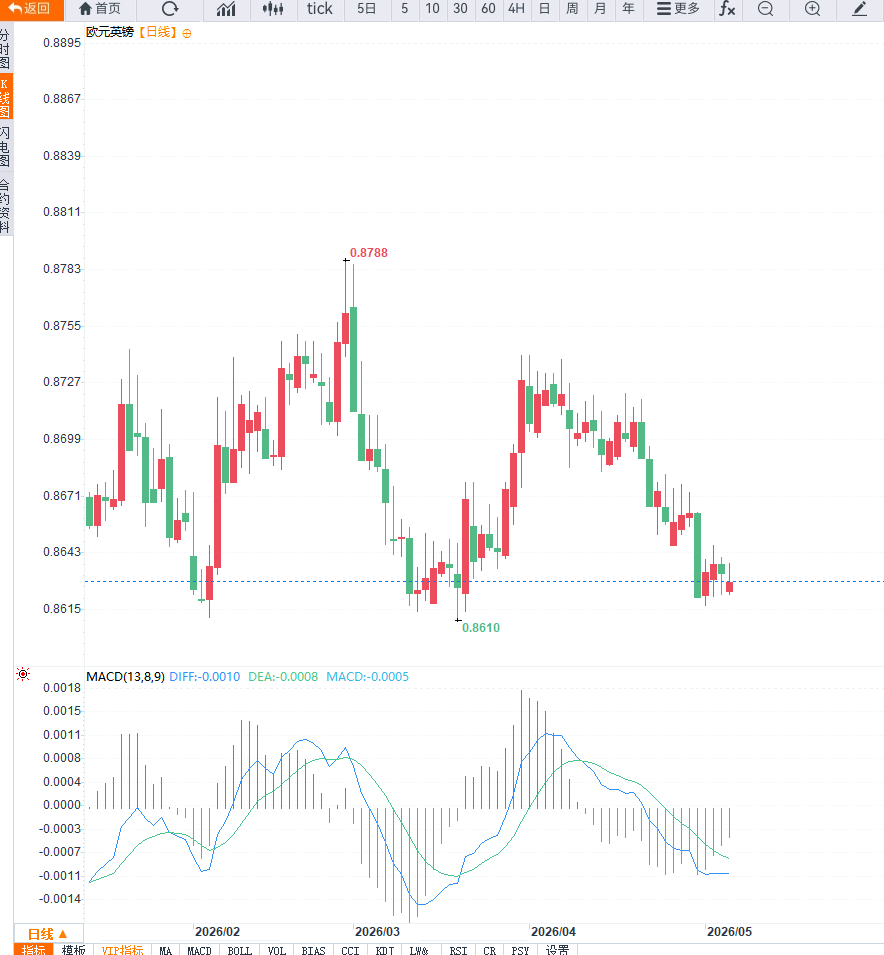
From a technical perspective, on the daily chart, the EUR/GBP pair remains in an overall upward trend, with the exchange rate gradually rising from its previous lows, indicating strengthening bullish momentum in the medium term. The key support level is currently around 0.8580 ; a break below this level could lead to a retest of the psychological level of 0.8500. Resistance is concentrated in the 0.8700-0.8750 range ; a decisive break above this level could open up further upside potential. In terms of momentum indicators, the Relative Strength Index (RSI) remains in the neutral-to-strong zone, indicating that the market still has some upward momentum but has not yet entered extreme territory.
On the 4-hour chart, the short-term trend shows a slightly bullish consolidation pattern, with the price trading above the moving average system, indicating that short-term buying pressure remains dominant. If the exchange rate holds above 0.8650, it may further test the 0.8700 resistance level; conversely, if it falls below 0.8600, the risk of a short-term pullback will increase. The MACD indicator shows that the bullish momentum has slowed slightly, suggesting a potential need for short-term consolidation.
In summary, the current euro/pound exchange rate movement is primarily driven by two factors: rising political uncertainty in the UK and hawkish expectations for the ECB's policy . Against the backdrop of a complex global macroeconomic environment, funds are more inclined to allocate to currency assets with clearer policy paths, thus providing a temporary boost to the euro.
Editor's Summary:
The UK local elections have become the core variable influencing the pound's exchange rate. Political uncertainty has rapidly transmitted from the bond market to the currency market, amplifying the pound's volatility. Meanwhile, hawkish signals from the European Central Bank have strengthened the euro's interest rate advantage, giving the euro upward momentum against the pound. In the short term, if the election results trigger expectations of policy instability, the exchange rate may further test key resistance levels. However, in the medium to long term, the market still needs to pay attention to the inflation path, economic growth performance, and changes in the pace of central bank policy, as these factors will determine the sustainability and scope of the exchange rate trend.
As the election approaches, market concerns about political risks are gradually intensifying, directly reflected in the bond market. UK government bond yields have recently climbed, reaching near 30-year highs , indicating fluctuating investor confidence in fiscal stability and policy continuity. Against the backdrop of highly sensitive global capital flows, rising yields typically imply a widening risk premium, thus putting downward pressure on the local currency, and consequently, the pound sterling.
Market research indicates that institutions generally believe that if the ruling party performs below expectations in this election, market concerns about policy implementation capabilities will intensify further. Some institutions predict that the euro/pound exchange rate may rise to around 0.8900 in the coming weeks , reflecting a temporary increase in investor preference for euro assets.
Meanwhile, monetary policy divergence has become another key factor driving exchange rates. Both the European Central Bank (ECB) and the Bank of England (BOE) chose to hold rates steady at their April meetings, but their policy signals diverged significantly. The ECB's overall stance leaned towards hawkishness, emphasizing continued focus on inflation, while the BOE preferred to observe the impact of slowing economic growth.
European Central Bank official Joachim Nagel stated, "If inflation does not improve significantly in the coming weeks, a rate hike may need to be considered in June." This statement reinforced market expectations of rising eurozone interest rates, providing support for the euro. In contrast, the UK economy faces the dual pressures of weakening growth momentum and uncertainty surrounding declining inflation, limiting the Bank of England's room for further policy tightening.
From a technical perspective, on the daily chart, the EUR/GBP pair remains in an overall upward trend, with the exchange rate gradually rising from its previous lows, indicating strengthening bullish momentum in the medium term. The key support level is currently around 0.8580 ; a break below this level could lead to a retest of the psychological level of 0.8500. Resistance is concentrated in the 0.8700-0.8750 range ; a decisive break above this level could open up further upside potential. In terms of momentum indicators, the Relative Strength Index (RSI) remains in the neutral-to-strong zone, indicating that the market still has some upward momentum but has not yet entered extreme territory.
On the 4-hour chart, the short-term trend shows a slightly bullish consolidation pattern, with the price trading above the moving average system, indicating that short-term buying pressure remains dominant. If the exchange rate holds above 0.8650, it may further test the 0.8700 resistance level; conversely, if it falls below 0.8600, the risk of a short-term pullback will increase. The MACD indicator shows that the bullish momentum has slowed slightly, suggesting a potential need for short-term consolidation.
In summary, the current euro/pound exchange rate movement is primarily driven by two factors: rising political uncertainty in the UK and hawkish expectations for the ECB's policy . Against the backdrop of a complex global macroeconomic environment, funds are more inclined to allocate to currency assets with clearer policy paths, thus providing a temporary boost to the euro.
Editor's Summary:
The UK local elections have become the core variable influencing the pound's exchange rate. Political uncertainty has rapidly transmitted from the bond market to the currency market, amplifying the pound's volatility. Meanwhile, hawkish signals from the European Central Bank have strengthened the euro's interest rate advantage, giving the euro upward momentum against the pound. In the short term, if the election results trigger expectations of policy instability, the exchange rate may further test key resistance levels. However, in the medium to long term, the market still needs to pay attention to the inflation path, economic growth performance, and changes in the pace of central bank policy, as these factors will determine the sustainability and scope of the exchange rate trend.
- Risk Warning and Disclaimer
- The market involves risk, and trading may not be suitable for all investors. This article is for reference only and does not constitute personal investment advice, nor does it take into account certain users’ specific investment objectives, financial situation, or other needs. Any investment decisions made based on this information are at your own risk.