Breaking News! Strait May Open in Phases: A New Graceful Script for the US and Iran
2026-05-07 17:21:30
On Thursday (May 7), during the Asian and European trading sessions, positive news emerged from the Strait of Hormuz, causing international oil prices to fall sharply, with both WTI and Brent crude oil prices dropping by more than 3%.
According to the latest reports from Saudi media Alhadath, Al Arabiya, and Pakistani mediators, the US and Iran have reached an agreement on a core framework for "gradually opening the Strait of Hormuz in exchange for easing the maritime blockade."
With Pakistan's mediation, a "30-day negotiation memorandum" has surfaced, and a substantial breakthrough is expected in the situation of ships trapped in the strait in the coming hours.
The US and Iran have reached a preliminary consensus on easing the maritime blockade, and a geopolitical drama about survival, elections, and face is entering its final stage.
Pakistani sources revealed that Trump has asked Iran to respond quickly to the US proposal, and Iran may submit a formal reply today through Pakistani mediators.
The core of this consensus is not complete peace, but a highly pragmatic exchange of resources: the United States eases its blockade of Iranian ports in exchange for Iran gradually reopening the Strait of Hormuz.
Iran has sent a clear signal that its Ports and Maritime Organization has begun providing fuel and medical assistance to more than a thousand ships stranded in the Strait of Hormuz.
More significantly, the Iranian Revolutionary Guard has designated a new shipping route called the "Larak Corridor," marking a shift from a "complete blockade" to "institutionalized control" of the strait—ships can pass safely as long as they comply with Iran's new regulations, avoid hostile lists, and may pay a certain "maintenance fee."
The unusual "urgency" shown by US President Trump in the negotiations is underpinned by a cold, hard election logic.
May 2026 is a crucial month for the US midterm elections. On May 19, key swing states such as Pennsylvania and Georgia will hold intensive primaries, which are seen as an important indicator of the November general election.
For Trump, oil prices remaining above $100 for an extended period are "poison" for the Republican Party's election prospects.
He desperately needs to see news of a "breakthrough" in the Strait within the next few hours to drive down oil prices, thus providing Republican candidates with campaign ammunition as irrefutable proof of his "maximum pressure" victory.
More importantly, Trump plans to visit China in mid-May.
To avoid speaking about Middle Eastern energy security from the perspective of a "seeker of help," he must secure a "phase one agreement" before departing, transforming the Iranian issue from a diplomatic burden into political capital and cultivating an image of a "tough but able-to-reach" leader.
Although Iran claims that "dismantling nuclear facilities" is a harsh provocation, the reality of economic pressures makes it impossible for it to continue the blockade.
The United States imposed a comprehensive maritime blockade on Iranian ports starting April 13, causing Iran's crude oil exports to plummet from approximately 2.1 million barrels per day to 567,000 barrels per day, resulting in a daily loss of about $500 million in oil revenue.
Even more critical is the oil storage crisis. Data from the International Energy Agency, Kpler, shows that Iran's onshore oil reserves have increased to 49 million barrels, with only 12 to 22 days of production capacity remaining. It is expected to reach its physical limit by mid-May.
If Iran does not "sell oil to clear its inventory," it will face the heavy cost of permanently shutting down its oil wells, which would be a devastating blow to the Iranian economy, where oil revenue accounts for more than 60% of its fiscal revenue.
The easing of the blockade means that tens of millions of barrels of crude oil that have been stockpiled can be quickly converted into cash. This foreign exchange repatriation is a "lifeline" for the Iranian government, which is struggling under sanctions, to maintain domestic stability and is also a key bargaining chip to gain social support.
The current favorable outcome of the negotiations is essentially that both sides are seeking a "more attractive" exit mechanism.
In this "atypical ceasefire," there were no real winners or complete losers, only helpless choices made under the pressure of high war costs and imminent political pressure.
The US narrative can boast that "Iran's nuclear program has been constrained for a long time," even though in reality it may only mean the mothballing of some equipment, while claiming to have "successfully lifted the blockade of the Strait of Hormuz" to protect its military and economic interests in the Middle East.
Iran's narrative: It could claim to "end the illegal US blockade and establish a new order in the Straits," even if that means accepting stricter inspections, while strengthening its actual control over the Strait of Hormuz through the establishment of the "Laraq Corridor."
That "30-day negotiation memorandum" was the most brilliant buffer.
It did not resolve the fundamental contradiction between the nuclear program and sanctions, but it bought valuable time through a "phased liberalization."
Over the next 30 days, navigation in the strait may gradually resume, and oil prices will fall accordingly. The real "hard nut to crack" will be postponed until after the US presidential election in November, giving both sides some strategic breathing room.
The gates of the Strait of Hormuz are slowly opening, a testament to the helplessness and tacit understanding among all parties after careful calculation of their interests.
This "orderly retreat" will not be the end of the story, but the beginning of a new round of competition.
The Strait will gradually resume navigation, with stranded ships passing through the "Larac Corridor" in batches. Afterward, the US and Iran will engage in a tug-of-war over core issues such as restrictions on nuclear programs, the extent of sanctions lifting, and control of the Strait. The memorandum may be extended multiple times, resulting in a situation of "talks without a breakdown."
New rules of navigation may emerge in the Strait of Hormuz, with Iran's "institutionalized control" and the United States' "freedom of navigation" claims likely to coexist for a long time, making the strait a "barometer" of the power balance between the US and Iran.
As the Pakistani mediators have stated, this is not a peace agreement, but rather an "agreement to avoid war."
Since neither side has significantly softened its negotiating terms and neither the US nor Iran has truly conceded defeat, under the pressure of reality, they have chosen to initiate an orderly withdrawal, under the cover of a memorandum, to save face for each other. The "new script" in the Strait of Hormuz has only just begun.
From a technical perspective, the Brent crude oil July contract broke below the 0.768 Fibonacci retracement level and found support near the 20- and 30-day moving averages, currently forming a short-term upward trend. In the short term, oil prices are expected to hold the upward trend line and rebound. If the trend line is broken, the upward trend may turn into range-bound trading.
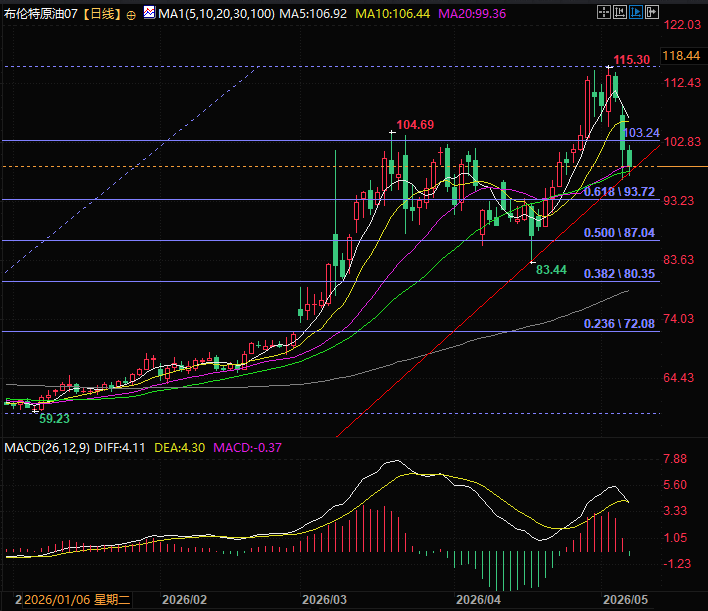
(Brent crude oil July daily chart, source: EasyForex)
At 17:20 Beijing time, Brent crude oil was trading at $99.15 per barrel.
According to the latest reports from Saudi media Alhadath, Al Arabiya, and Pakistani mediators, the US and Iran have reached an agreement on a core framework for "gradually opening the Strait of Hormuz in exchange for easing the maritime blockade."
With Pakistan's mediation, a "30-day negotiation memorandum" has surfaced, and a substantial breakthrough is expected in the situation of ships trapped in the strait in the coming hours.
The US and Iran have reached a preliminary consensus on easing the maritime blockade, and a geopolitical drama about survival, elections, and face is entering its final stage.
Breakthrough Consensus: Larak Corridor and Phased Opening Plan
Pakistani sources revealed that Trump has asked Iran to respond quickly to the US proposal, and Iran may submit a formal reply today through Pakistani mediators.
The core of this consensus is not complete peace, but a highly pragmatic exchange of resources: the United States eases its blockade of Iranian ports in exchange for Iran gradually reopening the Strait of Hormuz.
Iran has sent a clear signal that its Ports and Maritime Organization has begun providing fuel and medical assistance to more than a thousand ships stranded in the Strait of Hormuz.
More significantly, the Iranian Revolutionary Guard has designated a new shipping route called the "Larak Corridor," marking a shift from a "complete blockade" to "institutionalized control" of the strait—ships can pass safely as long as they comply with Iran's new regulations, avoid hostile lists, and may pay a certain "maintenance fee."
Trump's Election Strategy: The May Battle for Political Capital
The unusual "urgency" shown by US President Trump in the negotiations is underpinned by a cold, hard election logic.
May 2026 is a crucial month for the US midterm elections. On May 19, key swing states such as Pennsylvania and Georgia will hold intensive primaries, which are seen as an important indicator of the November general election.
For Trump, oil prices remaining above $100 for an extended period are "poison" for the Republican Party's election prospects.
He desperately needs to see news of a "breakthrough" in the Strait within the next few hours to drive down oil prices, thus providing Republican candidates with campaign ammunition as irrefutable proof of his "maximum pressure" victory.
More importantly, Trump plans to visit China in mid-May.
To avoid speaking about Middle Eastern energy security from the perspective of a "seeker of help," he must secure a "phase one agreement" before departing, transforming the Iranian issue from a diplomatic burden into political capital and cultivating an image of a "tough but able-to-reach" leader.
Iran's Existential Crisis: Oil Storage Limits and Economic Survival Funds
Although Iran claims that "dismantling nuclear facilities" is a harsh provocation, the reality of economic pressures makes it impossible for it to continue the blockade.
The United States imposed a comprehensive maritime blockade on Iranian ports starting April 13, causing Iran's crude oil exports to plummet from approximately 2.1 million barrels per day to 567,000 barrels per day, resulting in a daily loss of about $500 million in oil revenue.
Even more critical is the oil storage crisis. Data from the International Energy Agency, Kpler, shows that Iran's onshore oil reserves have increased to 49 million barrels, with only 12 to 22 days of production capacity remaining. It is expected to reach its physical limit by mid-May.
If Iran does not "sell oil to clear its inventory," it will face the heavy cost of permanently shutting down its oil wells, which would be a devastating blow to the Iranian economy, where oil revenue accounts for more than 60% of its fiscal revenue.
The easing of the blockade means that tens of millions of barrels of crude oil that have been stockpiled can be quickly converted into cash. This foreign exchange repatriation is a "lifeline" for the Iranian government, which is struggling under sanctions, to maintain domestic stability and is also a key bargaining chip to gain social support.
A Decent Step: The Political Art of Taking a Step Back
The current favorable outcome of the negotiations is essentially that both sides are seeking a "more attractive" exit mechanism.
In this "atypical ceasefire," there were no real winners or complete losers, only helpless choices made under the pressure of high war costs and imminent political pressure.
The US narrative can boast that "Iran's nuclear program has been constrained for a long time," even though in reality it may only mean the mothballing of some equipment, while claiming to have "successfully lifted the blockade of the Strait of Hormuz" to protect its military and economic interests in the Middle East.
Iran's narrative: It could claim to "end the illegal US blockade and establish a new order in the Straits," even if that means accepting stricter inspections, while strengthening its actual control over the Strait of Hormuz through the establishment of the "Laraq Corridor."
That "30-day negotiation memorandum" was the most brilliant buffer.
It did not resolve the fundamental contradiction between the nuclear program and sanctions, but it bought valuable time through a "phased liberalization."
Over the next 30 days, navigation in the strait may gradually resume, and oil prices will fall accordingly. The real "hard nut to crack" will be postponed until after the US presidential election in November, giving both sides some strategic breathing room.
Outlook: Overtime Matches and the Beginning of a New Order
The gates of the Strait of Hormuz are slowly opening, a testament to the helplessness and tacit understanding among all parties after careful calculation of their interests.
This "orderly retreat" will not be the end of the story, but the beginning of a new round of competition.
The Strait will gradually resume navigation, with stranded ships passing through the "Larac Corridor" in batches. Afterward, the US and Iran will engage in a tug-of-war over core issues such as restrictions on nuclear programs, the extent of sanctions lifting, and control of the Strait. The memorandum may be extended multiple times, resulting in a situation of "talks without a breakdown."
New rules of navigation may emerge in the Strait of Hormuz, with Iran's "institutionalized control" and the United States' "freedom of navigation" claims likely to coexist for a long time, making the strait a "barometer" of the power balance between the US and Iran.
Summary and Technical Analysis:
As the Pakistani mediators have stated, this is not a peace agreement, but rather an "agreement to avoid war."
Since neither side has significantly softened its negotiating terms and neither the US nor Iran has truly conceded defeat, under the pressure of reality, they have chosen to initiate an orderly withdrawal, under the cover of a memorandum, to save face for each other. The "new script" in the Strait of Hormuz has only just begun.
From a technical perspective, the Brent crude oil July contract broke below the 0.768 Fibonacci retracement level and found support near the 20- and 30-day moving averages, currently forming a short-term upward trend. In the short term, oil prices are expected to hold the upward trend line and rebound. If the trend line is broken, the upward trend may turn into range-bound trading.
(Brent crude oil July daily chart, source: EasyForex)
At 17:20 Beijing time, Brent crude oil was trading at $99.15 per barrel.
- Risk Warning and Disclaimer
- The market involves risk, and trading may not be suitable for all investors. This article is for reference only and does not constitute personal investment advice, nor does it take into account certain users’ specific investment objectives, financial situation, or other needs. Any investment decisions made based on this information are at your own risk.