Expectations of Japanese intervention and risks from UK local elections weighed on the pound, with GBP/JPY remaining range-bound at high levels.
2026-05-07 16:21:46
The British pound traded around 212.50 against the Japanese yen (GBP/JPY) during Thursday's European session, showing relatively stable movement. The exchange rate has recently been fluctuating between 210.50 and 214.20, with market sentiment clearly leaning towards caution.

Previously, the pound sterling rose to a high of around 216.60 against the yen, but subsequently fell rapidly due to market suspicions of intervention in the currency market by Tokyo. The market believes that Japanese authorities may continue to take measures to support the yen in the near future, thereby limiting further upside potential for GBP/JPY. The Japanese government's continued signals of intervention in the currency market have become a significant factor supporting the yen recently.
Japanese Finance Ministry official Takayama has repeatedly stated in May that the authorities will take "decisive action" against speculative activities in the foreign exchange market. Meanwhile, Japan's top foreign exchange official, Atsushi Mimura, reiterated on Thursday that the Japanese government has no restrictions on the frequency of intervention in the foreign exchange market and stated that it maintains daily communication with the United States. These statements are seen by the market as a verbal warning to speculative short-selling of the yen, keeping the market highly vigilant against yen short positions. Furthermore, the Bank of Japan's recent gradual release of hawkish policy signals has further strengthened market expectations for the yen's medium- to long-term stabilization.
On the other hand, uncertainty also exists in the UK. British voters are participating in elections for 136 local councils in England, as well as the Scottish and Welsh parliaments. The market widely expects the ruling Labour Party to suffer a significant setback in these local elections. If the results are confirmed, it could trigger renewed market concerns about the UK's political stability and fiscal prospects.
Uncertainty surrounding the UK local election results is weakening market risk appetite for the pound. In recent years, the UK's fiscal deficit, slowing economic growth, and high interest rate environment have already put pressure on the UK economy. If the market is concerned about potential changes in the UK government's future policy direction, the pound may face further pressure in the short term.
Meanwhile, global market risk sentiment has improved recently. Market optimism regarding a potential agreement between the US and Iran has somewhat reduced demand for the US dollar as a safe haven and improved sentiment towards global risk assets. However, due to significant uncertainty surrounding the Middle East situation, international funds remain cautious overall, which has limited the unilateral movement of the pound against the yen.
From a technical perspective, the GBP/JPY daily chart shows a significant pullback after reaching a high of around 216.60, and is currently consolidating at a relatively high level. The 212.00-212.50 area forms a key short-term support zone, while the area around 214.20 constitutes a critical resistance zone. The 214.20 area has become a crucial dividing line between bullish and bearish sentiment on the daily chart. A decisive break above 214.20 could lead to a retest of the 216.60 high, and potentially even a further rise to the 218.00 area. On the downside, the 210.50 area is the first major support level; a break below this level could lead to further declines towards 209.20 and 207.80. The daily MACD indicator has shown signs of a bearish crossover at a high level, with the green histogram expanding, indicating a weakening of medium-term upward momentum. The RSI indicator has fallen back to around 55, suggesting that the market has gradually returned to equilibrium from its previous extreme bullish state.
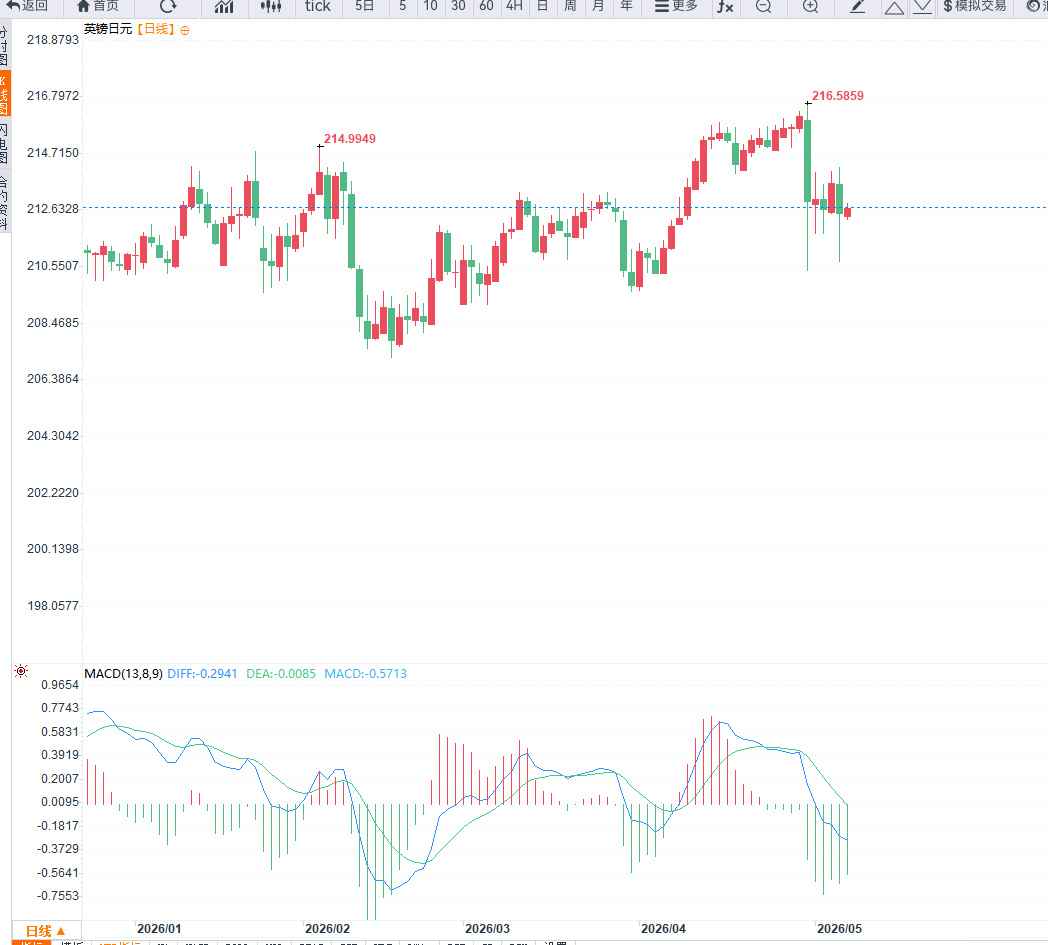
From a technical perspective, while the medium- to long-term trend of GBP/JPY remains bullish, it has entered a clear consolidation phase at higher levels in the short term. The daily chart shows that bullish momentum is beginning to slow, while the 4-hour chart reflects a lack of clear market direction.
Editor's Summary : The current GBP/JPY exchange rate is primarily influenced by both "expectations of Japanese intervention" and "political uncertainty in the UK." In the short term, the Japanese government's continued warnings of currency intervention have significantly strengthened market support for the yen, while the UK local elections have increased market concerns about the political and fiscal stability of the UK. From a technical perspective, GBP/JPY has shifted from a previous unilateral upward trend to a high-level consolidation phase, and future market volatility may continue to intensify. Investors should pay close attention to official Japanese intervention signals, the results of the UK local elections, and changes in global risk sentiment.
Previously, the pound sterling rose to a high of around 216.60 against the yen, but subsequently fell rapidly due to market suspicions of intervention in the currency market by Tokyo. The market believes that Japanese authorities may continue to take measures to support the yen in the near future, thereby limiting further upside potential for GBP/JPY. The Japanese government's continued signals of intervention in the currency market have become a significant factor supporting the yen recently.
Japanese Finance Ministry official Takayama has repeatedly stated in May that the authorities will take "decisive action" against speculative activities in the foreign exchange market. Meanwhile, Japan's top foreign exchange official, Atsushi Mimura, reiterated on Thursday that the Japanese government has no restrictions on the frequency of intervention in the foreign exchange market and stated that it maintains daily communication with the United States. These statements are seen by the market as a verbal warning to speculative short-selling of the yen, keeping the market highly vigilant against yen short positions. Furthermore, the Bank of Japan's recent gradual release of hawkish policy signals has further strengthened market expectations for the yen's medium- to long-term stabilization.
On the other hand, uncertainty also exists in the UK. British voters are participating in elections for 136 local councils in England, as well as the Scottish and Welsh parliaments. The market widely expects the ruling Labour Party to suffer a significant setback in these local elections. If the results are confirmed, it could trigger renewed market concerns about the UK's political stability and fiscal prospects.
Uncertainty surrounding the UK local election results is weakening market risk appetite for the pound. In recent years, the UK's fiscal deficit, slowing economic growth, and high interest rate environment have already put pressure on the UK economy. If the market is concerned about potential changes in the UK government's future policy direction, the pound may face further pressure in the short term.
Meanwhile, global market risk sentiment has improved recently. Market optimism regarding a potential agreement between the US and Iran has somewhat reduced demand for the US dollar as a safe haven and improved sentiment towards global risk assets. However, due to significant uncertainty surrounding the Middle East situation, international funds remain cautious overall, which has limited the unilateral movement of the pound against the yen.
From a technical perspective, the GBP/JPY daily chart shows a significant pullback after reaching a high of around 216.60, and is currently consolidating at a relatively high level. The 212.00-212.50 area forms a key short-term support zone, while the area around 214.20 constitutes a critical resistance zone. The 214.20 area has become a crucial dividing line between bullish and bearish sentiment on the daily chart. A decisive break above 214.20 could lead to a retest of the 216.60 high, and potentially even a further rise to the 218.00 area. On the downside, the 210.50 area is the first major support level; a break below this level could lead to further declines towards 209.20 and 207.80. The daily MACD indicator has shown signs of a bearish crossover at a high level, with the green histogram expanding, indicating a weakening of medium-term upward momentum. The RSI indicator has fallen back to around 55, suggesting that the market has gradually returned to equilibrium from its previous extreme bullish state.
From a technical perspective, while the medium- to long-term trend of GBP/JPY remains bullish, it has entered a clear consolidation phase at higher levels in the short term. The daily chart shows that bullish momentum is beginning to slow, while the 4-hour chart reflects a lack of clear market direction.
Editor's Summary : The current GBP/JPY exchange rate is primarily influenced by both "expectations of Japanese intervention" and "political uncertainty in the UK." In the short term, the Japanese government's continued warnings of currency intervention have significantly strengthened market support for the yen, while the UK local elections have increased market concerns about the political and fiscal stability of the UK. From a technical perspective, GBP/JPY has shifted from a previous unilateral upward trend to a high-level consolidation phase, and future market volatility may continue to intensify. Investors should pay close attention to official Japanese intervention signals, the results of the UK local elections, and changes in global risk sentiment.
- Risk Warning and Disclaimer
- The market involves risk, and trading may not be suitable for all investors. This article is for reference only and does not constitute personal investment advice, nor does it take into account certain users’ specific investment objectives, financial situation, or other needs. Any investment decisions made based on this information are at your own risk.