Key Game in US-Iran Negotiations: Core Differences Coexist with Hopes for Peace
2026-05-07 21:05:13
On Thursday (May 7), during the European and American trading sessions, international oil prices continued to decline, with Brent crude falling to around the 96 mark.
According to Iran's Tasnim News Agency, Iranian President Pezehiziyan said today (May 7) that he recently met with Iran's Supreme Leader Mojtaba Khamenei. The meeting was held in a cordial atmosphere and lasted for nearly two and a half hours, signifying that the negotiating team received authorization from the Supreme Leader of the Revolutionary Guard and that the leaders within Iran were united.
A Pakistani official said on the 7th that relevant Pakistani departments held a meeting in the capital Islamabad that day to prepare for possible negotiations between the United States and Iran, and even a signing ceremony for an agreement, to be held in Islamabad.
Another Pakistani source said that the Pakistani military, police and other relevant personnel also held a joint meeting that day in Rawalpindi, a city near the capital, to determine security measures for the possible US-Iran talks next week.
Currently, the ceasefire negotiations between the United States and Iran have entered a critical sprint stage, and the game between the two sides over core issues such as the end of the war, nuclear program control, and control of the Strait of Hormuz is becoming increasingly fierce.
Although Iran has not yet given a formal response to the latest US proposal, its leadership has sent a clear signal of opposition through public channels.
Iranian Parliament Foreign Policy and National Security Committee spokesman Ibrahim Rezaei bluntly stated that the proposal submitted by the United States "is more like a list of wishful demands than an actionable and realistic solution," pointing out that the proposal lacks reciprocity.
Iranian Parliament Speaker Mohammad Bagher Ghalibaf publicly mocked reports of an impending agreement on English-language social media, saying, "Talk is cheap, and the negotiations have failed," clearly expressing his dissatisfaction with the US demands.
However, according to a report from Tehran by journalist Rasul Serdar Atas, Iran is still conducting a comprehensive assessment of the US proposal and is expected to give a formal response through Pakistani mediators.
As the core mediator in the US-Iran negotiations, Pakistan played a key role in easing tensions.
Pakistan's Foreign Ministry made a clear statement on Thursday welcoming the news of a possible agreement between the US and Iran, while emphasizing in the statement that "as mediators, we will not lose the trust of both sides by leaking details," making it clear that no further details of the negotiations will be disclosed at this stage.
In fact, Pakistani Prime Minister Shahbaz had previously called the talks between the US and Iran, which were facilitated by Pakistan, a "historic development" and publicly stated his belief that the negotiations would soon translate into lasting peace, fully demonstrating the mediator's positive attitude in promoting consensus between the two sides.
This neutral and pragmatic mediation strategy has injected significant momentum into the stalled US-Iran negotiations.
Judging from Iran's official statements, its negotiating position and priorities have been clearly defined.
Journalist Rasul Serdar Atas pointed out that Iran has made it clear that "the core of the negotiations at this stage is to end the fighting on all fronts, not the nuclear program," and that ending the conflict is its top priority.
Tehran's core demands include three key points: first, to obtain direct security guarantees from the UN Security Council; second, to fully lift all sanctions imposed by the United States.
Third, the Strait of Hormuz will be reopened. Iran has made it clear that "if the above three goals are achieved, consultations on the nuclear program will be held in the second phase of negotiations," demonstrating a negotiation strategy of "addressing the immediate crisis first, and then discussing long-term issues."
On the nuclear issue, Iran has always maintained a tough stance and set "red lines that cannot be crossed".
Journalist Almiqdad Arrouhaid emphasized that Iranian leaders have repeatedly made it clear that "the nuclear enrichment program is non-negotiable," a position echoed by the head of the Atomic Energy Organization of Iran, who publicly stated that uranium enrichment is a legitimate right enjoyed by Iran under the Treaty on the Non-Proliferation of Nuclear Weapons and is not open to compromise.
Former U.S. Assistant Secretary of State Mark Kimmett also believes that the Trump administration's demand for Iran to completely halt uranium enrichment is unrealistic, stating that "Iran will certainly uphold its legitimate right to enrich uranium to 3.67%"—a standard explicitly permitted in the 2015 nuclear agreement.
It is noteworthy that Iran only gradually increased its enrichment level to 60% after the Trump administration withdrew from the agreement in 2018. It now possesses approximately 440 kilograms (970 pounds) of uranium material at this enrichment level, just one step away from the 90% weapons-grade level required to manufacture nuclear weapons.
Kimmit speculated that Trump's real intention might be to demand that Iran transfer its existing enriched uranium stockpile abroad. Possible compromises from Iran would include transferring it to a third country or diluting it to a non-weapons-grade level. However, Arrouhaid made it clear that Iran firmly refuses to hand over its existing enriched uranium stockpile.
This disagreement also echoes Israel's position. Israeli Prime Minister Netanyahu recently emphasized that the US and Israel have reached a consensus that all enriched uranium materials in Iran must be removed, and he has ordered the Israeli Defense Forces to prepare for all possible scenarios.
The sovereignty and navigation issues of the Strait of Hormuz have become another core point of contention in the US-Iran negotiations.
Arrouhaid pointed out that Iran is continuously strengthening its control over the strait, "establishing new rules and control mechanisms for all ships passing through this strategic waterway."
It is understood that Iran has initiated a temporary passage mechanism since the outbreak of the war, requiring passing ships to pay fees and settle accounts in non-US dollars. This model has been recognized by some countries.
Meanwhile, the US's Gulf allies, who suffered retaliatory attacks from Iran, continued to pressure for the unconditional resumption of navigation through the Strait of Hormuz.
Looking back at the background of the conflict, after the US and Israel launched a military strike against Iran on February 28, Iran immediately retaliated against the Gulf countries, with the main targets being US military facilities, which further heightened the tension in the Strait of Hormuz.
As a transportation route for one-fifth of the world's oil and gas supply, the safety of navigation through this strait directly affects the global energy landscape, making negotiations on this issue even more urgent.
Despite the fact that the core differences remain unresolved, Trump has repeatedly made high-profile claims that an agreement to end the war is on the horizon, but so far he has failed to deliver.
However, the situation has shown positive signs recently. On Thursday, it was reported that a Pakistani source and another person familiar with the mediation process revealed that the two sides are about to reach an agreement on a one-page memorandum that will formally declare the end of the conflict.
Sources say the agreement will trigger follow-up negotiations, with key issues including lifting the strait shipping blockade, rescinding US sanctions against Iran, and imposing restrictions on Iran's nuclear program.
Currently, the US and Iran still have irreconcilable differences on key issues such as nuclear program control and sovereignty over the Strait of Hormuz, and Israel's hardline stance has added uncertainty to the negotiations.
However, thanks to Pakistan's active mediation, the two sides were able to sit down and advance negotiations on the memorandum, laying the foundation for a glimmer of peace in the Middle East.
Iran's subsequent official response will be crucial to the development of the situation, and the world is watching closely to see if this negotiation, which affects the energy landscape and geopolitics, can achieve a substantial breakthrough.
From a technical perspective, looking at the entire upward cycle, Brent crude oil has fallen to the 0.618 percentile of this price increase, which means it has given back nearly 40% of the gains, with 96.40 acting as strong support.
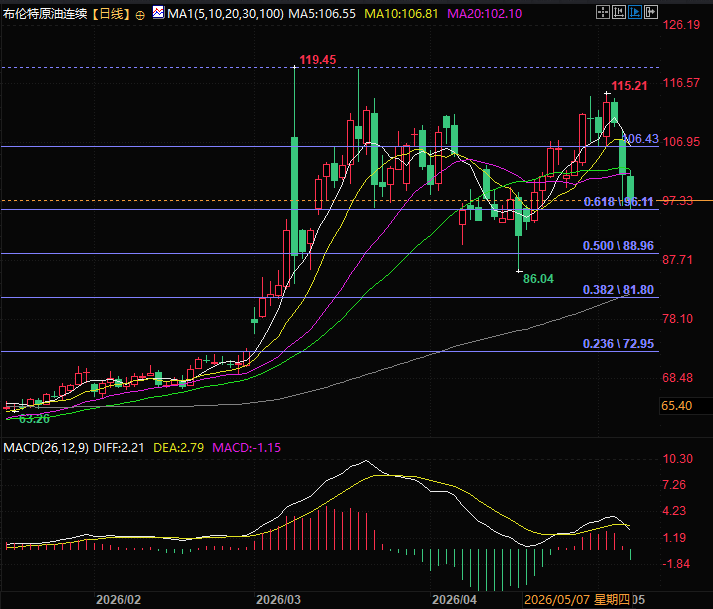
(Brent crude oil daily chart, source: EasyForex)
At 21:03 Beijing time, Brent crude oil was trading at $97.92 per barrel.
According to Iran's Tasnim News Agency, Iranian President Pezehiziyan said today (May 7) that he recently met with Iran's Supreme Leader Mojtaba Khamenei. The meeting was held in a cordial atmosphere and lasted for nearly two and a half hours, signifying that the negotiating team received authorization from the Supreme Leader of the Revolutionary Guard and that the leaders within Iran were united.
A Pakistani official said on the 7th that relevant Pakistani departments held a meeting in the capital Islamabad that day to prepare for possible negotiations between the United States and Iran, and even a signing ceremony for an agreement, to be held in Islamabad.
Another Pakistani source said that the Pakistani military, police and other relevant personnel also held a joint meeting that day in Rawalpindi, a city near the capital, to determine security measures for the possible US-Iran talks next week.
Negotiations have entered their final stage, with Iran publicly expressing its opposition.
Currently, the ceasefire negotiations between the United States and Iran have entered a critical sprint stage, and the game between the two sides over core issues such as the end of the war, nuclear program control, and control of the Strait of Hormuz is becoming increasingly fierce.
Although Iran has not yet given a formal response to the latest US proposal, its leadership has sent a clear signal of opposition through public channels.
Iranian Parliament Foreign Policy and National Security Committee spokesman Ibrahim Rezaei bluntly stated that the proposal submitted by the United States "is more like a list of wishful demands than an actionable and realistic solution," pointing out that the proposal lacks reciprocity.
Iranian Parliament Speaker Mohammad Bagher Ghalibaf publicly mocked reports of an impending agreement on English-language social media, saying, "Talk is cheap, and the negotiations have failed," clearly expressing his dissatisfaction with the US demands.
However, according to a report from Tehran by journalist Rasul Serdar Atas, Iran is still conducting a comprehensive assessment of the US proposal and is expected to give a formal response through Pakistani mediators.
Pakistan actively mediated, adhering to the principles of neutrality and confidentiality.
As the core mediator in the US-Iran negotiations, Pakistan played a key role in easing tensions.
Pakistan's Foreign Ministry made a clear statement on Thursday welcoming the news of a possible agreement between the US and Iran, while emphasizing in the statement that "as mediators, we will not lose the trust of both sides by leaking details," making it clear that no further details of the negotiations will be disclosed at this stage.
In fact, Pakistani Prime Minister Shahbaz had previously called the talks between the US and Iran, which were facilitated by Pakistan, a "historic development" and publicly stated his belief that the negotiations would soon translate into lasting peace, fully demonstrating the mediator's positive attitude in promoting consensus between the two sides.
This neutral and pragmatic mediation strategy has injected significant momentum into the stalled US-Iran negotiations.
Iran has made its negotiation priorities clear: a ceasefire comes first, and the nuclear issue will be postponed.
Judging from Iran's official statements, its negotiating position and priorities have been clearly defined.
Journalist Rasul Serdar Atas pointed out that Iran has made it clear that "the core of the negotiations at this stage is to end the fighting on all fronts, not the nuclear program," and that ending the conflict is its top priority.
Tehran's core demands include three key points: first, to obtain direct security guarantees from the UN Security Council; second, to fully lift all sanctions imposed by the United States.
Third, the Strait of Hormuz will be reopened. Iran has made it clear that "if the above three goals are achieved, consultations on the nuclear program will be held in the second phase of negotiations," demonstrating a negotiation strategy of "addressing the immediate crisis first, and then discussing long-term issues."
Nuclear dispute escalates: Iran draws red lines, US demands thwarted.
On the nuclear issue, Iran has always maintained a tough stance and set "red lines that cannot be crossed".
Journalist Almiqdad Arrouhaid emphasized that Iranian leaders have repeatedly made it clear that "the nuclear enrichment program is non-negotiable," a position echoed by the head of the Atomic Energy Organization of Iran, who publicly stated that uranium enrichment is a legitimate right enjoyed by Iran under the Treaty on the Non-Proliferation of Nuclear Weapons and is not open to compromise.
Former U.S. Assistant Secretary of State Mark Kimmett also believes that the Trump administration's demand for Iran to completely halt uranium enrichment is unrealistic, stating that "Iran will certainly uphold its legitimate right to enrich uranium to 3.67%"—a standard explicitly permitted in the 2015 nuclear agreement.
It is noteworthy that Iran only gradually increased its enrichment level to 60% after the Trump administration withdrew from the agreement in 2018. It now possesses approximately 440 kilograms (970 pounds) of uranium material at this enrichment level, just one step away from the 90% weapons-grade level required to manufacture nuclear weapons.
Kimmit speculated that Trump's real intention might be to demand that Iran transfer its existing enriched uranium stockpile abroad. Possible compromises from Iran would include transferring it to a third country or diluting it to a non-weapons-grade level. However, Arrouhaid made it clear that Iran firmly refuses to hand over its existing enriched uranium stockpile.
This disagreement also echoes Israel's position. Israeli Prime Minister Netanyahu recently emphasized that the US and Israel have reached a consensus that all enriched uranium materials in Iran must be removed, and he has ordered the Israeli Defense Forces to prepare for all possible scenarios.
The Strait of Hormuz Dispute: Conflict Between Sovereignty Control and Navigation Demands
The sovereignty and navigation issues of the Strait of Hormuz have become another core point of contention in the US-Iran negotiations.
Arrouhaid pointed out that Iran is continuously strengthening its control over the strait, "establishing new rules and control mechanisms for all ships passing through this strategic waterway."
It is understood that Iran has initiated a temporary passage mechanism since the outbreak of the war, requiring passing ships to pay fees and settle accounts in non-US dollars. This model has been recognized by some countries.
Meanwhile, the US's Gulf allies, who suffered retaliatory attacks from Iran, continued to pressure for the unconditional resumption of navigation through the Strait of Hormuz.
Looking back at the background of the conflict, after the US and Israel launched a military strike against Iran on February 28, Iran immediately retaliated against the Gulf countries, with the main targets being US military facilities, which further heightened the tension in the Strait of Hormuz.
As a transportation route for one-fifth of the world's oil and gas supply, the safety of navigation through this strait directly affects the global energy landscape, making negotiations on this issue even more urgent.
Is a glimmer of hope emerging in negotiations? A memorandum of understanding coexists with core disagreements.
Despite the fact that the core differences remain unresolved, Trump has repeatedly made high-profile claims that an agreement to end the war is on the horizon, but so far he has failed to deliver.
However, the situation has shown positive signs recently. On Thursday, it was reported that a Pakistani source and another person familiar with the mediation process revealed that the two sides are about to reach an agreement on a one-page memorandum that will formally declare the end of the conflict.
Sources say the agreement will trigger follow-up negotiations, with key issues including lifting the strait shipping blockade, rescinding US sanctions against Iran, and imposing restrictions on Iran's nuclear program.
Currently, the US and Iran still have irreconcilable differences on key issues such as nuclear program control and sovereignty over the Strait of Hormuz, and Israel's hardline stance has added uncertainty to the negotiations.
However, thanks to Pakistan's active mediation, the two sides were able to sit down and advance negotiations on the memorandum, laying the foundation for a glimmer of peace in the Middle East.
Iran's subsequent official response will be crucial to the development of the situation, and the world is watching closely to see if this negotiation, which affects the energy landscape and geopolitics, can achieve a substantial breakthrough.
From a technical perspective, looking at the entire upward cycle, Brent crude oil has fallen to the 0.618 percentile of this price increase, which means it has given back nearly 40% of the gains, with 96.40 acting as strong support.
(Brent crude oil daily chart, source: EasyForex)
At 21:03 Beijing time, Brent crude oil was trading at $97.92 per barrel.
- Risk Warning and Disclaimer
- The market involves risk, and trading may not be suitable for all investors. This article is for reference only and does not constitute personal investment advice, nor does it take into account certain users’ specific investment objectives, financial situation, or other needs. Any investment decisions made based on this information are at your own risk.