With the ceasefire easing, the US dollar index continues to decline and is expected to fall below the pre-war level of 97.5.
2026-05-07 20:44:22
Thursday (May 7) saw extremely volatile trading in the foreign exchange market over the past 24 hours during the European session. Continued easing of tensions in the Gulf region boosted risk appetite, leading to a sharp decline in the US dollar and gains in most emerging market currencies. Volatility in the currency markets intensified again in the afternoon.
With the nearly month-long ceasefire agreement between Washington and Tehran remaining in place, the US dollar weakened against major currencies, further cooling demand for safe-haven assets. Meanwhile, tanker traffic in the Strait of Hormuz is gradually returning to normal, geopolitical risks have subsided, and investors are beginning to more actively shift towards higher-risk assets.
The euro benefited from improved prospects for European energy supplies, leading to more optimistic market sentiment; the pound sterling continued its classic performance during periods of rising risk appetite, becoming a beneficiary of capital inflows. Both benefited from the decline in the dollar premium.
This morning, the foreign exchange market showed signs of stabilization, while the simultaneous rise in the stock market further indicated market expectations that the situation would continue to ease. There is growing speculation that President Trump hopes to finalize an agreement with Iran before the meeting between the Chinese and US leaders. Latest news indicates that Iran is considering the US proposal to reopen the Strait of Hormuz, while nuclear negotiations have been postponed to a later date. Trump reiterated his warning that a new round of military action would not be ruled out if negotiations break down, but his overall tone remained optimistic, suggesting the conflict could end within a week. Oil prices are currently hovering around $100 per barrel, but volatility remains high.
Technical Analysis: Support at $97.61 still needs to be monitored.
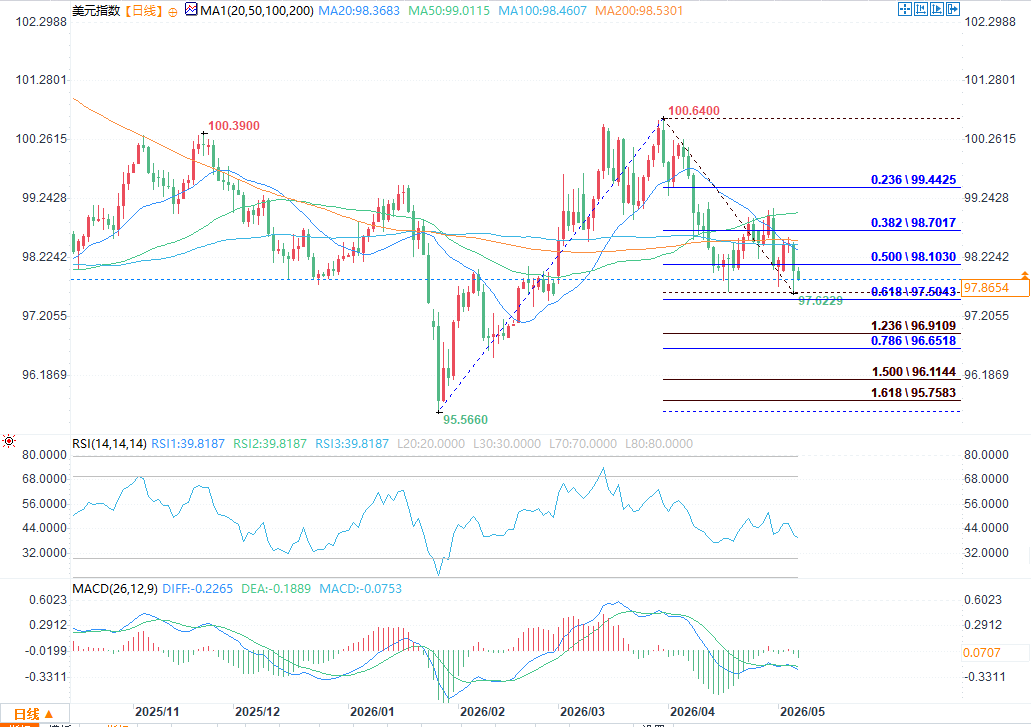
The US dollar index has broken below the 0.5 Fibonacci retracement level and the downtrend line of the previous upward wave on the daily chart, with moving averages forming a bearish alignment, confirming a weakening short-term trend. Currently, the price is oscillating around the 0.618 Fibonacci support level (around 97.58), with the RSI falling back into neutral-to-bearish territory and the MACD histogram expanding, indicating that bearish momentum has not yet fully dissipated. If the 97.58 support level is breached, the downside targets are 96.91 and 96.65 respectively; a rebound would require first recovering the resistance levels of 98.70 (0.382) and 99.44 (0.236) to potentially reverse the downward trend.
Stock Market Signals and Their Broader Market Implications
It is worth noting that the influence of the stock market on dollar-denominated currency pairs is increasing, and this logic still holds true. For some G10 currency pairs, including EUR/USD, the volatility of global stock markets has become greater than the impact of oil prices on exchange rates.
In other words, even if oil prices fluctuate further, a strong stock market performance remains a necessary condition for supporting the continued weakening of the US dollar. Considering the strong performance of risk assets and the current relative balance of market forces, even if oil prices remain significantly higher than in February, the probability of the DXY index falling back below the pre-war level of 97.50 is still quite considerable.
Analysts warn: Ceasefire agreement remains fragile
In the coming week, volatility will remain high as the foreign exchange market awaits the final outcome of the US-Iran agreement. Analysts generally warn that if negotiations fail to make substantial progress, the US dollar is quite likely to rebound to its previous levels, even without an escalation of military conflict. The ceasefire agreement only eliminates most, not all, of the risk of a sharp rise in the dollar—if the agreement collapses, the dollar's status as a safe-haven currency will quickly return.
Meanwhile, market focus is shifting to the upcoming US inflation data, which will provide clearer guidance for the Fed's policy path. The policy signals from the European Central Bank and the Bank of England may diverge further. The foreign exchange market under this background deserves close attention.
At 19:46 Beijing time, the US dollar index was at 97.9006/9123, down 0.12%.
With the nearly month-long ceasefire agreement between Washington and Tehran remaining in place, the US dollar weakened against major currencies, further cooling demand for safe-haven assets. Meanwhile, tanker traffic in the Strait of Hormuz is gradually returning to normal, geopolitical risks have subsided, and investors are beginning to more actively shift towards higher-risk assets.
The euro benefited from improved prospects for European energy supplies, leading to more optimistic market sentiment; the pound sterling continued its classic performance during periods of rising risk appetite, becoming a beneficiary of capital inflows. Both benefited from the decline in the dollar premium.
This morning, the foreign exchange market showed signs of stabilization, while the simultaneous rise in the stock market further indicated market expectations that the situation would continue to ease. There is growing speculation that President Trump hopes to finalize an agreement with Iran before the meeting between the Chinese and US leaders. Latest news indicates that Iran is considering the US proposal to reopen the Strait of Hormuz, while nuclear negotiations have been postponed to a later date. Trump reiterated his warning that a new round of military action would not be ruled out if negotiations break down, but his overall tone remained optimistic, suggesting the conflict could end within a week. Oil prices are currently hovering around $100 per barrel, but volatility remains high.
Technical Analysis: Support at $97.61 still needs to be monitored.
The US dollar index has broken below the 0.5 Fibonacci retracement level and the downtrend line of the previous upward wave on the daily chart, with moving averages forming a bearish alignment, confirming a weakening short-term trend. Currently, the price is oscillating around the 0.618 Fibonacci support level (around 97.58), with the RSI falling back into neutral-to-bearish territory and the MACD histogram expanding, indicating that bearish momentum has not yet fully dissipated. If the 97.58 support level is breached, the downside targets are 96.91 and 96.65 respectively; a rebound would require first recovering the resistance levels of 98.70 (0.382) and 99.44 (0.236) to potentially reverse the downward trend.
Stock Market Signals and Their Broader Market Implications
It is worth noting that the influence of the stock market on dollar-denominated currency pairs is increasing, and this logic still holds true. For some G10 currency pairs, including EUR/USD, the volatility of global stock markets has become greater than the impact of oil prices on exchange rates.
In other words, even if oil prices fluctuate further, a strong stock market performance remains a necessary condition for supporting the continued weakening of the US dollar. Considering the strong performance of risk assets and the current relative balance of market forces, even if oil prices remain significantly higher than in February, the probability of the DXY index falling back below the pre-war level of 97.50 is still quite considerable.
Analysts warn: Ceasefire agreement remains fragile
In the coming week, volatility will remain high as the foreign exchange market awaits the final outcome of the US-Iran agreement. Analysts generally warn that if negotiations fail to make substantial progress, the US dollar is quite likely to rebound to its previous levels, even without an escalation of military conflict. The ceasefire agreement only eliminates most, not all, of the risk of a sharp rise in the dollar—if the agreement collapses, the dollar's status as a safe-haven currency will quickly return.
Meanwhile, market focus is shifting to the upcoming US inflation data, which will provide clearer guidance for the Fed's policy path. The policy signals from the European Central Bank and the Bank of England may diverge further. The foreign exchange market under this background deserves close attention.
At 19:46 Beijing time, the US dollar index was at 97.9006/9123, down 0.12%.
- Risk Warning and Disclaimer
- The market involves risk, and trading may not be suitable for all investors. This article is for reference only and does not constitute personal investment advice, nor does it take into account certain users’ specific investment objectives, financial situation, or other needs. Any investment decisions made based on this information are at your own risk.