Gunfire erupts again in the Strait of Hormuz, yet oil prices remain stagnant?
2026-05-08 14:57:07
Oil prices remained volatile in European trading on Friday (May 8), with Brent crude trading around $100 per barrel. Renewed conflict between the US and Iran cast a shadow over the prospects for peace talks to end the ten-week war. Brent crude rose as much as 2.9% in early Asian trading, approaching $103 per barrel, before giving back some of its gains; WTI crude traded around $96. Despite the tense situation, Brent crude has still fallen by more than 6% this week.
I. The course of the firefight: The US stated it was "not seeking escalation."
U.S. Central Command said Thursday that the U.S. military struck targets inside Iran after Iran fired on three U.S. destroyers transiting the Strait of Hormuz. The U.S. stated that the three warships had safely sailed out of the strait undamaged and that it was "not seeking escalation" but remained prepared to protect U.S. forces. Trump added on social media, "If they don't sign an agreement soon, we will strike them harder and harder in the future."
II. Market Analysis: Oil Prices Swing Between "Diplomacy" and "Escalation"
"Oil prices are caught between two risks—diplomacy on one side and escalation on the other. The market is still giving peace proposals a chance, but not enough to completely eliminate the war premium," said a Saxo Bank strategist. The chief investment officer of Karobar Capital noted that the "relatively limited" oil price reaction indicates that the market currently still views the situation as "manageable"—a contrast to the significant repricing triggered by each escalation in the early stages of the conflict.
III. Trump: Ceasefire "remains in effect," no export restrictions required
Trump said Thursday night that the ceasefire with Iran remains in effect despite the exchange of fire. He also stated that there is no need to restrict U.S. crude oil or jet fuel exports because "we have a lot of oil."
IV. Regional Situation and Institutional Warnings
The UAE said on Friday that its air defense systems were intercepting missiles and drones. International Energy Agency Executive Director Fatih Birol warned that the war would cost the world 14 million barrels of oil per day, and that post-conflict production increases would be gradual. Bridgewater Associates founder Ray Dalio defined the outcome of the US-Iran conflict as "almost black and white – who will control the Strait of Hormuz."
The tug-of-war between the hope for peace and the premium of war continues.
The clashes between the US and Iran sent oil prices soaring, but the gains were relatively limited—the market still harbors a glimmer of hope for a peace agreement, though it's no longer as certain as before. Trump's contradictory signals—making tough statements while simultaneously claiming the ceasefire "remains effective"—have trapped oil prices in a tug-of-war between "diplomacy" and "escalation." In the short term, the actual passage through the Strait of Hormuz and any substantial progress in US-Iran negotiations will remain the core variables determining oil price direction.
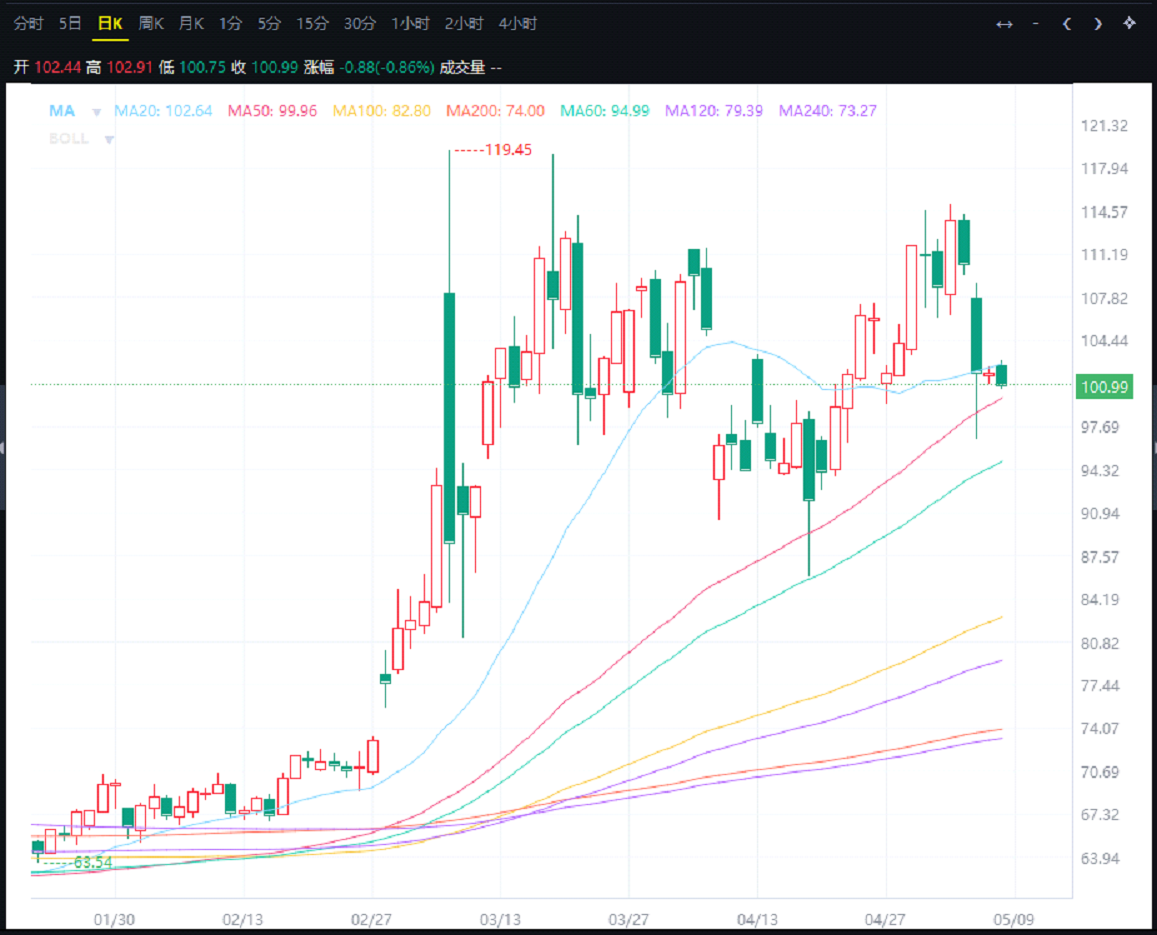
(Brent crude oil futures daily chart, source: FX678)
From a technical perspective, the current price of 100.99 is roughly in line with the 20-day moving average (MA20) at 102.64, indicating a sideways consolidation and suggesting an unclear short-term direction. The price is currently about $1.70 below the MA20, facing slight downward pressure in the short term.
In terms of medium-term moving averages, the 60-day moving average (MA60) is at $94.99, and the 50-day moving average (MA50) is at $99.96—the MA50 (99.96) is the first important support level below the current price. This moving average has been tested multiple times this year and has consistently provided effective support, making it technically significant.
The long-term moving averages MA100 (82.80) and MA200 (74.00) are far below the current price, indicating that the medium-to-long-term upward trend structure remains intact and has not yet been broken.
In a geopolitically driven market, oil prices could reverse at any time. With the weekend approaching and the non-farm payrolls data due tonight, while paying attention to the situation in Iran, we also need to be mindful of the increased uncertainty surrounding the Russia-Ukraine conflict. The Russian Ministry of Defense recently stated that Ukraine violated the ceasefire agreement, and Russian forces ceased fighting from midnight. However, Ukraine continued to launch attacks, and the Russian military responded in kind to the attacks.
At 14:55 Beijing time, Brent crude oil futures were trading at $100.70 per barrel.
I. The course of the firefight: The US stated it was "not seeking escalation."
U.S. Central Command said Thursday that the U.S. military struck targets inside Iran after Iran fired on three U.S. destroyers transiting the Strait of Hormuz. The U.S. stated that the three warships had safely sailed out of the strait undamaged and that it was "not seeking escalation" but remained prepared to protect U.S. forces. Trump added on social media, "If they don't sign an agreement soon, we will strike them harder and harder in the future."
II. Market Analysis: Oil Prices Swing Between "Diplomacy" and "Escalation"
"Oil prices are caught between two risks—diplomacy on one side and escalation on the other. The market is still giving peace proposals a chance, but not enough to completely eliminate the war premium," said a Saxo Bank strategist. The chief investment officer of Karobar Capital noted that the "relatively limited" oil price reaction indicates that the market currently still views the situation as "manageable"—a contrast to the significant repricing triggered by each escalation in the early stages of the conflict.
III. Trump: Ceasefire "remains in effect," no export restrictions required
Trump said Thursday night that the ceasefire with Iran remains in effect despite the exchange of fire. He also stated that there is no need to restrict U.S. crude oil or jet fuel exports because "we have a lot of oil."
IV. Regional Situation and Institutional Warnings
The UAE said on Friday that its air defense systems were intercepting missiles and drones. International Energy Agency Executive Director Fatih Birol warned that the war would cost the world 14 million barrels of oil per day, and that post-conflict production increases would be gradual. Bridgewater Associates founder Ray Dalio defined the outcome of the US-Iran conflict as "almost black and white – who will control the Strait of Hormuz."
The tug-of-war between the hope for peace and the premium of war continues.
The clashes between the US and Iran sent oil prices soaring, but the gains were relatively limited—the market still harbors a glimmer of hope for a peace agreement, though it's no longer as certain as before. Trump's contradictory signals—making tough statements while simultaneously claiming the ceasefire "remains effective"—have trapped oil prices in a tug-of-war between "diplomacy" and "escalation." In the short term, the actual passage through the Strait of Hormuz and any substantial progress in US-Iran negotiations will remain the core variables determining oil price direction.
(Brent crude oil futures daily chart, source: FX678)
From a technical perspective, the current price of 100.99 is roughly in line with the 20-day moving average (MA20) at 102.64, indicating a sideways consolidation and suggesting an unclear short-term direction. The price is currently about $1.70 below the MA20, facing slight downward pressure in the short term.
In terms of medium-term moving averages, the 60-day moving average (MA60) is at $94.99, and the 50-day moving average (MA50) is at $99.96—the MA50 (99.96) is the first important support level below the current price. This moving average has been tested multiple times this year and has consistently provided effective support, making it technically significant.
The long-term moving averages MA100 (82.80) and MA200 (74.00) are far below the current price, indicating that the medium-to-long-term upward trend structure remains intact and has not yet been broken.
In a geopolitically driven market, oil prices could reverse at any time. With the weekend approaching and the non-farm payrolls data due tonight, while paying attention to the situation in Iran, we also need to be mindful of the increased uncertainty surrounding the Russia-Ukraine conflict. The Russian Ministry of Defense recently stated that Ukraine violated the ceasefire agreement, and Russian forces ceased fighting from midnight. However, Ukraine continued to launch attacks, and the Russian military responded in kind to the attacks.
At 14:55 Beijing time, Brent crude oil futures were trading at $100.70 per barrel.
- Risk Warning and Disclaimer
- The market involves risk, and trading may not be suitable for all investors. This article is for reference only and does not constitute personal investment advice, nor does it take into account certain users’ specific investment objectives, financial situation, or other needs. Any investment decisions made based on this information are at your own risk.