Weak German data and volatile Middle East tensions kept the euro/dollar exchange rate hovering around 1.1750, awaiting guidance from the non-farm payrolls report.
2026-05-08 16:24:36
The euro rebounded slightly against the US dollar (EUR/USD) to around 1.1750 ahead of the European session on Friday, recovering some of its earlier losses. However, overall, EUR/USD has still failed to break out of the trading range formed over the past three weeks, with the 1.1800 area continuing to act as key technical resistance.

Recent sentiment in the foreign exchange market has been continuously influenced by the situation in the Middle East, expectations regarding Federal Reserve policy, and changes in economic data from Europe and the United States. Although the market had previously been optimistic that a ceasefire agreement might be reached between the United States and Iran, renewed military clashes near the Strait of Hormuz have reignited risk aversion in the market.
Market research indicates that the United States and Iran recently clashed near the Strait of Hormuz. US President Trump stated that the ceasefire agreement remains in effect and urged Iran to sign the relevant agreement as soon as possible.
Meanwhile, Iran is studying the 14-point agreement framework proposed by the United States, and the market is still awaiting further clarification of the situation. The volatile situation in the Middle East has suppressed market risk appetite, but safe-haven buying of the US dollar has not seen a full-blown surge. This has resulted in the EUR/USD pair, while lacking breakout momentum, maintaining its overall high-level consolidation structure.
Besides geopolitical factors, weak European economic data also limited the euro's gains. German industrial production data released on Friday showed that industrial production fell for the second consecutive month in March, significantly weaker than the market's previously expected rebound. Meanwhile, Germany's trade balance also fell short of market expectations.
While German exports saw some growth, imports increased significantly, leading to a narrowing of the overall trade surplus. This indicates that although domestic demand in Germany has improved somewhat, the manufacturing sector and external demand remain under pressure. Weak German economic data reflects the fragile recovery of the Eurozone's manufacturing sector. As Europe's largest economy, Germany's industrial and export performance is generally considered an important indicator of the Eurozone economy. Currently, the European economy is still affected by high interest rates, slowing global demand, and insufficient manufacturing activity, which is one of the key reasons why the euro has struggled to break through 1.18 recently.
However, the market did not experience a significant sell-off of the euro despite the weak German data, as investors were more focused on the upcoming US April non-farm payroll data. The market expects the US to add approximately 62,000 non-farm jobs in April, far below the previous figure of 178,000, indicating that the US job market may be beginning to slow. Meanwhile, the US unemployment rate is expected to remain around 4.3%.
If US employment data is significantly weak, it could strengthen market expectations for future interest rate cuts by the Federal Reserve, thereby suppressing the dollar and pushing EUR/USD to retest the area above 1.18. Another important focus for the market is the widening divergence within the Federal Reserve regarding the future path of interest rates. Some officials are concerned about slowing economic growth, while others remain focused on inflationary pressures.
Widening policy divergence within the Federal Reserve has led to market caution regarding the medium- to long-term outlook for the US dollar. This is a key reason why the dollar has recently lacked sustained upward momentum. At the Eurozone level, while the European Central Bank (ECB) has begun to signal some easing, core inflation remains relatively high, leading the market to believe that the ECB's rate cuts may be slow. This discrepancy between expectations of a potential Fed easing stance and a cautious ECB rate cut has also contributed to the euro's continued strength.
From a daily chart perspective, EUR/USD maintains a generally bullish range-bound structure. The exchange rate has tested the 1.1790-1.1800 area multiple times recently, but failed to break through effectively, indicating significant selling pressure in this area. Technically, the daily MACD remains above the zero line, but the red bars are shrinking, indicating weakening upward momentum. The RSI is currently around 56, suggesting a slightly bullish market sentiment. Regarding moving averages, the 5-day and 10-day moving averages are flattening, while the 20-day moving average continues to rise, indicating that the overall trend of EUR/USD has not yet turned bearish, but the market has entered a consolidation phase. 1.1800 has become the most crucial medium-term directional watershed for EUR/USD. If it can be effectively broken, the market may further test 1.1850 or even the year's high. However, if US employment data is stronger than expected, the US dollar may strengthen again, pushing EUR/USD back down.
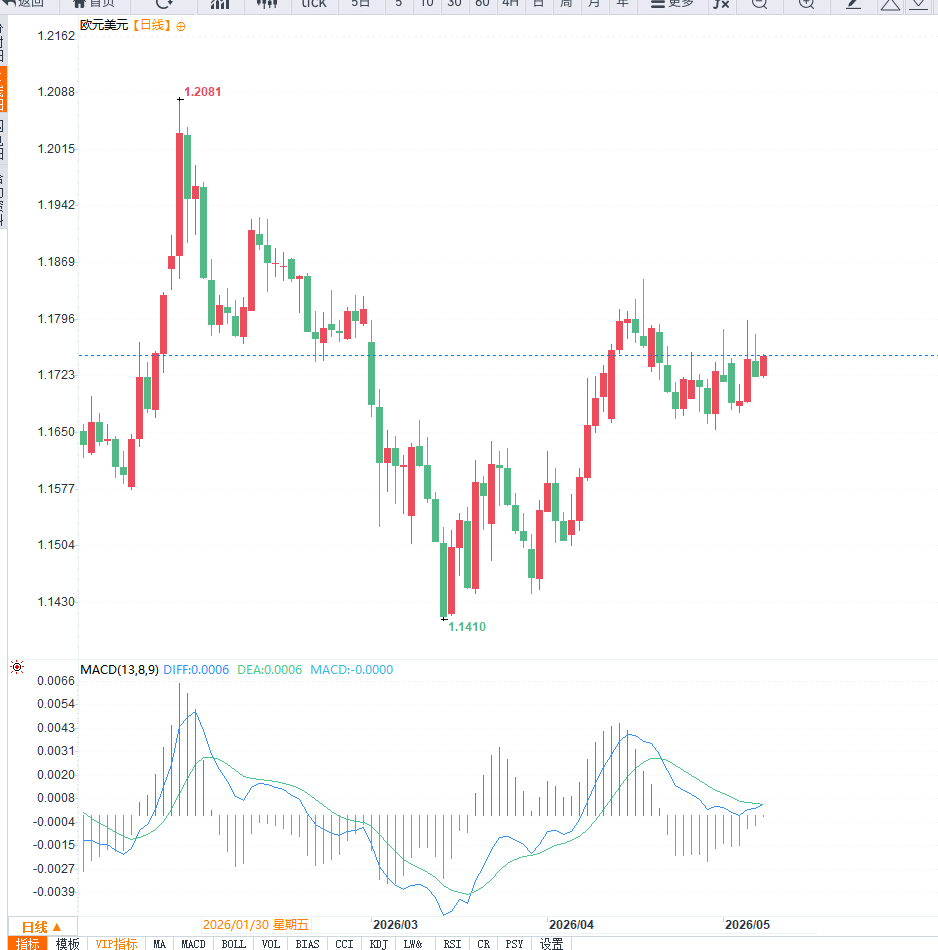
Editor's Summary : The euro/dollar exchange rate is currently maintaining a high-level consolidation structure. Although weak German economic data limits the euro's upside potential, market expectations of future interest rate cuts by the Federal Reserve continue to suppress the dollar's performance. From a technical perspective, the EUR/USD daily chart remains bullish, but the 1.1800 area presents significant technical resistance. If US employment data is weak in the future, the euro may retest its higher levels; conversely, if US data is strong, the exchange rate may retest the 1.17 or even lower support areas.
Recent sentiment in the foreign exchange market has been continuously influenced by the situation in the Middle East, expectations regarding Federal Reserve policy, and changes in economic data from Europe and the United States. Although the market had previously been optimistic that a ceasefire agreement might be reached between the United States and Iran, renewed military clashes near the Strait of Hormuz have reignited risk aversion in the market.
Market research indicates that the United States and Iran recently clashed near the Strait of Hormuz. US President Trump stated that the ceasefire agreement remains in effect and urged Iran to sign the relevant agreement as soon as possible.
Meanwhile, Iran is studying the 14-point agreement framework proposed by the United States, and the market is still awaiting further clarification of the situation. The volatile situation in the Middle East has suppressed market risk appetite, but safe-haven buying of the US dollar has not seen a full-blown surge. This has resulted in the EUR/USD pair, while lacking breakout momentum, maintaining its overall high-level consolidation structure.
Besides geopolitical factors, weak European economic data also limited the euro's gains. German industrial production data released on Friday showed that industrial production fell for the second consecutive month in March, significantly weaker than the market's previously expected rebound. Meanwhile, Germany's trade balance also fell short of market expectations.
While German exports saw some growth, imports increased significantly, leading to a narrowing of the overall trade surplus. This indicates that although domestic demand in Germany has improved somewhat, the manufacturing sector and external demand remain under pressure. Weak German economic data reflects the fragile recovery of the Eurozone's manufacturing sector. As Europe's largest economy, Germany's industrial and export performance is generally considered an important indicator of the Eurozone economy. Currently, the European economy is still affected by high interest rates, slowing global demand, and insufficient manufacturing activity, which is one of the key reasons why the euro has struggled to break through 1.18 recently.
However, the market did not experience a significant sell-off of the euro despite the weak German data, as investors were more focused on the upcoming US April non-farm payroll data. The market expects the US to add approximately 62,000 non-farm jobs in April, far below the previous figure of 178,000, indicating that the US job market may be beginning to slow. Meanwhile, the US unemployment rate is expected to remain around 4.3%.
If US employment data is significantly weak, it could strengthen market expectations for future interest rate cuts by the Federal Reserve, thereby suppressing the dollar and pushing EUR/USD to retest the area above 1.18. Another important focus for the market is the widening divergence within the Federal Reserve regarding the future path of interest rates. Some officials are concerned about slowing economic growth, while others remain focused on inflationary pressures.
Widening policy divergence within the Federal Reserve has led to market caution regarding the medium- to long-term outlook for the US dollar. This is a key reason why the dollar has recently lacked sustained upward momentum. At the Eurozone level, while the European Central Bank (ECB) has begun to signal some easing, core inflation remains relatively high, leading the market to believe that the ECB's rate cuts may be slow. This discrepancy between expectations of a potential Fed easing stance and a cautious ECB rate cut has also contributed to the euro's continued strength.
From a daily chart perspective, EUR/USD maintains a generally bullish range-bound structure. The exchange rate has tested the 1.1790-1.1800 area multiple times recently, but failed to break through effectively, indicating significant selling pressure in this area. Technically, the daily MACD remains above the zero line, but the red bars are shrinking, indicating weakening upward momentum. The RSI is currently around 56, suggesting a slightly bullish market sentiment. Regarding moving averages, the 5-day and 10-day moving averages are flattening, while the 20-day moving average continues to rise, indicating that the overall trend of EUR/USD has not yet turned bearish, but the market has entered a consolidation phase. 1.1800 has become the most crucial medium-term directional watershed for EUR/USD. If it can be effectively broken, the market may further test 1.1850 or even the year's high. However, if US employment data is stronger than expected, the US dollar may strengthen again, pushing EUR/USD back down.
Editor's Summary : The euro/dollar exchange rate is currently maintaining a high-level consolidation structure. Although weak German economic data limits the euro's upside potential, market expectations of future interest rate cuts by the Federal Reserve continue to suppress the dollar's performance. From a technical perspective, the EUR/USD daily chart remains bullish, but the 1.1800 area presents significant technical resistance. If US employment data is weak in the future, the euro may retest its higher levels; conversely, if US data is strong, the exchange rate may retest the 1.17 or even lower support areas.
- Risk Warning and Disclaimer
- The market involves risk, and trading may not be suitable for all investors. This article is for reference only and does not constitute personal investment advice, nor does it take into account certain users’ specific investment objectives, financial situation, or other needs. Any investment decisions made based on this information are at your own risk.