The US and Iran agreed to extend the ceasefire agreement reached in early April for 60 days, causing US crude oil prices to fall below $90 during trading.
2026-05-26 02:10:32
According to multiple media reports, the United States and Iran are close to reaching an agreement to extend the ceasefire that began in early April for another 60 days. The agreement is presented in the form of a "one-page memorandum," and the core framework has been "largely agreed upon."
According to the draft agreement, once formally signed, Iran will clear landmines from the Strait of Hormuz within 30 days, ensure free passage for all ships, and cease collecting transit fees. In exchange, the United States will gradually and in stages lift some sanctions on Iranian assets, allow Iran to resume oil exports, and create conditions for subsequent negotiations on the nuclear issue. The Iranian nuclear negotiations are expected to resume during the ceasefire extension period.
Sources say the agreement is expected to be approved by Iran's Supreme Leader Ayatollah Ali Khamenei. The two sides are still finalizing details through mediation channels such as Pakistan, and further announcements are expected by the end of this week or early next week. Market reaction was boosted by the prospect of an agreement, with international oil prices continuing to fall. West Texas Intermediate (WTI) crude fell to a three-week low, below $90 per barrel, a single-day drop of nearly 7%. Brent crude also fell sharply, with market optimism about a recovery in global energy supply dominating trading.
Supporters' Viewpoint
The Trump administration, some Republicans, and optimistic media outlets viewed the US-Iran Memorandum of Understanding (MoU) as a major victory for pragmatic diplomacy. The framework's key points include: extending the ceasefire for 60 days, Iran clearing mines from the Strait of Hormuz and fully opening the waterway (without tolls), the US providing some sanctions waivers and allowing Iran to sell oil, and unfreezing some assets. Core, thorny issues such as nuclear facilities and enriched uranium stockpiles will be addressed in detailed negotiations over the next 30-60 days.
Trump has repeatedly emphasized that he is "only signing good agreements" and that progress is "orderly and constructive," claiming that this move can end the conflict, alleviate the global energy crisis, stabilize oil prices, and create conditions for expanding the Abraham Accords. Supporters believe this fully reflects Trump's diplomatic philosophy of "strength brings peace," avoiding prolonged war and providing short-term breathing room for the Middle East. Positive market reactions further corroborate its potential economic benefits. Iran remains cautiously optimistic, emphasizing that several agreements have been reached, focusing on ending the multi-front war and safeguarding its sovereignty and economic interests.
Opposing viewpoints
Critics argue that the agreement makes too many concessions and carries extremely high potential risks, potentially rendering previous military gains futile. Republican hawks such as Ted Cruz and Lindsey Graham warn that if Iran retains its uranium enrichment capabilities, receives financial respite, and maintains de facto influence over the Strait, but fails to completely abandon its nuclear ambitions or resolve issues related to ballistic missiles and proxies, it would be a "catastrophic mistake." They worry that Iran will use this opportunity to rebuild its power, posing a long-term threat to regional stability and U.S. interests.
Democratic figures and some media outlets have pointed out that the details of the agreement remain vague, and points of contention (such as the nuclear verification mechanism and proxy conflicts) have not been resolved. It may simply be a repeat of the "pre-war status quo," and a hasty signing could lead to a recurrence of historical mistakes. Conservative commentators emphasize that unfreezing billions of dollars in Iranian assets in exchange for only limited concessions is tantamount to indirectly funding destabilizing forces in the region.
Israel and Iran's positions
Israel reacted most strongly, with Netanyahu and senior officials warning that the draft bill failed to completely dismantle the Iranian nuclear threat and resolve the issue of proxies such as Hezbollah in Lebanon, potentially allowing Iran to recover and threatening Israel's survival. Israel explicitly reserved its right to act independently, expressing concern that the US prioritized energy stability at the expense of its allies' core interests; some Israeli media outlets called it a "failure."
Iran, however, maintains a hardline stance, denying any agreement to immediately abandon uranium enrichment or make any significant unilateral concessions, emphasizing that any agreement must comprehensively end hostilities, lift the blockade, and guarantee sovereignty. Hardliners remain wary of negotiations, fearing excessive compromise. Overall, the divergence reflects a profound trade-off between short-term cessation of hostilities and long-term strategic deterrence. If an agreement is ultimately reached, the related disputes are expected to persist for a long time.
Technical Analysis
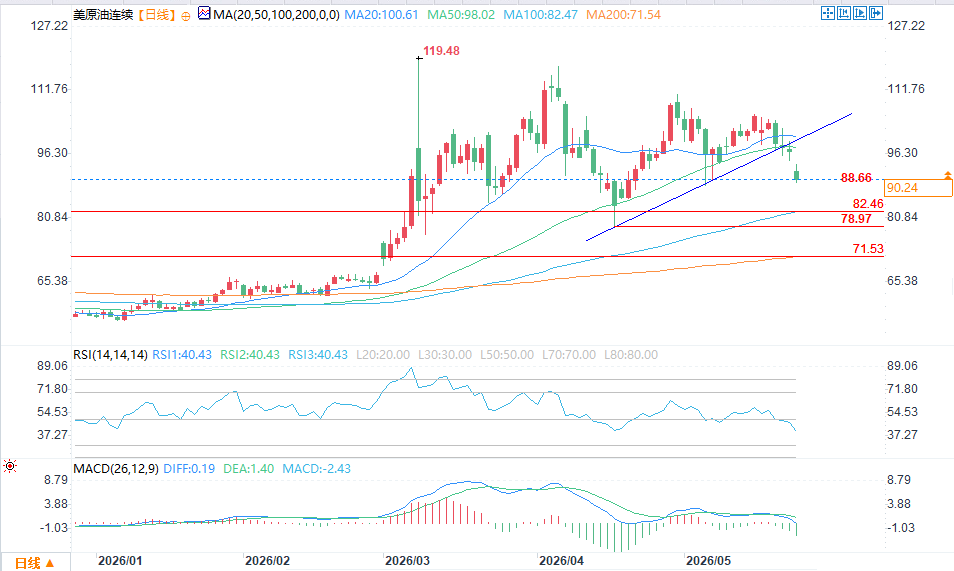
Currently, US crude oil has broken below both the short-term uptrend line and the 50-day moving average (MA50), a key level for determining medium-term strength or weakness. Medium-term bullish momentum has significantly weakened, and market sentiment has shifted from bullish to bearish. Whether it can regain and stabilize above the MA50 in the coming days will be a crucial signal for determining whether the trend has reversed.
The support levels below, in order of strength, are: 88.66 (previous low, key short-term defense line);
82.47 (MA100, plus horizontal support);
71.54 (MA200, a major long-term support level).
If the price breaks below 88.66, it will likely adjust further towards the 100-day moving average (MA100). A bullish counterattack requires two steps: first, recovering and stabilizing above the 50-day moving average (MA50), and second, breaking through the 20-day moving average (MA20) to return to a bullish alignment of short-term moving averages. If the rebound only touches the MA50 before encountering resistance and falling back, it is likely a continuation of the downtrend, and the bearish trend will continue to dominate.
Summarize
This potential agreement injects a degree of certainty into the turbulent Middle East situation, providing short-term support for lower oil prices and improved market risk appetite. However, its long-term effectiveness depends on progress in nuclear negotiations, the implementation of verification mechanisms, and the management of proxy conflicts in the region. We recommend continued monitoring of potential official confirmation over the weekend and the oil price's reaction around the MA50 level.
Once the Strait of Hormuz is successfully opened and free passage is restored, the global energy supply chain will improve significantly, tensions in the Middle East are expected to ease substantially, and oil price pressures will further subside. However, significant differences remain between the two sides on the final signing details, and the verification mechanism, timetable, and degree of concessions during implementation require close attention. The Trump administration faces strong pressure from domestic hawks and allies (especially Israel), while hardliners within Iran will also constrain its room for concessions. Nevertheless, a cautiously optimistic outlook can be maintained overall—achieving a "stop to the fighting" and restarting dialogue in the short term would be a rare and pragmatic step forward under the current circumstances.
According to the draft agreement, once formally signed, Iran will clear landmines from the Strait of Hormuz within 30 days, ensure free passage for all ships, and cease collecting transit fees. In exchange, the United States will gradually and in stages lift some sanctions on Iranian assets, allow Iran to resume oil exports, and create conditions for subsequent negotiations on the nuclear issue. The Iranian nuclear negotiations are expected to resume during the ceasefire extension period.
Sources say the agreement is expected to be approved by Iran's Supreme Leader Ayatollah Ali Khamenei. The two sides are still finalizing details through mediation channels such as Pakistan, and further announcements are expected by the end of this week or early next week. Market reaction was boosted by the prospect of an agreement, with international oil prices continuing to fall. West Texas Intermediate (WTI) crude fell to a three-week low, below $90 per barrel, a single-day drop of nearly 7%. Brent crude also fell sharply, with market optimism about a recovery in global energy supply dominating trading.
Supporters' Viewpoint
The Trump administration, some Republicans, and optimistic media outlets viewed the US-Iran Memorandum of Understanding (MoU) as a major victory for pragmatic diplomacy. The framework's key points include: extending the ceasefire for 60 days, Iran clearing mines from the Strait of Hormuz and fully opening the waterway (without tolls), the US providing some sanctions waivers and allowing Iran to sell oil, and unfreezing some assets. Core, thorny issues such as nuclear facilities and enriched uranium stockpiles will be addressed in detailed negotiations over the next 30-60 days.
Trump has repeatedly emphasized that he is "only signing good agreements" and that progress is "orderly and constructive," claiming that this move can end the conflict, alleviate the global energy crisis, stabilize oil prices, and create conditions for expanding the Abraham Accords. Supporters believe this fully reflects Trump's diplomatic philosophy of "strength brings peace," avoiding prolonged war and providing short-term breathing room for the Middle East. Positive market reactions further corroborate its potential economic benefits. Iran remains cautiously optimistic, emphasizing that several agreements have been reached, focusing on ending the multi-front war and safeguarding its sovereignty and economic interests.
Opposing viewpoints
Critics argue that the agreement makes too many concessions and carries extremely high potential risks, potentially rendering previous military gains futile. Republican hawks such as Ted Cruz and Lindsey Graham warn that if Iran retains its uranium enrichment capabilities, receives financial respite, and maintains de facto influence over the Strait, but fails to completely abandon its nuclear ambitions or resolve issues related to ballistic missiles and proxies, it would be a "catastrophic mistake." They worry that Iran will use this opportunity to rebuild its power, posing a long-term threat to regional stability and U.S. interests.
Democratic figures and some media outlets have pointed out that the details of the agreement remain vague, and points of contention (such as the nuclear verification mechanism and proxy conflicts) have not been resolved. It may simply be a repeat of the "pre-war status quo," and a hasty signing could lead to a recurrence of historical mistakes. Conservative commentators emphasize that unfreezing billions of dollars in Iranian assets in exchange for only limited concessions is tantamount to indirectly funding destabilizing forces in the region.
Israel and Iran's positions
Israel reacted most strongly, with Netanyahu and senior officials warning that the draft bill failed to completely dismantle the Iranian nuclear threat and resolve the issue of proxies such as Hezbollah in Lebanon, potentially allowing Iran to recover and threatening Israel's survival. Israel explicitly reserved its right to act independently, expressing concern that the US prioritized energy stability at the expense of its allies' core interests; some Israeli media outlets called it a "failure."
Iran, however, maintains a hardline stance, denying any agreement to immediately abandon uranium enrichment or make any significant unilateral concessions, emphasizing that any agreement must comprehensively end hostilities, lift the blockade, and guarantee sovereignty. Hardliners remain wary of negotiations, fearing excessive compromise. Overall, the divergence reflects a profound trade-off between short-term cessation of hostilities and long-term strategic deterrence. If an agreement is ultimately reached, the related disputes are expected to persist for a long time.
Technical Analysis
Currently, US crude oil has broken below both the short-term uptrend line and the 50-day moving average (MA50), a key level for determining medium-term strength or weakness. Medium-term bullish momentum has significantly weakened, and market sentiment has shifted from bullish to bearish. Whether it can regain and stabilize above the MA50 in the coming days will be a crucial signal for determining whether the trend has reversed.
The support levels below, in order of strength, are: 88.66 (previous low, key short-term defense line);
82.47 (MA100, plus horizontal support);
71.54 (MA200, a major long-term support level).
If the price breaks below 88.66, it will likely adjust further towards the 100-day moving average (MA100). A bullish counterattack requires two steps: first, recovering and stabilizing above the 50-day moving average (MA50), and second, breaking through the 20-day moving average (MA20) to return to a bullish alignment of short-term moving averages. If the rebound only touches the MA50 before encountering resistance and falling back, it is likely a continuation of the downtrend, and the bearish trend will continue to dominate.
Summarize
This potential agreement injects a degree of certainty into the turbulent Middle East situation, providing short-term support for lower oil prices and improved market risk appetite. However, its long-term effectiveness depends on progress in nuclear negotiations, the implementation of verification mechanisms, and the management of proxy conflicts in the region. We recommend continued monitoring of potential official confirmation over the weekend and the oil price's reaction around the MA50 level.
Once the Strait of Hormuz is successfully opened and free passage is restored, the global energy supply chain will improve significantly, tensions in the Middle East are expected to ease substantially, and oil price pressures will further subside. However, significant differences remain between the two sides on the final signing details, and the verification mechanism, timetable, and degree of concessions during implementation require close attention. The Trump administration faces strong pressure from domestic hawks and allies (especially Israel), while hardliners within Iran will also constrain its room for concessions. Nevertheless, a cautiously optimistic outlook can be maintained overall—achieving a "stop to the fighting" and restarting dialogue in the short term would be a rare and pragmatic step forward under the current circumstances.
- Risk Warning and Disclaimer
- The market involves risk, and trading may not be suitable for all investors. This article is for reference only and does not constitute personal investment advice, nor does it take into account certain users’ specific investment objectives, financial situation, or other needs. Any investment decisions made based on this information are at your own risk.