Gold surged 1% as expectations for a US-Iran reconciliation rose, putting pressure on both oil prices and the dollar.
2026-05-26 00:39:21
On Monday (May 25), during the US trading session, international gold prices (XAU/USD) saw a strong rebound, sweeping away the recent pullback. Market optimism regarding a peace agreement between the US and Iran surged, directly leading to a weakening dollar and a sharp drop in international oil prices. Gold, as a safe-haven asset and an inflation hedge, benefited simultaneously, with its price reaching approximately $4568.79 per ounce during the session, a daily increase of 1.38%.
The US-Iran negotiations released key signals, and market sentiment shifted across the board.
The core driver of this gold price rebound comes from multiple positive news items regarding the breakthrough progress in US-Iran peace talks. US President Trump publicly stated that negotiations with Iran are progressing in an "orderly and constructive manner," injecting strong confidence into the market.
According to multiple sources, the core terms of the potential agreement have emerged:
Extend the ceasefire agreement for 60 days to completely end the war in the Middle East;
Fully resume shipping in the Strait of Hormuz and lift the blockade of key waterways;
Lift the US maritime blockade of Iranian ports;
Negotiations related to Iran's nuclear program will continue, but will not be included in this round of agreements.
Iranian officials simultaneously released positive signals. Iranian Foreign Ministry spokesman Bagay stated that, with Pakistan's mediation, bilateral consultations had resolved most issues, and the overall negotiation process was progressing steadily. However, he also cautioned the market that a final agreement had not yet been reached, and many uncertainties remained. Trump also stated that there was "no need to rush into signing," indirectly confirming that both sides still needed to engage in in-depth negotiations on numerous details.
However, the market is not entirely optimistic. The report points out that serious differences remain between the two sides on two core issues: restrictions on Iran's nuclear program and the extent of sanctions lifting. Further negotiations are highly likely to encounter setbacks, which casts a shadow over the potential for a sustained rise in gold prices.
Chain reaction: Oil prices plummeted by more than 5%, and the US dollar index approached the 99 mark.
The expectation of a US-Iran reconciliation has directly triggered a chain reaction in the commodity and foreign exchange markets, completely changing the short-term operating rhythm of various assets:
International oil prices plummeted: WTI crude oil futures plunged more than 5% intraday, as the war premium accumulated in oil prices quickly faded due to the blockade of the Strait of Hormuz and the conflict in the Middle East.
The US dollar index continues to weaken: The US dollar index (DXY), which tracks the exchange rate of the US dollar against six major currencies, has fallen sharply, approaching the 99.00 mark. The weakening of the US dollar directly reduces the cost of holding gold, further boosting the price of gold.
The rationale for gold's rise: Cooling inflation expectations and weakening interest rate hike expectations.
Since the outbreak of the Middle East war in early 2026, gold has been under pressure for an extended period. The core reason is that soaring oil prices have pushed up global inflation expectations, and the market is generally concerned that the Federal Reserve will be forced to restart interest rate hikes to suppress inflation. As gold is a non-interest-bearing asset, its cost-effectiveness has decreased significantly in a high-interest-rate market environment, thus leading to a continued slump in its price.
Current CME FedWatch data shows that the market still expects a 40% probability of a 25 basis point rate hike at the Fed's December meeting, and this expectation has long suppressed the upside potential of gold prices.
However, the expectation of a US-Iran reconciliation completely reversed this negative logic: if the two sides formally reach an agreement and the Strait of Hormuz is fully opened to the outside world, the global oil supply shortage will be alleviated, the risk of energy-driven inflation will be significantly reduced, the necessity for the Federal Reserve to restart interest rate hikes will be greatly reduced, and the disadvantage of gold as a non-interest-bearing asset will be weakened, thereby supporting the strong rebound in gold prices in this round.
However, before the US-Iran negotiations are finalized and a formal written agreement is reached, the upside potential for gold prices will still be constrained by many factors, and short-term trends will remain highly dependent on the strength of the US dollar, oil price fluctuations, and changes in the Fed's interest rate hike expectations.
Solid long-term support: Central bank gold purchases and investment demand provide a safety net.
Despite increased short-term market volatility and intensified battles between bulls and bears, the long-term fundamentals supporting gold remain solid. The global de-dollarization process is progressing steadily, with central banks worldwide continuing to significantly increase their gold reserves to optimize their foreign exchange reserve structures. Simultaneously, global retail and institutional demand for gold investment remains robust, and gold ETF holdings are generally high. These dual positive factors effectively limit the possibility of a deep price correction.
Market Outlook: Focus on Negotiation Progress and PCE Inflation Data
In the short term, the market's core trading focus will continue to revolve around the latest developments in the US-Iran negotiations. Any breakthrough positive news or a stalemate or conflict in the negotiations will directly trigger sharp fluctuations in gold prices. In the latter half of this week, the market's trading focus will shift to the US May Personal Consumption Expenditures (PCE) inflation data. At the same time, several Federal Reserve officials will also make public speeches. Investors can glean the latest direction of the Federal Reserve's interest rate policy from these speeches to judge the medium- to long-term trend of gold prices.
Technical Analysis: The market is currently in a range-bound trading pattern; a break above the 100-day moving average is needed to open up further upside potential.
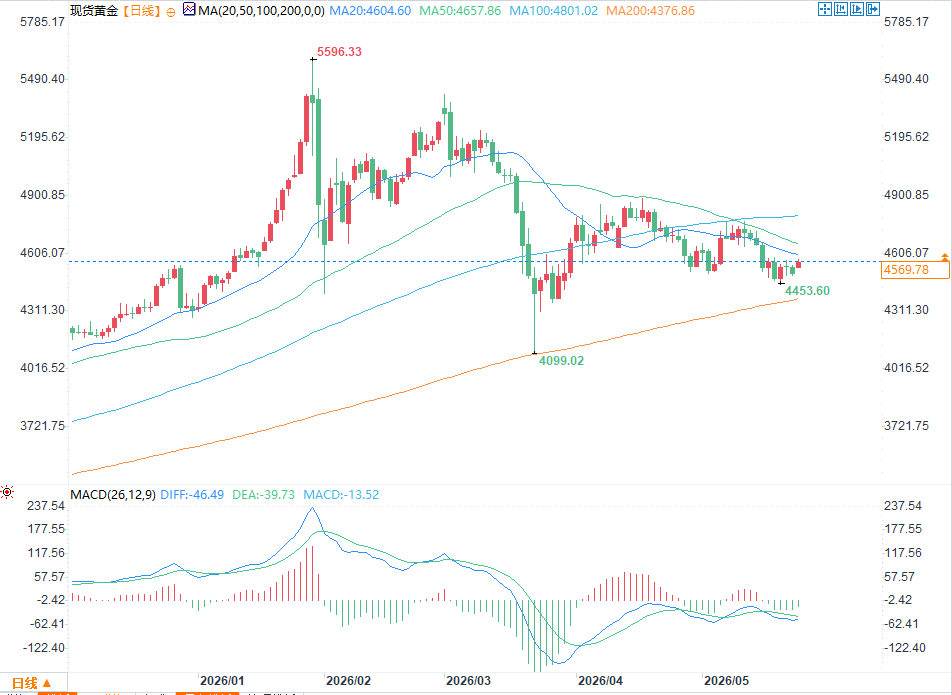
(Spot gold daily chart source: FX678)
From a technical perspective, international gold is currently in a wide-range fluctuation pattern, with clear distinctions between long-term support and short-term resistance.
Solid long-term support: Gold prices have remained above the 200-day moving average (approximately $4,381), and the fundamental structure of the medium- to long-term bull market has not been damaged, providing solid bottom protection for gold prices.
Strong short-term resistance: The 100-day moving average (around $4,800) forms a direct top resistance, and recent rebounds in gold prices have failed to achieve an effective breakthrough, indicating insufficient upward momentum for bulls in the short term;
Weak indicator signals: The daily RSI (Relative Strength Index) is around 44, which is in the neutral to weak range; the MACD indicator is running steadily below the zero axis, and the histogram has turned slightly green. All technical indicators reflect the lack of bullish power in the market, and the probability of maintaining a range-bound trend in the short term is the highest.
Key support and resistance levels
Support levels below: First support level at $4,500 (recent consolidation platform); strong support level at $4,381 (200-day moving average). If this key level is breached, gold prices will likely begin a deep correction.
Resistance levels: First resistance level is $4,800 (100-day moving average); strong resistance level is $5,000 (psychological level + previous high-volume trading area). If the bulls can effectively break through this range, gold may start a new round of upward movement.
The US-Iran negotiations released key signals, and market sentiment shifted across the board.
The core driver of this gold price rebound comes from multiple positive news items regarding the breakthrough progress in US-Iran peace talks. US President Trump publicly stated that negotiations with Iran are progressing in an "orderly and constructive manner," injecting strong confidence into the market.
According to multiple sources, the core terms of the potential agreement have emerged:
Extend the ceasefire agreement for 60 days to completely end the war in the Middle East;
Fully resume shipping in the Strait of Hormuz and lift the blockade of key waterways;
Lift the US maritime blockade of Iranian ports;
Negotiations related to Iran's nuclear program will continue, but will not be included in this round of agreements.
Iranian officials simultaneously released positive signals. Iranian Foreign Ministry spokesman Bagay stated that, with Pakistan's mediation, bilateral consultations had resolved most issues, and the overall negotiation process was progressing steadily. However, he also cautioned the market that a final agreement had not yet been reached, and many uncertainties remained. Trump also stated that there was "no need to rush into signing," indirectly confirming that both sides still needed to engage in in-depth negotiations on numerous details.
However, the market is not entirely optimistic. The report points out that serious differences remain between the two sides on two core issues: restrictions on Iran's nuclear program and the extent of sanctions lifting. Further negotiations are highly likely to encounter setbacks, which casts a shadow over the potential for a sustained rise in gold prices.
Chain reaction: Oil prices plummeted by more than 5%, and the US dollar index approached the 99 mark.
The expectation of a US-Iran reconciliation has directly triggered a chain reaction in the commodity and foreign exchange markets, completely changing the short-term operating rhythm of various assets:
International oil prices plummeted: WTI crude oil futures plunged more than 5% intraday, as the war premium accumulated in oil prices quickly faded due to the blockade of the Strait of Hormuz and the conflict in the Middle East.
The US dollar index continues to weaken: The US dollar index (DXY), which tracks the exchange rate of the US dollar against six major currencies, has fallen sharply, approaching the 99.00 mark. The weakening of the US dollar directly reduces the cost of holding gold, further boosting the price of gold.
The rationale for gold's rise: Cooling inflation expectations and weakening interest rate hike expectations.
Since the outbreak of the Middle East war in early 2026, gold has been under pressure for an extended period. The core reason is that soaring oil prices have pushed up global inflation expectations, and the market is generally concerned that the Federal Reserve will be forced to restart interest rate hikes to suppress inflation. As gold is a non-interest-bearing asset, its cost-effectiveness has decreased significantly in a high-interest-rate market environment, thus leading to a continued slump in its price.
Current CME FedWatch data shows that the market still expects a 40% probability of a 25 basis point rate hike at the Fed's December meeting, and this expectation has long suppressed the upside potential of gold prices.
However, the expectation of a US-Iran reconciliation completely reversed this negative logic: if the two sides formally reach an agreement and the Strait of Hormuz is fully opened to the outside world, the global oil supply shortage will be alleviated, the risk of energy-driven inflation will be significantly reduced, the necessity for the Federal Reserve to restart interest rate hikes will be greatly reduced, and the disadvantage of gold as a non-interest-bearing asset will be weakened, thereby supporting the strong rebound in gold prices in this round.
However, before the US-Iran negotiations are finalized and a formal written agreement is reached, the upside potential for gold prices will still be constrained by many factors, and short-term trends will remain highly dependent on the strength of the US dollar, oil price fluctuations, and changes in the Fed's interest rate hike expectations.
Solid long-term support: Central bank gold purchases and investment demand provide a safety net.
Despite increased short-term market volatility and intensified battles between bulls and bears, the long-term fundamentals supporting gold remain solid. The global de-dollarization process is progressing steadily, with central banks worldwide continuing to significantly increase their gold reserves to optimize their foreign exchange reserve structures. Simultaneously, global retail and institutional demand for gold investment remains robust, and gold ETF holdings are generally high. These dual positive factors effectively limit the possibility of a deep price correction.
Market Outlook: Focus on Negotiation Progress and PCE Inflation Data
In the short term, the market's core trading focus will continue to revolve around the latest developments in the US-Iran negotiations. Any breakthrough positive news or a stalemate or conflict in the negotiations will directly trigger sharp fluctuations in gold prices. In the latter half of this week, the market's trading focus will shift to the US May Personal Consumption Expenditures (PCE) inflation data. At the same time, several Federal Reserve officials will also make public speeches. Investors can glean the latest direction of the Federal Reserve's interest rate policy from these speeches to judge the medium- to long-term trend of gold prices.
Technical Analysis: The market is currently in a range-bound trading pattern; a break above the 100-day moving average is needed to open up further upside potential.
(Spot gold daily chart source: FX678)
From a technical perspective, international gold is currently in a wide-range fluctuation pattern, with clear distinctions between long-term support and short-term resistance.
Solid long-term support: Gold prices have remained above the 200-day moving average (approximately $4,381), and the fundamental structure of the medium- to long-term bull market has not been damaged, providing solid bottom protection for gold prices.
Strong short-term resistance: The 100-day moving average (around $4,800) forms a direct top resistance, and recent rebounds in gold prices have failed to achieve an effective breakthrough, indicating insufficient upward momentum for bulls in the short term;
Weak indicator signals: The daily RSI (Relative Strength Index) is around 44, which is in the neutral to weak range; the MACD indicator is running steadily below the zero axis, and the histogram has turned slightly green. All technical indicators reflect the lack of bullish power in the market, and the probability of maintaining a range-bound trend in the short term is the highest.
Key support and resistance levels
Support levels below: First support level at $4,500 (recent consolidation platform); strong support level at $4,381 (200-day moving average). If this key level is breached, gold prices will likely begin a deep correction.
Resistance levels: First resistance level is $4,800 (100-day moving average); strong resistance level is $5,000 (psychological level + previous high-volume trading area). If the bulls can effectively break through this range, gold may start a new round of upward movement.
- Risk Warning and Disclaimer
- The market involves risk, and trading may not be suitable for all investors. This article is for reference only and does not constitute personal investment advice, nor does it take into account certain users’ specific investment objectives, financial situation, or other needs. Any investment decisions made based on this information are at your own risk.