The dollar index paused its three-day winning streak, with internal policy disagreements within the Federal Reserve becoming the focus.
2026-06-04 10:02:14
On Thursday (June 4) during the Asian session, the US dollar index retreated slightly, trading around 99.45. As Israel and Lebanon agreed to implement a ceasefire agreement, expectations for a ceasefire in the Middle East rose, slightly weakening the safe-haven demand for the US dollar. Previously, due to concerns about the deteriorating situation in the Middle East and rising expectations of a Federal Reserve interest rate hike, the US dollar index recorded three consecutive days of gains, reaching a near two-month high.
After three consecutive days of gains, the US dollar is taking a breather, and investors are turning their attention to the policy disagreements within the Federal Reserve.
As the Federal Reserve's policy meeting approaches in mid-June, two Fed officials have sent drastically different policy signals. New York Fed President Williams believes the current policy is "just right," while Dallas Fed President Logan warns that a rate hike may be needed later this year to curb inflation.
New York Federal Reserve President Williams said on Wednesday that he expects the upside risks to inflation triggered by the Middle East conflict to be short-lived and reiterated that there is currently no need to adjust U.S. monetary policy.
In a media interview, Williams said, "I am not too worried at the moment about the price surge caused by the war, the continued impact of tariffs, and the dramatic secondary effects or persistent inflation caused by investments in artificial intelligence."
He stated that with a stable job market and no upward pressure on inflation, inflation expectations are "firmly anchored." Williams added that he believes the energy price increase is a "one-off effect" and does not expect energy prices to rise significantly next year or in 2028.
Williams reiterated that he believes the Fed's policy is "just right" and there is currently no need to raise or lower interest rates.
“I don’t see any clear reason why we should adjust interest rates, but I also don’t see a clear direction for future interest rate movements,” he said.
Williams also stated that although benchmark interest rates are close to neutral levels, the Fed's current policy stance remains slightly restrictive.
In contrast to Williams' dovish stance, Dallas Fed President Logan expressed a more hawkish view on Wednesday. She stated that strong economic growth and signs of "explosive" corporate earnings worried her, and that the Fed might need to raise interest rates this year to bring inflation back to its 2% target level.
In prepared remarks for a speech in El Paso, Texas, Logan said that financial conditions remain loose, and investment in artificial intelligence continues to boom and drive demand growth, but has not yet had the effect of curbing inflation through productivity gains.
She noted that while rising energy prices have had a particularly significant impact on low-income households, consumer spending remains strong. "These circumstances suggest that monetary policy has not yet constrained the economy," Logan said.
She also stated that inflation is rising, not only due to tariffs imposed last year and oil price increases caused by the Iran war this year, but also driven by other factors.
Logan believes that given the current high inflation, monetary policy is currently "neutral, or even slightly accommodative," which is not in line with the policy stance needed by the economy.
She stated that inflation is trending towards around 2.5%, but the Fed's goal is to bring it down to 2%. "To achieve that goal, we would need at least a slightly tighter policy to accomplish the task of suppressing inflation," Logan said. She further stated, "I am increasingly concerned that higher interest rates may be needed later this year to fully restore price stability and strike a proper balance between the Fed's dual mandate."
At the last Federal Reserve meeting, Logan was one of three dissenting officials who argued that the Fed should signal that the next policy step might be an interest rate hike, not just a rate cut.
The Federal Reserve is expected to keep the target range for its benchmark interest rate unchanged at 3.50%-3.75% at its policy meeting on June 16-17. Policymakers are still assessing the impact of the Middle East conflict on inflation and the uncertainty surrounding the near-term economic outlook.
Federal Reserve policymakers agree that the risks to the U.S. economy would be smaller if the Middle East conflict that has caused oil and other commodity prices to soar ended quickly.
Several policymakers have suggested that interest rate hikes may be necessary at some point in the future if price pressures persist. With inflation having exceeded the Federal Reserve's 2% target for several years, some officials worry that the latest shock could increase the risk of inflation expectations becoming unanchored. Policymakers are closely monitoring whether this will occur.
Although financial markets have already priced in the possibility of a rate hike at the Federal Reserve's December meeting, Williams said investors are forming their own monetary policy expectations based on the latest data.
The disagreement between Williams and Logan reflects differing assessments within the Federal Reserve regarding the sustainability of inflation and the policy path. Williams leans towards a wait-and-see approach, believing current interest rate levels are appropriate; Logan, however, warns of upside risks and does not rule out the possibility of further rate hikes. How this divergence will be resolved at the June meeting will be a key focus for the market.
The US dollar index has been rising steadily since its May low of 97.62, and is currently holding above all moving averages across the 20, 50, 100, and 200 timeframes. The medium-term moving averages are turning upwards and providing support. The MACD lines are above the zero line, and the red bars continue to show bullish momentum. The RSI is in a neutral to bullish range around 58, with no overbought divergence, indicating a strengthening technical trend.
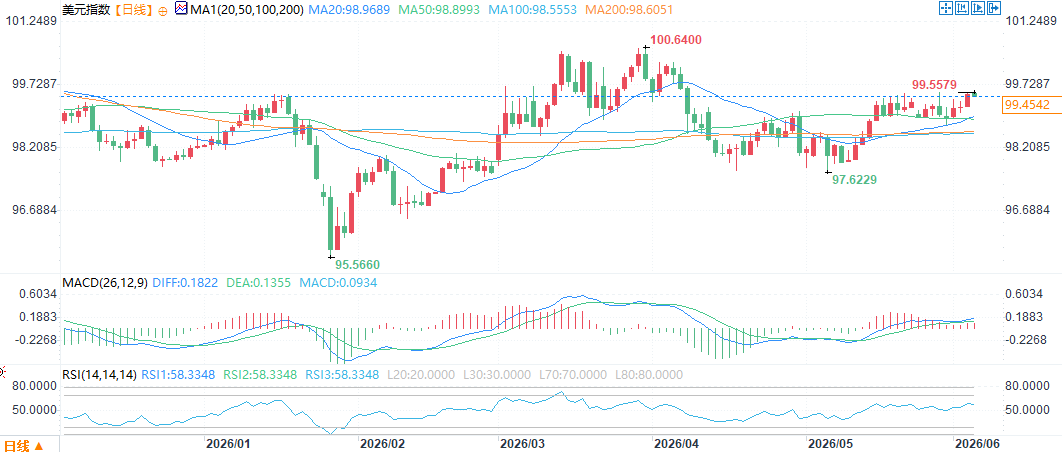
(US Dollar Index Daily Chart, Source: FX678)
Key resistance levels are at the previous high of 100.64 and the short-term high of 99.56, while dense support from moving averages lies around 98-99. The market is fluctuating at high levels due to the divergence between Fed officials. If the moving average support holds, it will continue to test the previous high. Only a significant pullback and a break below 97.6229 would break the current rebound structure.
At 10:00 Beijing time, the US dollar index was at 99.45.
After three consecutive days of gains, the US dollar is taking a breather, and investors are turning their attention to the policy disagreements within the Federal Reserve.
As the Federal Reserve's policy meeting approaches in mid-June, two Fed officials have sent drastically different policy signals. New York Fed President Williams believes the current policy is "just right," while Dallas Fed President Logan warns that a rate hike may be needed later this year to curb inflation.
Williams: Policy "just right," impact of Middle East conflict expected to be short-lived
New York Federal Reserve President Williams said on Wednesday that he expects the upside risks to inflation triggered by the Middle East conflict to be short-lived and reiterated that there is currently no need to adjust U.S. monetary policy.
In a media interview, Williams said, "I am not too worried at the moment about the price surge caused by the war, the continued impact of tariffs, and the dramatic secondary effects or persistent inflation caused by investments in artificial intelligence."
He stated that with a stable job market and no upward pressure on inflation, inflation expectations are "firmly anchored." Williams added that he believes the energy price increase is a "one-off effect" and does not expect energy prices to rise significantly next year or in 2028.
Williams reiterated that he believes the Fed's policy is "just right" and there is currently no need to raise or lower interest rates.
“I don’t see any clear reason why we should adjust interest rates, but I also don’t see a clear direction for future interest rate movements,” he said.
Williams also stated that although benchmark interest rates are close to neutral levels, the Fed's current policy stance remains slightly restrictive.
Logan: Monetary policy remains loose; interest rate hikes may be needed to curb inflation.
In contrast to Williams' dovish stance, Dallas Fed President Logan expressed a more hawkish view on Wednesday. She stated that strong economic growth and signs of "explosive" corporate earnings worried her, and that the Fed might need to raise interest rates this year to bring inflation back to its 2% target level.
In prepared remarks for a speech in El Paso, Texas, Logan said that financial conditions remain loose, and investment in artificial intelligence continues to boom and drive demand growth, but has not yet had the effect of curbing inflation through productivity gains.
She noted that while rising energy prices have had a particularly significant impact on low-income households, consumer spending remains strong. "These circumstances suggest that monetary policy has not yet constrained the economy," Logan said.
She also stated that inflation is rising, not only due to tariffs imposed last year and oil price increases caused by the Iran war this year, but also driven by other factors.
Logan believes that given the current high inflation, monetary policy is currently "neutral, or even slightly accommodative," which is not in line with the policy stance needed by the economy.
She stated that inflation is trending towards around 2.5%, but the Fed's goal is to bring it down to 2%. "To achieve that goal, we would need at least a slightly tighter policy to accomplish the task of suppressing inflation," Logan said. She further stated, "I am increasingly concerned that higher interest rates may be needed later this year to fully restore price stability and strike a proper balance between the Fed's dual mandate."
At the last Federal Reserve meeting, Logan was one of three dissenting officials who argued that the Fed should signal that the next policy step might be an interest rate hike, not just a rate cut.
Policy Background and Market Expectations
The Federal Reserve is expected to keep the target range for its benchmark interest rate unchanged at 3.50%-3.75% at its policy meeting on June 16-17. Policymakers are still assessing the impact of the Middle East conflict on inflation and the uncertainty surrounding the near-term economic outlook.
Federal Reserve policymakers agree that the risks to the U.S. economy would be smaller if the Middle East conflict that has caused oil and other commodity prices to soar ended quickly.
Several policymakers have suggested that interest rate hikes may be necessary at some point in the future if price pressures persist. With inflation having exceeded the Federal Reserve's 2% target for several years, some officials worry that the latest shock could increase the risk of inflation expectations becoming unanchored. Policymakers are closely monitoring whether this will occur.
Although financial markets have already priced in the possibility of a rate hike at the Federal Reserve's December meeting, Williams said investors are forming their own monetary policy expectations based on the latest data.
The disagreement between Williams and Logan reflects differing assessments within the Federal Reserve regarding the sustainability of inflation and the policy path. Williams leans towards a wait-and-see approach, believing current interest rate levels are appropriate; Logan, however, warns of upside risks and does not rule out the possibility of further rate hikes. How this divergence will be resolved at the June meeting will be a key focus for the market.
Technical Analysis of the US Dollar Index
The US dollar index has been rising steadily since its May low of 97.62, and is currently holding above all moving averages across the 20, 50, 100, and 200 timeframes. The medium-term moving averages are turning upwards and providing support. The MACD lines are above the zero line, and the red bars continue to show bullish momentum. The RSI is in a neutral to bullish range around 58, with no overbought divergence, indicating a strengthening technical trend.
(US Dollar Index Daily Chart, Source: FX678)
Key resistance levels are at the previous high of 100.64 and the short-term high of 99.56, while dense support from moving averages lies around 98-99. The market is fluctuating at high levels due to the divergence between Fed officials. If the moving average support holds, it will continue to test the previous high. Only a significant pullback and a break below 97.6229 would break the current rebound structure.
At 10:00 Beijing time, the US dollar index was at 99.45.
- Risk Warning and Disclaimer
- The market involves risk, and trading may not be suitable for all investors. This article is for reference only and does not constitute personal investment advice, nor does it take into account certain users’ specific investment objectives, financial situation, or other needs. Any investment decisions made based on this information are at your own risk.