Escalating Middle East tensions vs. Expectations of a Rate Hike by the Reserve Bank of New Zealand: Where will the New Zealand dollar go?
2026-06-04 17:01:57
On Thursday (June 4) during the European session, the New Zealand dollar rose slightly to around 0.5865 against the US dollar, potentially ending its three-day losing streak.
However, the upside potential for the New Zealand dollar may be limited, as renewed conflict in the Middle East has pushed up oil prices and dampened market risk appetite. Meanwhile, market focus is also on Friday's upcoming US non-farm payroll report for May.
Iranian Foreign Minister Araqchi stated on June 3rd, according to Iranian media reports, that negotiations on ending the war have not made "substantial progress." His remarks came amidst renewed missile and drone attacks between the US and Iran, further undermining efforts to reach an agreement. Araqchi also warned that any Israeli attack on Beirut "would lead to a full-scale resumption of the war." Signs that tensions in the Middle East may persist will boost demand for safe-haven currencies such as the US dollar in the short term, thus putting downward pressure on the New Zealand dollar.
According to media reports citing US officials, President Trump has privately told his staff that he would consider terminating the ceasefire agreement if Iran causes the deaths of US soldiers. However, the current pause in airstrikes remains unchanged. Trump's unwillingness to reignite the war suggests that he may be willing to tolerate sporadic clashes lasting for weeks or even months to avoid a wider war in the Middle East.
Amid escalating geopolitical risks, funds tend to flow into traditional safe-haven assets such as the US dollar. The US dollar index thus benefits, putting pressure on most non-US currencies, including the New Zealand dollar.
Reserve Bank of New Zealand Governor Brehman said last week that the official cash rate could be raised sooner and by a larger margin than previously signaled, citing factors including Middle East conflict-driven inflation, slowing growth, and rising input costs for New Zealand and its trading partners. These factors collectively underscore the urgency for the central bank to tighten policy.
The market has repriced the New Zealand interest rate outlook, with traders now expecting multiple rate hikes by early 2027. The Reserve Bank of New Zealand's hawkish stance provides support for the New Zealand dollar through interest rate differentials, policy divergence, and self-reinforcing expectations.
However, the evolution of the situation in the Middle East remains a key external variable. If geopolitical risks worsen further, risk aversion may outweigh the interest rate advantage and limit the New Zealand dollar's gains.
Investors are awaiting Friday's release of the U.S. May non-farm payrolls report, which will be a key clue for the market to judge the Federal Reserve's policy path. The previously released ADP employment data was better than expected, setting a positive tone for this non-farm payrolls report, but the market still needs to see official data to confirm the true state of the labor market.
If Friday's non-farm payroll data is strong—for example, with job growth significantly exceeding the expected 185,000, or wage growth unexpectedly rising—it will further strengthen market expectations that the Federal Reserve will maintain high interest rates or even raise rates this year. This will put downward pressure on the New Zealand dollar through two channels: first, the US dollar index will strengthen along with hawkish expectations, directly depressing the New Zealand dollar against the US dollar; second, risk appetite may be dampened by tightening expectations, and the New Zealand dollar, as a commodity currency, will also be under pressure.
Conversely, if the non-farm payroll data falls short of expectations, or the previous figure is revised downwards, it could temporarily alleviate market concerns about further tightening by the Federal Reserve. This would provide the New Zealand dollar with breathing room, allowing it to benefit more fully from the Reserve Bank of New Zealand's own hawkish stance. At that point, the New Zealand dollar could potentially test the 0.5900 level against the US dollar.
The New Zealand dollar has rebounded from its March low of 0.5679 against the US dollar on the daily chart. Currently, the exchange rate is trading around 0.5865, close to the 50-day moving average (MA50) and holding above the 200-day moving average (MA200). In the short term, it is facing resistance at the MA20 (0.5897) and the previous high of 0.5993. The price is consolidating within a range of 0.5679-0.5993. A break above 0.5993 would open up further upside potential, while a break below 0.5850 would lead to a retest of recent lows.
The MACD lines are closely aligned with the zero line, with a slight short green bar appearing, indicating a near balance between bullish and bearish momentum. The RSI is in the neutral range of 47.46, with no overbought or oversold signals, suggesting a continuation of the range-bound trading pattern in the short term. There is no clear directional trend yet, and we await a price breakout from the edge of the trading range to confirm the subsequent trend.
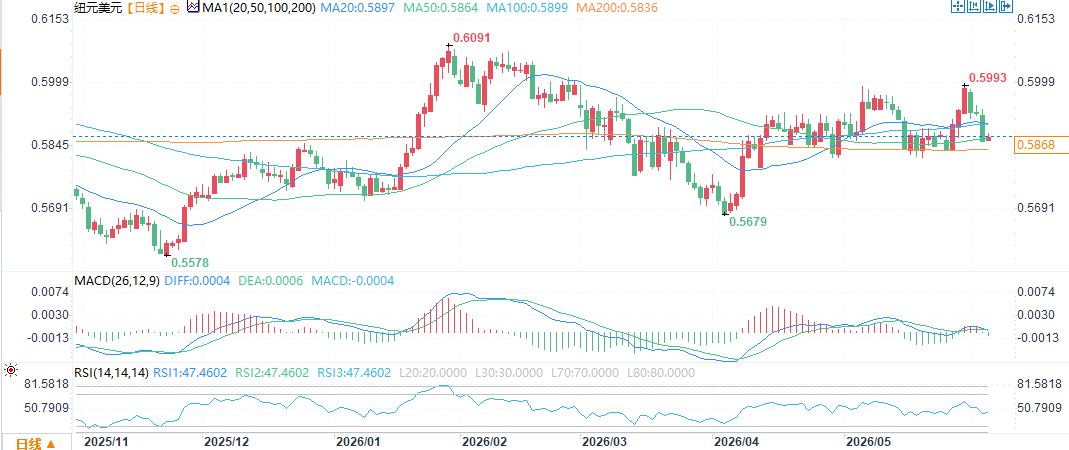
(NZD/USD daily chart, source: FX678)
At 16:54 Beijing time on June 4, the New Zealand dollar was trading at 0.5863/64 against the US dollar.
However, the upside potential for the New Zealand dollar may be limited, as renewed conflict in the Middle East has pushed up oil prices and dampened market risk appetite. Meanwhile, market focus is also on Friday's upcoming US non-farm payroll report for May.
Tensions in the Middle East persist, and safe-haven demand supports the US dollar.
Iranian Foreign Minister Araqchi stated on June 3rd, according to Iranian media reports, that negotiations on ending the war have not made "substantial progress." His remarks came amidst renewed missile and drone attacks between the US and Iran, further undermining efforts to reach an agreement. Araqchi also warned that any Israeli attack on Beirut "would lead to a full-scale resumption of the war." Signs that tensions in the Middle East may persist will boost demand for safe-haven currencies such as the US dollar in the short term, thus putting downward pressure on the New Zealand dollar.
According to media reports citing US officials, President Trump has privately told his staff that he would consider terminating the ceasefire agreement if Iran causes the deaths of US soldiers. However, the current pause in airstrikes remains unchanged. Trump's unwillingness to reignite the war suggests that he may be willing to tolerate sporadic clashes lasting for weeks or even months to avoid a wider war in the Middle East.
Amid escalating geopolitical risks, funds tend to flow into traditional safe-haven assets such as the US dollar. The US dollar index thus benefits, putting pressure on most non-US currencies, including the New Zealand dollar.
The Reserve Bank of New Zealand's hawkish stance provides support for the New Zealand dollar.
Reserve Bank of New Zealand Governor Brehman said last week that the official cash rate could be raised sooner and by a larger margin than previously signaled, citing factors including Middle East conflict-driven inflation, slowing growth, and rising input costs for New Zealand and its trading partners. These factors collectively underscore the urgency for the central bank to tighten policy.
The market has repriced the New Zealand interest rate outlook, with traders now expecting multiple rate hikes by early 2027. The Reserve Bank of New Zealand's hawkish stance provides support for the New Zealand dollar through interest rate differentials, policy divergence, and self-reinforcing expectations.
However, the evolution of the situation in the Middle East remains a key external variable. If geopolitical risks worsen further, risk aversion may outweigh the interest rate advantage and limit the New Zealand dollar's gains.
Market focus shifts to US non-farm payroll data
Investors are awaiting Friday's release of the U.S. May non-farm payrolls report, which will be a key clue for the market to judge the Federal Reserve's policy path. The previously released ADP employment data was better than expected, setting a positive tone for this non-farm payrolls report, but the market still needs to see official data to confirm the true state of the labor market.
If Friday's non-farm payroll data is strong—for example, with job growth significantly exceeding the expected 185,000, or wage growth unexpectedly rising—it will further strengthen market expectations that the Federal Reserve will maintain high interest rates or even raise rates this year. This will put downward pressure on the New Zealand dollar through two channels: first, the US dollar index will strengthen along with hawkish expectations, directly depressing the New Zealand dollar against the US dollar; second, risk appetite may be dampened by tightening expectations, and the New Zealand dollar, as a commodity currency, will also be under pressure.
Conversely, if the non-farm payroll data falls short of expectations, or the previous figure is revised downwards, it could temporarily alleviate market concerns about further tightening by the Federal Reserve. This would provide the New Zealand dollar with breathing room, allowing it to benefit more fully from the Reserve Bank of New Zealand's own hawkish stance. At that point, the New Zealand dollar could potentially test the 0.5900 level against the US dollar.
Technical Analysis
The New Zealand dollar has rebounded from its March low of 0.5679 against the US dollar on the daily chart. Currently, the exchange rate is trading around 0.5865, close to the 50-day moving average (MA50) and holding above the 200-day moving average (MA200). In the short term, it is facing resistance at the MA20 (0.5897) and the previous high of 0.5993. The price is consolidating within a range of 0.5679-0.5993. A break above 0.5993 would open up further upside potential, while a break below 0.5850 would lead to a retest of recent lows.
The MACD lines are closely aligned with the zero line, with a slight short green bar appearing, indicating a near balance between bullish and bearish momentum. The RSI is in the neutral range of 47.46, with no overbought or oversold signals, suggesting a continuation of the range-bound trading pattern in the short term. There is no clear directional trend yet, and we await a price breakout from the edge of the trading range to confirm the subsequent trend.
(NZD/USD daily chart, source: FX678)
At 16:54 Beijing time on June 4, the New Zealand dollar was trading at 0.5863/64 against the US dollar.
- Risk Warning and Disclaimer
- The market involves risk, and trading may not be suitable for all investors. This article is for reference only and does not constitute personal investment advice, nor does it take into account certain users’ specific investment objectives, financial situation, or other needs. Any investment decisions made based on this information are at your own risk.