The real variable behind the euro holding above 1.16 is not the decline in retail sales.
2026-06-04 17:56:57
On Thursday, the euro traded around 1.1622 against the dollar during the European session, rebounding from its intraday low. Overall, the core issue for the euro/dollar pair is not a one-sided trend, but rather the simultaneous pressure from three factors: cooling European consumption data, rising inflation, and persistent policy interest rate differentials.
The latest data shows that Eurozone retail sales fell 0.4% month-on-month in April, weaker than market expectations, while March's figure was revised from a weak reading to a 0.8% increase. Year-on-year, April retail sales still grew by 1.0%. The impact of this data on the euro against the dollar cannot be viewed solely in terms of a negative value. While the April decline was somewhat technical after the high base in March, the structural signals it releases are more noteworthy.
The breakdown shows that in April, sales of food, beverages, and tobacco increased by 0.9% month-on-month, while non-food sales decreased by 0.9%, and sales of motor fuel at specialty stores decreased by 2.7%. This indicates that household consumption has not collapsed across the board, but rather has shifted from discretionary spending and fuel consumption to more defensive necessities. For traders, this structural divergence is more important than the overall volume, because it shows that the demand side is absorbing the energy price shock, but consumer resilience has not completely disappeared.
Eurozone harmonized inflation rose to 3.2% in May, up from 3.0% in April; energy inflation was 10.9%, services inflation rose to 3.5% from 3.0%, and the figure excluding energy, food, alcohol, and tobacco rose to 2.5%. This data has two implications for exchange rates: on the one hand, rising inflationary pressures erode real income, constraining consumption; on the other hand, it also increases the need for the European Central Bank to maintain a tighter policy stance.
The European Central Bank's current deposit facility rate is 2.00%, its main refinancing rate is 2.15%, and its marginal lending facility rate is 2.40%; the Federal Reserve's target range for the federal funds rate remains at 3.50% to 3.75%. The nominal policy rate differential still favors the dollar, but the marginal variable on the euro side has shifted from "expectations of rate cuts" to "whether further tightening is needed." This is one of the reasons why the euro did not significantly fall below 1.16 against the dollar despite weak retail data.
The Eurozone's GDP grew by only 0.1% quarter-on-quarter and 0.8% year-on-year in the first quarter, with employment also increasing by 0.1% quarter-on-quarter. The unemployment rate in April was 6.3%, unchanged from March and the same period last year, with approximately 11.075 million unemployed. While growth is weak, the employment situation has not yet deteriorated significantly, leaving the Eurozone in an uncomfortable range for its exchange rate: growth is insufficient to support a strong euro, while inflation is insufficient to warrant a full shift to easing policies.
This combination typically compresses the certainty of trend trading. For the euro to break free from the tug-of-war around 1.16 against the dollar, a clearer direction from the fundamentals is needed: either subsequent consumption and services data must prove that demand can still support higher prices, or a decline in inflation will reopen the narrative of policy easing. Current data suggests more of a "slower growth, firmer prices" scenario, which will increase the exchange rate's sensitivity to individual data points and central bank statements.
From the daily chart, the euro/dollar pair is currently trading around 1.1622, below the Bollinger Band middle line at 1.1669, the upper line at 1.1782, and the lower line at 1.1555. After reaching a previous high of 1.1848, the price gradually declined, with the rebound high of 1.1796 failing to reclaim the previous high, subsequently falling back to around 1.1575, forming a temporary low. Although the price has recently held above the lower Bollinger Band, it has consistently failed to effectively recover the middle line, indicating that the market remains in a weak equilibrium rather than a trend reversal.
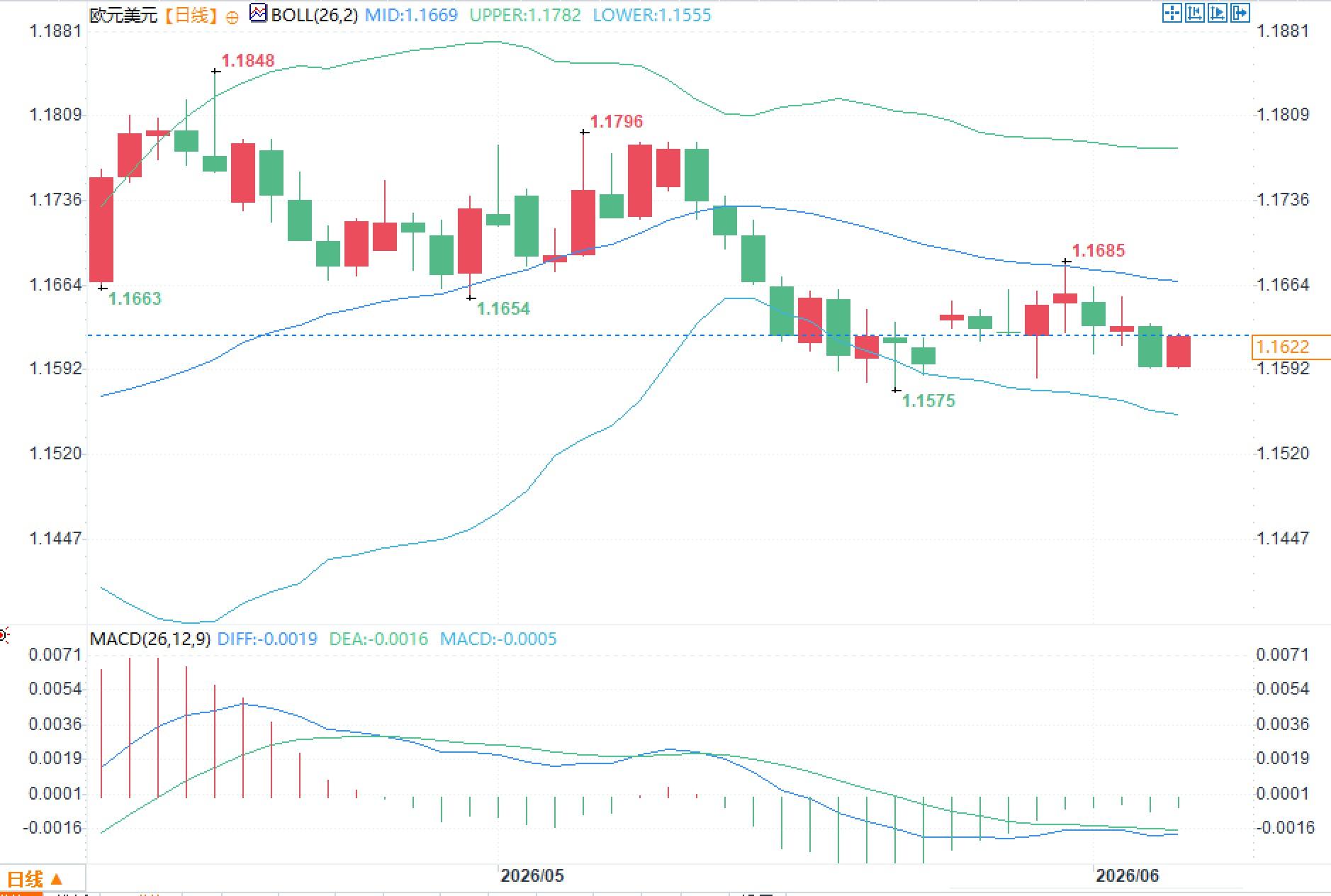
On the MACD level, the DIFF is -0.0019, the DEA is -0.0016, and the histogram is approximately -0.0005, indicating that the negative territory has not yet been reversed. The market message corresponding to this technical structure is clear: downward momentum has somewhat subsided, but the bulls have not yet regained control. The 1.1555 to 1.1575 area is a low zone that has been repeatedly tested in recent fluctuations, while the 1.1669 to 1.1685 area is the observation zone for whether the short-term rebound can transform into a higher platform.
Question 1: Retail sales fell 0.4% in April, so why didn't the euro fall significantly below 1.16 against the dollar?
A: The decline in April was partly due to the upward revision of March retail sales to 0.8% growth, reflecting the high base effect. Meanwhile, food sales grew by 0.9%, indicating that consumption did not experience a comprehensive slowdown. More importantly, the market repriced the European Central Bank's policies after inflation rose to 3.2%, offsetting some of the growth concerns.
Question 2: Where is the main pressure on the euro currently coming from?
A: The pressure comes from two ends. On one hand, weak non-food sales and fuel consumption reflect pressure on residents' actual purchasing power; on the other hand, the Federal Reserve's interest rate range is still higher than the European Central Bank's, and the interest rate differential has not fully reversed. For the euro to form a clearer direction, a breakthrough is needed on either the growth or policy expectations side.
The decline in retail sales is not simply a negative factor; the key lies in the change in consumption patterns.
The latest data shows that Eurozone retail sales fell 0.4% month-on-month in April, weaker than market expectations, while March's figure was revised from a weak reading to a 0.8% increase. Year-on-year, April retail sales still grew by 1.0%. The impact of this data on the euro against the dollar cannot be viewed solely in terms of a negative value. While the April decline was somewhat technical after the high base in March, the structural signals it releases are more noteworthy.
The breakdown shows that in April, sales of food, beverages, and tobacco increased by 0.9% month-on-month, while non-food sales decreased by 0.9%, and sales of motor fuel at specialty stores decreased by 2.7%. This indicates that household consumption has not collapsed across the board, but rather has shifted from discretionary spending and fuel consumption to more defensive necessities. For traders, this structural divergence is more important than the overall volume, because it shows that the demand side is absorbing the energy price shock, but consumer resilience has not completely disappeared.
Inflationary pressures are rising again, and the European Central Bank's room for maneuver is shrinking.
Eurozone harmonized inflation rose to 3.2% in May, up from 3.0% in April; energy inflation was 10.9%, services inflation rose to 3.5% from 3.0%, and the figure excluding energy, food, alcohol, and tobacco rose to 2.5%. This data has two implications for exchange rates: on the one hand, rising inflationary pressures erode real income, constraining consumption; on the other hand, it also increases the need for the European Central Bank to maintain a tighter policy stance.
The European Central Bank's current deposit facility rate is 2.00%, its main refinancing rate is 2.15%, and its marginal lending facility rate is 2.40%; the Federal Reserve's target range for the federal funds rate remains at 3.50% to 3.75%. The nominal policy rate differential still favors the dollar, but the marginal variable on the euro side has shifted from "expectations of rate cuts" to "whether further tightening is needed." This is one of the reasons why the euro did not significantly fall below 1.16 against the dollar despite weak retail data.
The fundamentals are not a strong recovery, but rather a repricing of low growth and high inflation.
The Eurozone's GDP grew by only 0.1% quarter-on-quarter and 0.8% year-on-year in the first quarter, with employment also increasing by 0.1% quarter-on-quarter. The unemployment rate in April was 6.3%, unchanged from March and the same period last year, with approximately 11.075 million unemployed. While growth is weak, the employment situation has not yet deteriorated significantly, leaving the Eurozone in an uncomfortable range for its exchange rate: growth is insufficient to support a strong euro, while inflation is insufficient to warrant a full shift to easing policies.
This combination typically compresses the certainty of trend trading. For the euro to break free from the tug-of-war around 1.16 against the dollar, a clearer direction from the fundamentals is needed: either subsequent consumption and services data must prove that demand can still support higher prices, or a decline in inflation will reopen the narrative of policy easing. Current data suggests more of a "slower growth, firmer prices" scenario, which will increase the exchange rate's sensitivity to individual data points and central bank statements.
Technical charts show that the exchange rate remains in a weak equilibrium below the middle band.
From the daily chart, the euro/dollar pair is currently trading around 1.1622, below the Bollinger Band middle line at 1.1669, the upper line at 1.1782, and the lower line at 1.1555. After reaching a previous high of 1.1848, the price gradually declined, with the rebound high of 1.1796 failing to reclaim the previous high, subsequently falling back to around 1.1575, forming a temporary low. Although the price has recently held above the lower Bollinger Band, it has consistently failed to effectively recover the middle line, indicating that the market remains in a weak equilibrium rather than a trend reversal.
On the MACD level, the DIFF is -0.0019, the DEA is -0.0016, and the histogram is approximately -0.0005, indicating that the negative territory has not yet been reversed. The market message corresponding to this technical structure is clear: downward momentum has somewhat subsided, but the bulls have not yet regained control. The 1.1555 to 1.1575 area is a low zone that has been repeatedly tested in recent fluctuations, while the 1.1669 to 1.1685 area is the observation zone for whether the short-term rebound can transform into a higher platform.
Frequently Asked Questions
Question 1: Retail sales fell 0.4% in April, so why didn't the euro fall significantly below 1.16 against the dollar?
A: The decline in April was partly due to the upward revision of March retail sales to 0.8% growth, reflecting the high base effect. Meanwhile, food sales grew by 0.9%, indicating that consumption did not experience a comprehensive slowdown. More importantly, the market repriced the European Central Bank's policies after inflation rose to 3.2%, offsetting some of the growth concerns.
Question 2: Where is the main pressure on the euro currently coming from?
A: The pressure comes from two ends. On one hand, weak non-food sales and fuel consumption reflect pressure on residents' actual purchasing power; on the other hand, the Federal Reserve's interest rate range is still higher than the European Central Bank's, and the interest rate differential has not fully reversed. For the euro to form a clearer direction, a breakthrough is needed on either the growth or policy expectations side.
- Risk Warning and Disclaimer
- The market involves risk, and trading may not be suitable for all investors. This article is for reference only and does not constitute personal investment advice, nor does it take into account certain users’ specific investment objectives, financial situation, or other needs. Any investment decisions made based on this information are at your own risk.