Crude oil trading reminder: After a sharp decline, oil prices have entered a period of consolidation, and prices may fluctuate repeatedly as they await a new equilibrium.
2026-06-16 09:14:49
International oil prices rebounded modestly in Asian trading on Tuesday, after WTI crude suffered a sharp sell-off of about 3.7% in the previous session, mainly due to market bets on a possible easing of tensions in the Middle East and an increased likelihood of the Strait of Hormuz reopening in the future. By early Asian trading, WTI crude prices had recovered to around $80 per barrel, but overall volatility was limited as investors awaited further confirmation of the interim peace agreement between the United States and Iran.

US President Trump previously stated that both sides had signed a memorandum of understanding to end the conflict and planned to push for the reopening of the Strait of Hormuz, which had been blocked for several months. However, as the US and Iran have not yet released the full details of the agreement, the market remains highly skeptical about its actual implementation, and many international shipping companies have not yet resumed their transport arrangements through this crucial waterway. According to semi-official Iranian media reports, the existing draft agreement is expected to restore navigation through the strait within 30 days, arranged by Iran. The Strait of Hormuz handles approximately 20% of global seaborne crude oil and liquefied natural gas transport and is one of the most important strategic channels in the global energy supply system.
As expectations for a return to supply grow, the National Iranian Oil Company has begun adjusting its export strategy, significantly lowering its official selling price for light sweet crude oil to Asian buyers in July. The premium over the Oman/Dubai benchmark has been reduced from $13 per barrel to $7.15 per barrel, indicating Iran's desire to quickly regain market share once international markets reopen. However, after a three-month blockade of the Strait of Hormuz, the global energy supply chain still needs time to recover, and there remains significant disagreement in the market regarding the speed of recovery in crude oil production and transportation capacity.
Meanwhile, the latest data from the U.S. Department of Energy shows a significant decline in U.S. strategic petroleum reserves. Last week, strategic reserves decreased by 8.9 million barrels to approximately 340.3 million barrels, the lowest level since 1983. This inventory decline is part of the U.S.'s ongoing program to release strategic reserves; the U.S. previously agreed to lend approximately 172 million barrels of crude oil from the reserve system to alleviate pressure on domestic fuel prices. Although geopolitical tensions have shown signs of easing, persistently low strategic reserves mean that the global crude oil market still lacks sufficient safety buffers.
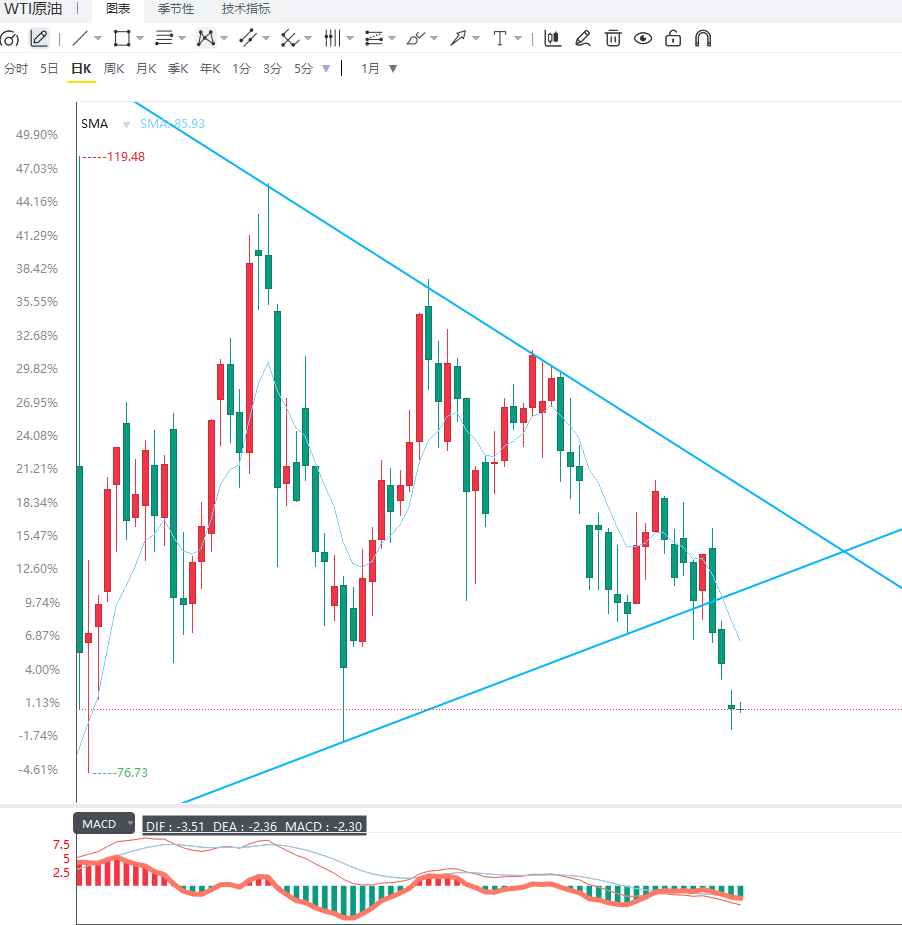
From a daily chart perspective, WTI crude oil previously fell rapidly due to expectations of a peace agreement, breaking below the short-term upward trend line, indicating a significant weakening of bullish momentum. Currently, the price is finding some support near the $80 mark, making this area a crucial battleground between bulls and bears in the short term. If the price continues to fall below the support near $79, it may further retreat to the $76-$77 area; conversely, if it regains a foothold above $82, it may retest the $85-$88 resistance area. From a market momentum perspective, short-term downward pressure has not yet been fully released, and the price may enter a consolidation phase.
The 4-hour chart shows that WTI crude oil has shown signs of a short-term technical rebound after a continuous sharp decline, but it is still trading below the short-term moving average resistance, indicating that the bears still hold the initiative. Although momentum indicators have shown signs of low-level correction, no clear reversal signal has yet formed. In the short term, attention should be paid to the $80 level. If the price can remain stable above this level, a range-bound consolidation may form; if the rebound fails to break through the resistance near $82, a retest of previous lows cannot be ruled out.
Editor's Summary : The expectation of easing tensions between the US and Iran has led the market to reassess the future outlook for crude oil supply, with the potential reopening of the Strait of Hormuz becoming a key variable in recent oil price movements. However, due to the lack of transparency regarding the details of the peace agreement, the resumption of shipping and Iranian crude oil exports will still take time, and supply risks have not been completely eliminated. Meanwhile, the decline in US strategic petroleum reserves to a multi-decade low has also limited further downside potential for oil prices. Going forward, the market will need to focus on the final implementation of the US-Iran agreement, the progress of navigation in the Strait of Hormuz, and changes in global inventories. WTI crude oil is expected to maintain a highly volatile and volatile pattern in the short term.
US President Trump previously stated that both sides had signed a memorandum of understanding to end the conflict and planned to push for the reopening of the Strait of Hormuz, which had been blocked for several months. However, as the US and Iran have not yet released the full details of the agreement, the market remains highly skeptical about its actual implementation, and many international shipping companies have not yet resumed their transport arrangements through this crucial waterway. According to semi-official Iranian media reports, the existing draft agreement is expected to restore navigation through the strait within 30 days, arranged by Iran. The Strait of Hormuz handles approximately 20% of global seaborne crude oil and liquefied natural gas transport and is one of the most important strategic channels in the global energy supply system.
As expectations for a return to supply grow, the National Iranian Oil Company has begun adjusting its export strategy, significantly lowering its official selling price for light sweet crude oil to Asian buyers in July. The premium over the Oman/Dubai benchmark has been reduced from $13 per barrel to $7.15 per barrel, indicating Iran's desire to quickly regain market share once international markets reopen. However, after a three-month blockade of the Strait of Hormuz, the global energy supply chain still needs time to recover, and there remains significant disagreement in the market regarding the speed of recovery in crude oil production and transportation capacity.
Meanwhile, the latest data from the U.S. Department of Energy shows a significant decline in U.S. strategic petroleum reserves. Last week, strategic reserves decreased by 8.9 million barrels to approximately 340.3 million barrels, the lowest level since 1983. This inventory decline is part of the U.S.'s ongoing program to release strategic reserves; the U.S. previously agreed to lend approximately 172 million barrels of crude oil from the reserve system to alleviate pressure on domestic fuel prices. Although geopolitical tensions have shown signs of easing, persistently low strategic reserves mean that the global crude oil market still lacks sufficient safety buffers.
From a daily chart perspective, WTI crude oil previously fell rapidly due to expectations of a peace agreement, breaking below the short-term upward trend line, indicating a significant weakening of bullish momentum. Currently, the price is finding some support near the $80 mark, making this area a crucial battleground between bulls and bears in the short term. If the price continues to fall below the support near $79, it may further retreat to the $76-$77 area; conversely, if it regains a foothold above $82, it may retest the $85-$88 resistance area. From a market momentum perspective, short-term downward pressure has not yet been fully released, and the price may enter a consolidation phase.
The 4-hour chart shows that WTI crude oil has shown signs of a short-term technical rebound after a continuous sharp decline, but it is still trading below the short-term moving average resistance, indicating that the bears still hold the initiative. Although momentum indicators have shown signs of low-level correction, no clear reversal signal has yet formed. In the short term, attention should be paid to the $80 level. If the price can remain stable above this level, a range-bound consolidation may form; if the rebound fails to break through the resistance near $82, a retest of previous lows cannot be ruled out.
Editor's Summary : The expectation of easing tensions between the US and Iran has led the market to reassess the future outlook for crude oil supply, with the potential reopening of the Strait of Hormuz becoming a key variable in recent oil price movements. However, due to the lack of transparency regarding the details of the peace agreement, the resumption of shipping and Iranian crude oil exports will still take time, and supply risks have not been completely eliminated. Meanwhile, the decline in US strategic petroleum reserves to a multi-decade low has also limited further downside potential for oil prices. Going forward, the market will need to focus on the final implementation of the US-Iran agreement, the progress of navigation in the Strait of Hormuz, and changes in global inventories. WTI crude oil is expected to maintain a highly volatile and volatile pattern in the short term.
- Risk Warning and Disclaimer
- The market involves risk, and trading may not be suitable for all investors. This article is for reference only and does not constitute personal investment advice, nor does it take into account certain users’ specific investment objectives, financial situation, or other needs. Any investment decisions made based on this information are at your own risk.