How long can the US-Iran agreement last? If it breaks down, could UK inflation exceed 4% and interest rate hikes return?
2026-06-16 11:44:56
On Tuesday (June 16) during the Asian session, the British pound fluctuated lower against the US dollar, currently down about 0.1% to around 1.3400.
The pound's modest decline is closely linked to a further easing of market expectations for a Bank of England interest rate hike. Recent analysis suggests that the US-Iran agreement is altering the UK's inflation outlook.
If the US-Iran agreement holds and oil shipments resume normally, UK inflation is likely to remain below 4%, allowing the Bank of England to avoid raising interest rates this summer. Thursday's interest rate decision is expected to see a 7-2 vote in favor of maintaining the current rate.
A rate hike was already highly unlikely following the Bank of England's interest rate decision this Thursday. The subsequent US-Iran agreement further tilted the balance towards a prolonged period of inactivity. Current market pricing indicates only a 25% probability of a rate hike in July, with only one hike expected for the entire year—compared to a previous peak of three expected.
The Bank of England's policy options lie between "holding rates steady" and "raising rates once"—with 4% inflation being a crucial red line. Last summer, the Bank of England explicitly stated that when inflation exceeds this level, it is more likely to become entrenched, and second-round effects (such as a wage-price spiral and widespread adjustments in corporate pricing behavior) are more likely to emerge. This assessment forms the core reference point for the Bank of England's monetary policy framework. In other words, as long as inflation remains below 4%, the central bank has ample reason to maintain interest rates; however, once this threshold is breached, the urgency to raise rates will significantly increase.
Given current energy prices, inflation is unlikely to reach 4%. Natural gas futures prices for next winter and beyond have fallen back to pre-war levels – a crucial factor in setting the quarterly cap on household energy prices. The UK energy regulator adjusts the cap on household energy bills every three months based on wholesale market prices, with forward futures prices being a key input variable in this calculation model. Currently, the cap is set to rise by 13% in July, primarily reflecting the lagged transmission of higher energy costs over the past few months. However, if current price levels do not change significantly, the price cap in October is likely to fall by 7%.
This dynamic will keep UK inflation between 3% and 3.5% in the autumn and winter, below the threshold for raising interest rates. Specifically, the increase in the upper limit in July will have a one-off boost to inflation in the third quarter, but the magnitude will be limited; while the expected decline in October will significantly lower the year-on-year increase in energy bills in the fourth quarter, thereby suppressing the overall inflation rate. It should be noted that the Bank of England believes that the anticipated interest rate cut did not occur, which in itself constitutes a de facto policy tightening. With inflation still above the target, maintaining the current interest rate rather than cutting it means that the actual stance of monetary policy has not been relaxed.
That said, commodity analysts believe there is still a considerable probability that energy prices will rise again—even if the agreement reached this weekend is maintained. This assessment is primarily based on structural factors on both the supply and demand sides.
From the supply side, oil inventories need rebuilding. The conflicts and strait blockades of the past few months have not only disrupted normal shipping but also significantly depleted global reserves. Even if the agreement is implemented and the strait reopens, replenishing inventories to normal levels will take weeks or even longer. Meanwhile, Europe still needs to replenish its natural gas reserves, which are currently far below seasonal averages. European gas storage facilities were not effectively filled after the winter heating season, and the storage window for the next winter is narrowing.
From the demand side, Asia will increasingly compete with Europe for LNG supply. With the gradual recovery of the Chinese economy and the growth of energy demand in South Asian countries, competition in the global LNG market is intensifying. In the past two years, Europe has mainly relied on high prices to attract seaborne gas to fill the gap left by Russian pipeline gas, but against the backdrop of recovering demand in Asia, Europe will face higher import costs and a tighter supply situation.
Even if shipping disruptions in the Strait of Hormuz ease significantly during June, oil prices are expected to average $97 per barrel in the third quarter. While this price level is lower than at the height of the conflict, it remains well above historical averages. Natural gas prices may also rise slightly, especially if European restocking efforts fall short of expectations.
However, this is unlikely to be enough to trigger an interest rate hike. Forecasts indicate that in this scenario, UK inflation will peak at around 3.8%—below the Bank of England's previously set key 4% threshold. More importantly, the continued reopening of the Strait of Hormuz will alter the balance of inflation risks: the tail risk of an extreme surge in energy prices due to a prolonged and disruptive disruption will be significantly reduced. As long as the strait remains open, markets have reason to believe that the worst-case scenario will not occur, thus curbing the self-reinforcing nature of inflation expectations.
The problem is that the situation will fundamentally change if the US-Iran agreement deteriorates or fails to prevent another surge in energy prices this summer. The current navigation situation in the Strait of Hormuz remains highly uncertain. Although Trump has ordered the lifting of the blockade, and Iranian media have reported extensively on the successful passage of ships, US forces on the front lines are maintaining control, and British reports indicate that the blockade has not yet been lifted. This disconnect between high-level directives and on-site execution means that the situation in the strait could deteriorate again at any time.
In the extreme scenario of a prolonged disruption to the Strait of Hormuz in June and July, oil prices are expected to briefly surge to $120 per barrel in July, with natural gas prices also rising sharply. This assessment is based on the fact that European natural gas inventories are currently far below seasonal averages, while Asian demand for liquefied natural gas is recovering, and global energy supply is already in a tight balance. A prolonged disruption to strait transport would quickly put pressure on the supply chain.
The surge in energy prices will directly impact British consumers. Forecasts indicate that UK inflation will exceed 4% by next winter—breaking the key red line previously set by the Bank of England. The Bank of England has clearly stated that when inflation remains above 4%, the risk of a second-round effect (such as a wage-price spiral) will increase significantly. Under these circumstances, it will be difficult for the Bank of England not to raise interest rates this summer.
This was roughly the global baseline scenario when the latest data was released last week—the core reason why a July rate hike was tentatively included in the forecast at that time. However, with the US-Iran agreement reached and the Strait of Hormuz partially reopened, this now seems less likely. But the actual progress of lifting the strait blockade, the willingness of both the US and Iran to fulfill their obligations, and interference from external factors such as Israel all mean that the risks have not completely disappeared. Time will ultimately tell.
As for this week's meeting, with neither new forecasts nor a press conference, the main question is how many officials will join Chief Economist Peale in voting for an immediate rate hike.
In this regard, we may see the reemergence of old lines within the committee that existed before the outbreak of the war. At that time, some officials, including Peel, believed that pricing behavior had permanently shifted since the pandemic, leading to a structurally higher inflation. Green, who shares this view, has almost stated that he will vote for a rate hike this week. Another long-time hawk, Mann, may also join her. A 7-2 vote is expected this week to maintain the current rate.
However, the other four members—five if you include President Bailey, whose stance is somewhere in between—believe that the risk of a second round of inflation has diminished compared to the last energy shock four years ago. And the latest data suggests this assessment is correct.
Last year, overall inflation came very close to 4% due to rising food prices. However, the latest data shows little indication that this will develop into more persistent price pressures. The labor market remains under pressure, and private sector wage growth is likely to fall below 3% in the near term—below the level the Bank of England said in February was consistent with its medium-term inflation target of 2%. This is ultimately why the Bank of England is expected to resume interest rate cuts in 2027—a figure not yet priced into the market.
According to the daily chart, the GBP/USD pair is currently in a high-level range-bound trading pattern. After reaching a high of 1.3657, the price has retreated, with key support levels at 1.3302 and 1.3159 proving effective. The moving average system (MA20, MA50, MA100, MA200) is highly convergent, indicating a convergence of costs across multiple timeframes and a temporary balance between bulls and bears, with no clear short-term trend.
In terms of indicators, the MACD's DIFF and DEA are almost touching, the histogram momentum is weak, and both bullish and bearish momentum are insufficient; the RSI value is 46.92, which is in the neutral range below the 50 midline, and there are no overbought or oversold signals, nor are there any unilateral strong or weak signals.
In terms of price structure, after a rapid recovery following the previous decline, the price has recently been fluctuating repeatedly between 1.3302 and 1.3480, forming a clear trading range along the upper and lower boundaries. The upper resistance levels are the 20-day moving average (MA20) at 1.3419 and the previous high of 1.3480, while the lower support level is the low of the trading range at 1.3302.
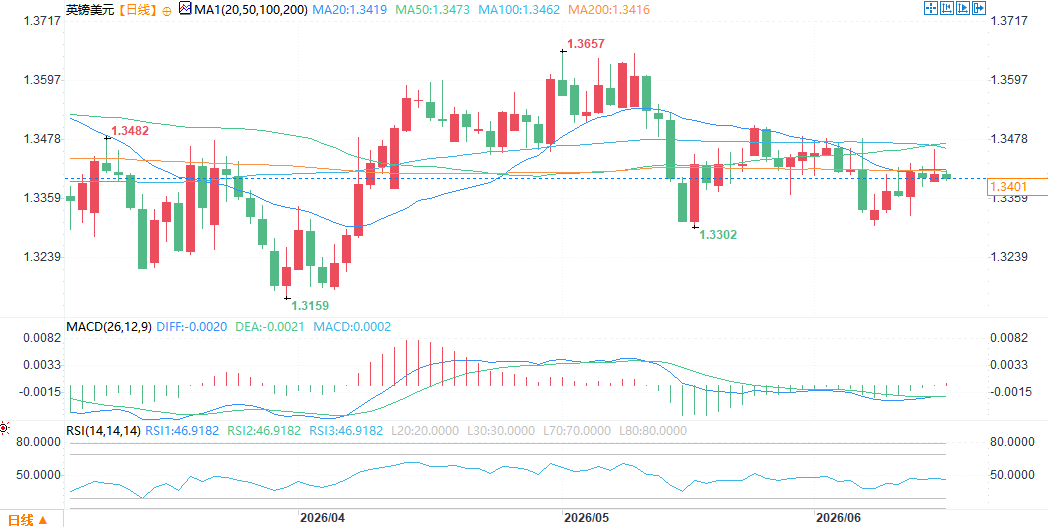
(GBP/USD daily chart, source: FX678)
At 11:44 Beijing time on June 16, the British pound was trading at 1.3403/04 against the US dollar.
The pound's modest decline is closely linked to a further easing of market expectations for a Bank of England interest rate hike. Recent analysis suggests that the US-Iran agreement is altering the UK's inflation outlook.
If the US-Iran agreement holds and oil shipments resume normally, UK inflation is likely to remain below 4%, allowing the Bank of England to avoid raising interest rates this summer. Thursday's interest rate decision is expected to see a 7-2 vote in favor of maintaining the current rate.
A rate hike was already highly unlikely following the Bank of England's interest rate decision this Thursday. The subsequent US-Iran agreement further tilted the balance towards a prolonged period of inactivity. Current market pricing indicates only a 25% probability of a rate hike in July, with only one hike expected for the entire year—compared to a previous peak of three expected.
A 4% inflation rate is a key red line, which current energy prices are unlikely to reach.
The Bank of England's policy options lie between "holding rates steady" and "raising rates once"—with 4% inflation being a crucial red line. Last summer, the Bank of England explicitly stated that when inflation exceeds this level, it is more likely to become entrenched, and second-round effects (such as a wage-price spiral and widespread adjustments in corporate pricing behavior) are more likely to emerge. This assessment forms the core reference point for the Bank of England's monetary policy framework. In other words, as long as inflation remains below 4%, the central bank has ample reason to maintain interest rates; however, once this threshold is breached, the urgency to raise rates will significantly increase.
Given current energy prices, inflation is unlikely to reach 4%. Natural gas futures prices for next winter and beyond have fallen back to pre-war levels – a crucial factor in setting the quarterly cap on household energy prices. The UK energy regulator adjusts the cap on household energy bills every three months based on wholesale market prices, with forward futures prices being a key input variable in this calculation model. Currently, the cap is set to rise by 13% in July, primarily reflecting the lagged transmission of higher energy costs over the past few months. However, if current price levels do not change significantly, the price cap in October is likely to fall by 7%.
This dynamic will keep UK inflation between 3% and 3.5% in the autumn and winter, below the threshold for raising interest rates. Specifically, the increase in the upper limit in July will have a one-off boost to inflation in the third quarter, but the magnitude will be limited; while the expected decline in October will significantly lower the year-on-year increase in energy bills in the fourth quarter, thereby suppressing the overall inflation rate. It should be noted that the Bank of England believes that the anticipated interest rate cut did not occur, which in itself constitutes a de facto policy tightening. With inflation still above the target, maintaining the current interest rate rather than cutting it means that the actual stance of monetary policy has not been relaxed.
Energy prices still face upside risks, but are not yet sufficient to trigger an interest rate hike.
That said, commodity analysts believe there is still a considerable probability that energy prices will rise again—even if the agreement reached this weekend is maintained. This assessment is primarily based on structural factors on both the supply and demand sides.
From the supply side, oil inventories need rebuilding. The conflicts and strait blockades of the past few months have not only disrupted normal shipping but also significantly depleted global reserves. Even if the agreement is implemented and the strait reopens, replenishing inventories to normal levels will take weeks or even longer. Meanwhile, Europe still needs to replenish its natural gas reserves, which are currently far below seasonal averages. European gas storage facilities were not effectively filled after the winter heating season, and the storage window for the next winter is narrowing.
From the demand side, Asia will increasingly compete with Europe for LNG supply. With the gradual recovery of the Chinese economy and the growth of energy demand in South Asian countries, competition in the global LNG market is intensifying. In the past two years, Europe has mainly relied on high prices to attract seaborne gas to fill the gap left by Russian pipeline gas, but against the backdrop of recovering demand in Asia, Europe will face higher import costs and a tighter supply situation.
Even if shipping disruptions in the Strait of Hormuz ease significantly during June, oil prices are expected to average $97 per barrel in the third quarter. While this price level is lower than at the height of the conflict, it remains well above historical averages. Natural gas prices may also rise slightly, especially if European restocking efforts fall short of expectations.
However, this is unlikely to be enough to trigger an interest rate hike. Forecasts indicate that in this scenario, UK inflation will peak at around 3.8%—below the Bank of England's previously set key 4% threshold. More importantly, the continued reopening of the Strait of Hormuz will alter the balance of inflation risks: the tail risk of an extreme surge in energy prices due to a prolonged and disruptive disruption will be significantly reduced. As long as the strait remains open, markets have reason to believe that the worst-case scenario will not occur, thus curbing the self-reinforcing nature of inflation expectations.
Risk scenario: If the agreement breaks down, inflation could exceed 4% and force interest rate hikes.
The problem is that the situation will fundamentally change if the US-Iran agreement deteriorates or fails to prevent another surge in energy prices this summer. The current navigation situation in the Strait of Hormuz remains highly uncertain. Although Trump has ordered the lifting of the blockade, and Iranian media have reported extensively on the successful passage of ships, US forces on the front lines are maintaining control, and British reports indicate that the blockade has not yet been lifted. This disconnect between high-level directives and on-site execution means that the situation in the strait could deteriorate again at any time.
In the extreme scenario of a prolonged disruption to the Strait of Hormuz in June and July, oil prices are expected to briefly surge to $120 per barrel in July, with natural gas prices also rising sharply. This assessment is based on the fact that European natural gas inventories are currently far below seasonal averages, while Asian demand for liquefied natural gas is recovering, and global energy supply is already in a tight balance. A prolonged disruption to strait transport would quickly put pressure on the supply chain.
The surge in energy prices will directly impact British consumers. Forecasts indicate that UK inflation will exceed 4% by next winter—breaking the key red line previously set by the Bank of England. The Bank of England has clearly stated that when inflation remains above 4%, the risk of a second-round effect (such as a wage-price spiral) will increase significantly. Under these circumstances, it will be difficult for the Bank of England not to raise interest rates this summer.
This was roughly the global baseline scenario when the latest data was released last week—the core reason why a July rate hike was tentatively included in the forecast at that time. However, with the US-Iran agreement reached and the Strait of Hormuz partially reopened, this now seems less likely. But the actual progress of lifting the strait blockade, the willingness of both the US and Iran to fulfill their obligations, and interference from external factors such as Israel all mean that the risks have not completely disappeared. Time will ultimately tell.
This week's decision: 7-2 vote to keep rates unchanged, but long-time hawks may vote to raise rates.
As for this week's meeting, with neither new forecasts nor a press conference, the main question is how many officials will join Chief Economist Peale in voting for an immediate rate hike.
In this regard, we may see the reemergence of old lines within the committee that existed before the outbreak of the war. At that time, some officials, including Peel, believed that pricing behavior had permanently shifted since the pandemic, leading to a structurally higher inflation. Green, who shares this view, has almost stated that he will vote for a rate hike this week. Another long-time hawk, Mann, may also join her. A 7-2 vote is expected this week to maintain the current rate.
However, the other four members—five if you include President Bailey, whose stance is somewhere in between—believe that the risk of a second round of inflation has diminished compared to the last energy shock four years ago. And the latest data suggests this assessment is correct.
Last year, overall inflation came very close to 4% due to rising food prices. However, the latest data shows little indication that this will develop into more persistent price pressures. The labor market remains under pressure, and private sector wage growth is likely to fall below 3% in the near term—below the level the Bank of England said in February was consistent with its medium-term inflation target of 2%. This is ultimately why the Bank of England is expected to resume interest rate cuts in 2027—a figure not yet priced into the market.
Technical Analysis
According to the daily chart, the GBP/USD pair is currently in a high-level range-bound trading pattern. After reaching a high of 1.3657, the price has retreated, with key support levels at 1.3302 and 1.3159 proving effective. The moving average system (MA20, MA50, MA100, MA200) is highly convergent, indicating a convergence of costs across multiple timeframes and a temporary balance between bulls and bears, with no clear short-term trend.
In terms of indicators, the MACD's DIFF and DEA are almost touching, the histogram momentum is weak, and both bullish and bearish momentum are insufficient; the RSI value is 46.92, which is in the neutral range below the 50 midline, and there are no overbought or oversold signals, nor are there any unilateral strong or weak signals.
In terms of price structure, after a rapid recovery following the previous decline, the price has recently been fluctuating repeatedly between 1.3302 and 1.3480, forming a clear trading range along the upper and lower boundaries. The upper resistance levels are the 20-day moving average (MA20) at 1.3419 and the previous high of 1.3480, while the lower support level is the low of the trading range at 1.3302.
(GBP/USD daily chart, source: FX678)
At 11:44 Beijing time on June 16, the British pound was trading at 1.3403/04 against the US dollar.
- Risk Warning and Disclaimer
- The market involves risk, and trading may not be suitable for all investors. This article is for reference only and does not constitute personal investment advice, nor does it take into account certain users’ specific investment objectives, financial situation, or other needs. Any investment decisions made based on this information are at your own risk.