Easing geopolitical tensions boosted risk appetite, and the USD/CAD pair remained range-bound at high levels.
2026-06-17 10:50:09
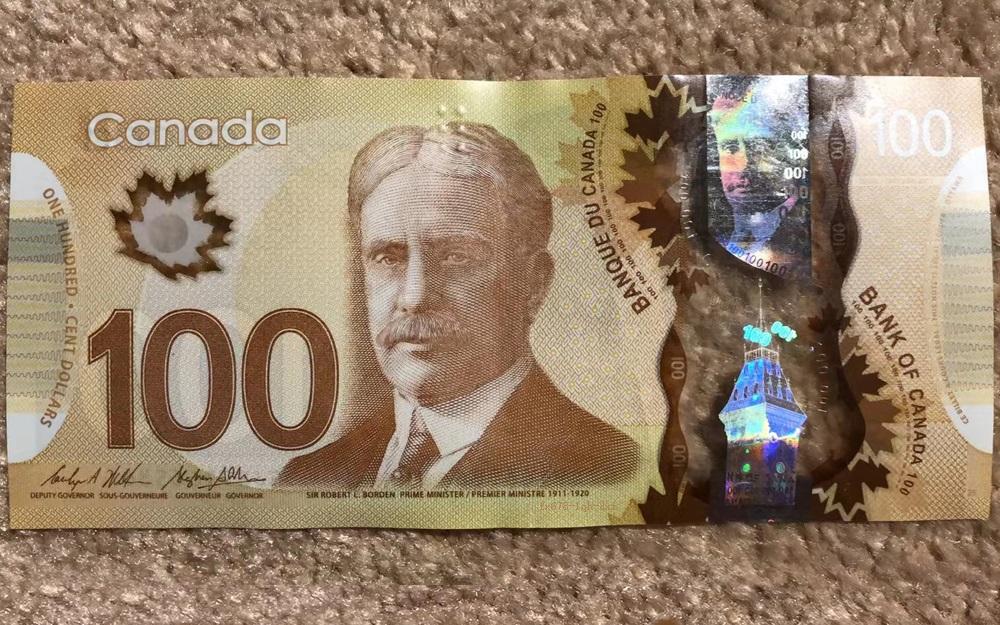
The USD/CAD pair maintained a slightly weak trend in Asian trading on Wednesday, correcting after four consecutive days of gains, with the exchange rate falling back to around 1.3990. Improved market risk appetite reduced the safe-haven appeal of the US dollar, putting pressure on the dollar index, but falling oil prices limited the Canadian dollar's overall decline due to a lack of significant upward momentum.
The US and Iran have made new progress in their efforts to reach a peace agreement to end the conflict. US Vice President Vance stated that President Trump may announce a preliminary agreement to end the conflict ahead of schedule. Meanwhile, Iranian Foreign Minister Abbas Araqchi confirmed that a new round of negotiations aimed at reaching a final comprehensive agreement will take place in Switzerland. Markets believe that if the agreement progresses smoothly, it will further alleviate global energy supply tensions and drive a continued improvement in market risk appetite.
In the crude oil market, the planned signing of a provisional agreement between the US and Iran in Switzerland this week, coupled with expectations of a resumption of Iranian crude oil exports and normalization of shipping in the Strait of Hormuz, led to a significant drop in international oil prices. The Strait of Hormuz handles approximately 20% of global seaborne crude oil transport; its resumption will help increase global energy supply and alleviate previous supply concerns. As Canada is one of the world's major crude oil exporters, falling oil prices typically reduce the attractiveness of the Canadian dollar, thus providing some support for the USD/CAD exchange rate.
The market is currently awaiting the outcome of the Federal Reserve's June policy meeting. The Fed is expected to maintain the target range for the federal funds rate at 3.50% to 3.75%, and policymakers are likely to continue a cautious wait-and-see approach. Investors will be closely watching Fed Chairman Kevin Warsh's latest remarks on inflation, economic growth, and the future path of interest rates.
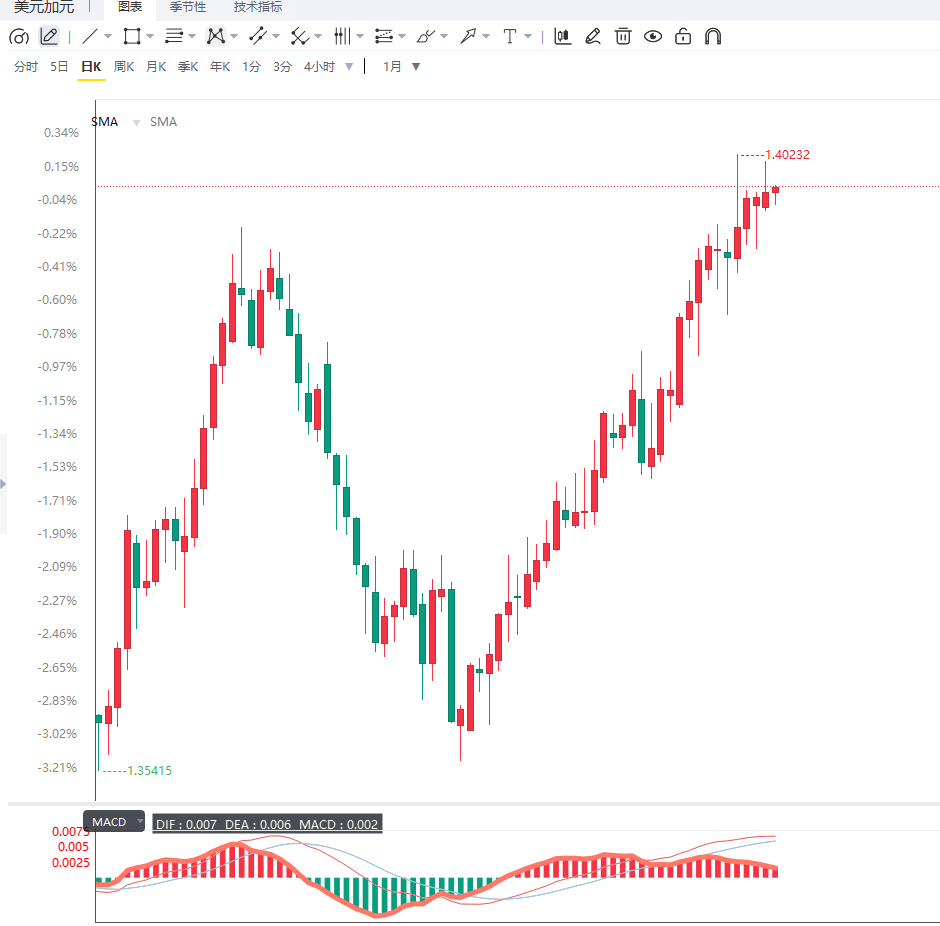
From a technical perspective, the daily chart shows that after four consecutive days of gains, the USD/CAD pair is approaching the psychological level of 1.4000. Short-term bullish momentum has slowed somewhat, but the overall structure remains bullish. The pair has held above key moving averages, indicating that the medium-term uptrend remains intact. Key resistance levels to watch are the 1.4000-1.4050 area; a decisive break above this level could lead to a further challenge of 1.4100. On the downside, support levels to watch are 1.3950 and 1.3900; a break below these levels could indicate a wider short-term pullback.
From a 4-hour chart perspective, the USD/CAD pair has shifted from a previous one-sided upward trend to a consolidation phase at higher levels. Technical indicators suggest that upward momentum has weakened, but the bears have not yet fully gained the upper hand. If oil prices continue to fall or the Federal Reserve releases hawkish signals, the USD/CAD pair may strengthen again; conversely, if market risk sentiment improves further and the US dollar weakens, the exchange rate may test support around 1.3950.
Editor's Summary:
The current USD/CAD exchange rate is influenced by multiple factors, including risk sentiment, oil prices, and expectations surrounding Federal Reserve policy. The US-Iran peace agreement has cooled safe-haven demand, putting pressure on the dollar, but falling oil prices have weakened support for the Canadian dollar, preventing a significant decline. In the short term, the Fed's interest rate decision and Chairman Kevin Warsh's policy stance will determine the dollar's direction, while whether the oil market can stabilize will also be a crucial factor affecting the Canadian dollar's performance. If the dollar strengthens again, the USD/CAD pair may break through the 1.4000 level; if the dollar continues to adjust, the exchange rate may fall back towards the 1.3950 or even 1.3900 area.
The US and Iran have made new progress in their efforts to reach a peace agreement to end the conflict. US Vice President Vance stated that President Trump may announce a preliminary agreement to end the conflict ahead of schedule. Meanwhile, Iranian Foreign Minister Abbas Araqchi confirmed that a new round of negotiations aimed at reaching a final comprehensive agreement will take place in Switzerland. Markets believe that if the agreement progresses smoothly, it will further alleviate global energy supply tensions and drive a continued improvement in market risk appetite.
In the crude oil market, the planned signing of a provisional agreement between the US and Iran in Switzerland this week, coupled with expectations of a resumption of Iranian crude oil exports and normalization of shipping in the Strait of Hormuz, led to a significant drop in international oil prices. The Strait of Hormuz handles approximately 20% of global seaborne crude oil transport; its resumption will help increase global energy supply and alleviate previous supply concerns. As Canada is one of the world's major crude oil exporters, falling oil prices typically reduce the attractiveness of the Canadian dollar, thus providing some support for the USD/CAD exchange rate.
The market is currently awaiting the outcome of the Federal Reserve's June policy meeting. The Fed is expected to maintain the target range for the federal funds rate at 3.50% to 3.75%, and policymakers are likely to continue a cautious wait-and-see approach. Investors will be closely watching Fed Chairman Kevin Warsh's latest remarks on inflation, economic growth, and the future path of interest rates.
From a technical perspective, the daily chart shows that after four consecutive days of gains, the USD/CAD pair is approaching the psychological level of 1.4000. Short-term bullish momentum has slowed somewhat, but the overall structure remains bullish. The pair has held above key moving averages, indicating that the medium-term uptrend remains intact. Key resistance levels to watch are the 1.4000-1.4050 area; a decisive break above this level could lead to a further challenge of 1.4100. On the downside, support levels to watch are 1.3950 and 1.3900; a break below these levels could indicate a wider short-term pullback.
From a 4-hour chart perspective, the USD/CAD pair has shifted from a previous one-sided upward trend to a consolidation phase at higher levels. Technical indicators suggest that upward momentum has weakened, but the bears have not yet fully gained the upper hand. If oil prices continue to fall or the Federal Reserve releases hawkish signals, the USD/CAD pair may strengthen again; conversely, if market risk sentiment improves further and the US dollar weakens, the exchange rate may test support around 1.3950.
Editor's Summary:
The current USD/CAD exchange rate is influenced by multiple factors, including risk sentiment, oil prices, and expectations surrounding Federal Reserve policy. The US-Iran peace agreement has cooled safe-haven demand, putting pressure on the dollar, but falling oil prices have weakened support for the Canadian dollar, preventing a significant decline. In the short term, the Fed's interest rate decision and Chairman Kevin Warsh's policy stance will determine the dollar's direction, while whether the oil market can stabilize will also be a crucial factor affecting the Canadian dollar's performance. If the dollar strengthens again, the USD/CAD pair may break through the 1.4000 level; if the dollar continues to adjust, the exchange rate may fall back towards the 1.3950 or even 1.3900 area.
- Risk Warning and Disclaimer
- The market involves risk, and trading may not be suitable for all investors. This article is for reference only and does not constitute personal investment advice, nor does it take into account certain users’ specific investment objectives, financial situation, or other needs. Any investment decisions made based on this information are at your own risk.