With the Fed meeting countdown underway, UBS asserts "no rate cuts this year"—Wash's debut could ignite the dollar's direction.
2026-06-17 11:14:19
On Wednesday (June 17) during the Asian session, the US dollar index traded in a narrow range, currently hovering around 99.50. It had previously fallen for two consecutive trading days. Behind this short-term weakness lies a slight adjustment in institutional views regarding the pace of the Federal Reserve's interest rate cuts.
UBS Global Wealth Management revised its forecast for the Federal Reserve's monetary policy on June 15, postponing the first rate cuts to March and June 2027, with each cut amounting to 25 basis points, and explicitly stated that no easing measures will be taken this year.
The agency believes that the monetary policy meeting chaired by the new Federal Reserve Chairman Warsh this week will present a more hawkish tone.
This forecast adjustment is primarily based on the current complex economic and geopolitical environment. UBS analysts noted in a report that while Warsh had previously expressed relatively dovish views, Federal Reserve policymakers are expected to demonstrate greater policy resolve in their statement at this meeting.
The market generally expects the FOMC meeting to keep the target range for the federal funds rate unchanged at 3.50%-3.75%.
UBS believes that with the interim US-Iran agreement reached and a series of central bank meetings scheduled, major central banks will not hastily shift to a dovish stance due to a short-term easing of geopolitical tensions. Instead, they will remain cautious, closely monitoring data over the coming months to determine whether energy price shocks will trigger a second round of inflationary pressures. This stance aligns with a shift in market expectations indicated by surveys of clients from institutions such as Goldman Sachs: the probability of a December rate hike has risen to approximately 60%, and investor optimism regarding rate cuts this year has significantly diminished.
UBS Global Wealth Management team emphasized that strong employment data, potential persistent inflation, and geopolitical uncertainty collectively form the basis for the Federal Reserve to maintain restrictive interest rates for a longer period. The debut of new Chairman Warsh will be a crucial window for the market to observe his communication style and policy direction, with attention focused on whether he will reduce forward guidance and strengthen the reliance on data.
Against the backdrop of UBS's latest forecast, bond investors continue to adopt a neutral duration strategy, increasing their holdings of short-term, high-quality bonds to cope with volatility. The US dollar index may find support due to rising expectations of interest rate hikes.
Overall, UBS's view further reinforces the market's cautious pricing in the Fed's policy path.
According to the daily chart, the US dollar index rose to a high of 100.31 before falling back for two consecutive days, with the price retracing to the 20-day moving average support level around 99.60, indicating intensified short-term competition between bulls and bears. The moving average system remains in a bullish alignment, with the 20, 50, 100, and 200-day moving averages providing layered support from top to bottom. The medium-term upward trend structure remains intact, and multiple medium- and long-term moving averages around 98.80 form a key defensive zone.
The MACD is above the zero line, but the DIFF line has crossed below the DEA line and the histogram has turned green, indicating a significant weakening of bullish momentum and a short-term correction signal. The RSI has fallen back to the 53 range, moving away from the overbought area near 70, and the recovery trend after the overextension of the rise continues.
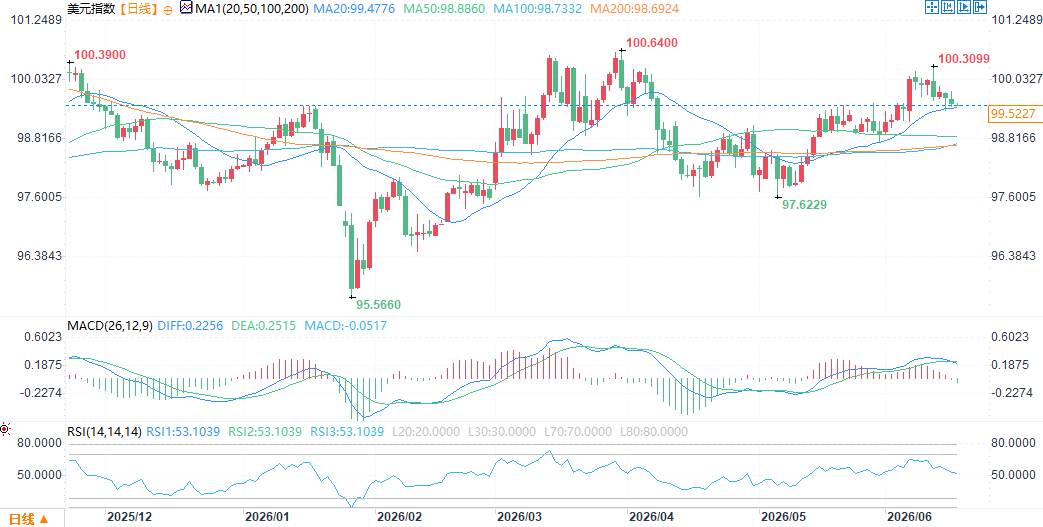
(US Dollar Index Daily Chart, Source: FX678)
UBS has pushed back its expectations for a Federal Reserve rate cut to 2027 and anticipates a hawkish signal from this week's meeting, reflecting a cautious and restrained approach to central bank policy amid inflation risks and geopolitical factors. Warsh's debut will provide key guidance for the direction of subsequent monetary policy; investors should pay close attention to the impact of the meeting statement, dot plot updates, and press conference wording on financial markets.
Q1: Why did UBS postpone the Fed's interest rate cut to 2027?
A: UBS believes no easing measures will be taken this year, mainly due to strong employment data, the potential risk of a second round of inflation triggered by an energy shock, and persistent geopolitical uncertainty. The institution has revised its first rate cut expectations from the end of 2026 to March and June 2027, respectively, by 25 basis points, emphasizing that the Federal Reserve needs to carefully monitor data developments.
Q2: What are UBS's predictions for the tone of this week's Fed meeting?
A: UBS expects Warsh's first FOMC meeting to deliver a hawkish signal, showcasing a more hawkish stance in the policy statement and dot plot. Although the market anticipates interest rates to remain unchanged at 3.50%-3.75%, the meeting will avoid a hasty shift to a dovish stance due to the US-Iran agreement, prioritizing an assessment of the inflation outlook. This aligns with the current trend of investors pricing in a roughly 60% probability of a December rate hike.
Q3: How are current geopolitical factors affecting the Federal Reserve's policy expectations?
A: While the interim US-Iran agreement may lead to lower oil prices and increased supply, UBS believes the lagged effects of the energy shock still need to be observed and could potentially push up inflation. Several central banks, including the Federal Reserve, will remain cautious during this week's meetings, unwilling to ease monetary policy prematurely to prevent a second round of inflationary effects. This also explains the backdrop of the bond market shifting towards neutral duration strategies and expectations of a stronger dollar.
Q4: What is the significance of Walsh's debut as the new chairman?
A: This meeting marks Warsh's first policy statement since taking office, and the outside world is watching to see if his communication style has changed, such as reducing forward guidance or weakening the role of the dot plot. UBS believes that although Warsh's previous views have been relatively dovish, the meeting will generally present a hawkish tone, which will affect the market's judgment on the Fed's independence and subsequent policy path.
Q5: What implications does UBS's forecast have for investors?
A: Investors should maintain a defensive stance, focusing on short-term bonds and high-quality fixed-income assets. The US dollar may find support, while volatility in equities and risk assets may increase. In the long term, the policy path is highly dependent on inflation and employment data; close monitoring of the FOMC statement and Warsh press conference is recommended. The overall environment highlights the uncertainty of monetary policy in 2026, making prudent management of interest rate risk crucial.
At 11:13 AM Beijing time on June 17, the US dollar index was at 99.52.
UBS Global Wealth Management revised its forecast for the Federal Reserve's monetary policy on June 15, postponing the first rate cuts to March and June 2027, with each cut amounting to 25 basis points, and explicitly stated that no easing measures will be taken this year.
The agency believes that the monetary policy meeting chaired by the new Federal Reserve Chairman Warsh this week will present a more hawkish tone.
This forecast adjustment is primarily based on the current complex economic and geopolitical environment. UBS analysts noted in a report that while Warsh had previously expressed relatively dovish views, Federal Reserve policymakers are expected to demonstrate greater policy resolve in their statement at this meeting.
The market generally expects the FOMC meeting to keep the target range for the federal funds rate unchanged at 3.50%-3.75%.
Hawkish signals dominate this week's meeting
UBS believes that with the interim US-Iran agreement reached and a series of central bank meetings scheduled, major central banks will not hastily shift to a dovish stance due to a short-term easing of geopolitical tensions. Instead, they will remain cautious, closely monitoring data over the coming months to determine whether energy price shocks will trigger a second round of inflationary pressures. This stance aligns with a shift in market expectations indicated by surveys of clients from institutions such as Goldman Sachs: the probability of a December rate hike has risen to approximately 60%, and investor optimism regarding rate cuts this year has significantly diminished.
UBS Global Wealth Management team emphasized that strong employment data, potential persistent inflation, and geopolitical uncertainty collectively form the basis for the Federal Reserve to maintain restrictive interest rates for a longer period. The debut of new Chairman Warsh will be a crucial window for the market to observe his communication style and policy direction, with attention focused on whether he will reduce forward guidance and strengthen the reliance on data.
Bond and dollar market reactions
Against the backdrop of UBS's latest forecast, bond investors continue to adopt a neutral duration strategy, increasing their holdings of short-term, high-quality bonds to cope with volatility. The US dollar index may find support due to rising expectations of interest rate hikes.
Overall, UBS's view further reinforces the market's cautious pricing in the Fed's policy path.
Technical Analysis
According to the daily chart, the US dollar index rose to a high of 100.31 before falling back for two consecutive days, with the price retracing to the 20-day moving average support level around 99.60, indicating intensified short-term competition between bulls and bears. The moving average system remains in a bullish alignment, with the 20, 50, 100, and 200-day moving averages providing layered support from top to bottom. The medium-term upward trend structure remains intact, and multiple medium- and long-term moving averages around 98.80 form a key defensive zone.
The MACD is above the zero line, but the DIFF line has crossed below the DEA line and the histogram has turned green, indicating a significant weakening of bullish momentum and a short-term correction signal. The RSI has fallen back to the 53 range, moving away from the overbought area near 70, and the recovery trend after the overextension of the rise continues.
(US Dollar Index Daily Chart, Source: FX678)
Editor's Summary
UBS has pushed back its expectations for a Federal Reserve rate cut to 2027 and anticipates a hawkish signal from this week's meeting, reflecting a cautious and restrained approach to central bank policy amid inflation risks and geopolitical factors. Warsh's debut will provide key guidance for the direction of subsequent monetary policy; investors should pay close attention to the impact of the meeting statement, dot plot updates, and press conference wording on financial markets.
Frequently Asked Questions
Q1: Why did UBS postpone the Fed's interest rate cut to 2027?
A: UBS believes no easing measures will be taken this year, mainly due to strong employment data, the potential risk of a second round of inflation triggered by an energy shock, and persistent geopolitical uncertainty. The institution has revised its first rate cut expectations from the end of 2026 to March and June 2027, respectively, by 25 basis points, emphasizing that the Federal Reserve needs to carefully monitor data developments.
Q2: What are UBS's predictions for the tone of this week's Fed meeting?
A: UBS expects Warsh's first FOMC meeting to deliver a hawkish signal, showcasing a more hawkish stance in the policy statement and dot plot. Although the market anticipates interest rates to remain unchanged at 3.50%-3.75%, the meeting will avoid a hasty shift to a dovish stance due to the US-Iran agreement, prioritizing an assessment of the inflation outlook. This aligns with the current trend of investors pricing in a roughly 60% probability of a December rate hike.
Q3: How are current geopolitical factors affecting the Federal Reserve's policy expectations?
A: While the interim US-Iran agreement may lead to lower oil prices and increased supply, UBS believes the lagged effects of the energy shock still need to be observed and could potentially push up inflation. Several central banks, including the Federal Reserve, will remain cautious during this week's meetings, unwilling to ease monetary policy prematurely to prevent a second round of inflationary effects. This also explains the backdrop of the bond market shifting towards neutral duration strategies and expectations of a stronger dollar.
Q4: What is the significance of Walsh's debut as the new chairman?
A: This meeting marks Warsh's first policy statement since taking office, and the outside world is watching to see if his communication style has changed, such as reducing forward guidance or weakening the role of the dot plot. UBS believes that although Warsh's previous views have been relatively dovish, the meeting will generally present a hawkish tone, which will affect the market's judgment on the Fed's independence and subsequent policy path.
Q5: What implications does UBS's forecast have for investors?
A: Investors should maintain a defensive stance, focusing on short-term bonds and high-quality fixed-income assets. The US dollar may find support, while volatility in equities and risk assets may increase. In the long term, the policy path is highly dependent on inflation and employment data; close monitoring of the FOMC statement and Warsh press conference is recommended. The overall environment highlights the uncertainty of monetary policy in 2026, making prudent management of interest rate risk crucial.
At 11:13 AM Beijing time on June 17, the US dollar index was at 99.52.
- Risk Warning and Disclaimer
- The market involves risk, and trading may not be suitable for all investors. This article is for reference only and does not constitute personal investment advice, nor does it take into account certain users’ specific investment objectives, financial situation, or other needs. Any investment decisions made based on this information are at your own risk.