June 19th Financial Breakfast: The US dollar hit a one-year high, putting downward pressure on gold; Israel attacked southern Lebanon; Iran postponed its trip to Switzerland; crude oil rebounded from a three-month low.
2026-06-19 06:41:05
On Friday (June 19, Beijing time) in early Asian trading, spot gold was trading around $4,204 per ounce, pressured by the dollar index hitting a one-year high driven by hawkish signals from the Federal Reserve; US crude oil was trading around $75.70 per barrel, after hitting a three-month low of around $72.83 per barrel on Wednesday. Although the 14-point interim agreement reached between the US and Iran extended the ceasefire for 60 days and pledged to restore navigation in the Strait of Hormuz, the Iranian negotiating delegation postponed its trip to Switzerland due to Israel's continued attacks in southern Lebanon, increasing uncertainty.

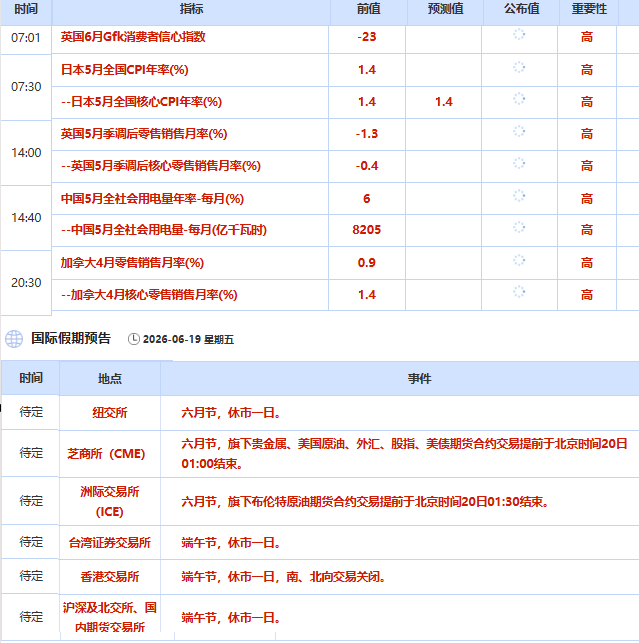
U.S. stocks rebounded strongly on Thursday, with the Nasdaq rising 1.9% to 26,517.93, the S&P 500 gaining 1.08% to 7,500.58, and the Dow Jones Industrial Average edged up 0.14% to 51,564.70, mainly boosted by a surge in semiconductor stocks.
The Philadelphia Semiconductor Index surged 6.4%, with Intel shares jumping 10.6% to a record high after Trump announced that Apple had agreed to partner with them to design and manufacture chips in the United States. Meanwhile, the US and Iran signed a temporary agreement extending the ceasefire for 60 days, and the first ships began transiting the Strait of Hormuz. Oil prices fell to their lowest level since early March, easing inflation concerns. However, the market is still digesting Federal Reserve Chairman Warsh's emphasis on curbing inflation. Traders estimate a roughly 50% probability of a 25-basis-point rate hike in September and a roughly 20% probability of a 50-basis-point hike.
Technology and consumer discretionary sectors led the gains, while travel-related stocks rose due to a lower outlook for fuel prices. The Russell 2000 small-cap index hit a new closing high, while initial jobless claims data showed that layoffs remained low. Overall, the S&P 500 rose 0.93% this week, the Nasdaq rose 2.43%, and the Dow Jones rose 0.71%. The market was closed on Friday for the Juneteenth holiday.
Gold prices fell on Thursday, with spot gold closing down 1.18% at $4,208.92 an ounce, mainly as hawkish signals from the Federal Reserve pushed the dollar index to a one-year high, putting pressure on dollar-denominated gold.
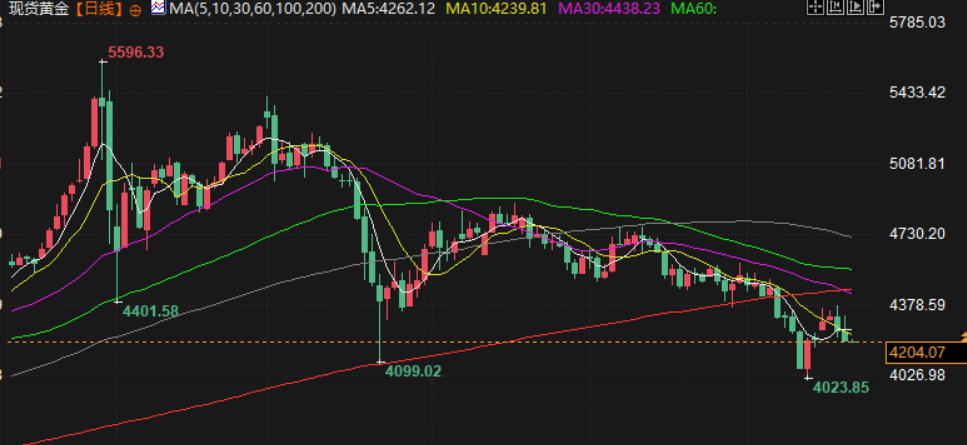
The Federal Reserve kept interest rates unchanged on Wednesday, but nine of its 19 policymakers believed a rate hike would be necessary later this year. Market expectations for a December rate hike have risen from 61% before the statement to 85%, and the high-interest-rate environment continues to suppress the performance of gold, a non-interest-bearing asset.
However, the signing of a temporary agreement between the US and Iran to extend the ceasefire for 60 days and allow ships to pass through the Strait of Hormuz, along with oil prices falling to multi-month lows, alleviated inflation concerns to some extent and provided some support for gold prices.
Other precious metals also declined, with spot silver falling 3% to $65.96, platinum down 1.9% to $1703.94, and palladium down 2.2% to $1285.96.
Oil prices fluctuated on Thursday. Brent crude rose 0.96% to settle at $79.37 a barrel, after hitting its lowest level since February 27 during the session. WTI crude rose 0.68% to settle at $75.52, after hitting a three-month low of $72.83 a barrel during the session.
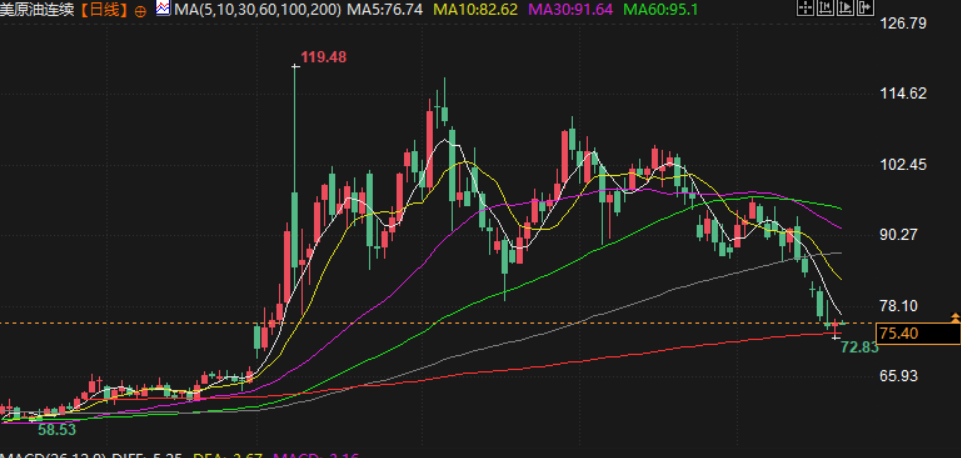
The market was under pressure in early trading as the 14-point interim agreement reached between the US and Iran, which extended the ceasefire for 60 days and pledged to restore navigation in the Strait of Hormuz, initially sparked expectations of a supply recovery. However, subsequent warnings from US Vice President Vance against further attacks on Hezbollah, which is supported by Iran in Lebanon, raised doubts about the sustainability of the ceasefire agreement, and geopolitical risk premiums once again supported a rebound in oil prices. The agreement requires the strait's navigation capacity to be restored to full capacity within 30 days, and analysts expect oil transportation to gradually recover. However, industry experts warned that with the recovery in demand and inventory replenishment, oil prices may not fall sharply. In addition, the second drone attack this week on a Moscow refinery added to geopolitical tensions.
The dollar index rose 0.45% to 100.83 on Thursday, driven by hawkish signals from the Federal Reserve, marking a one-year high since May 2025. This was driven by the fact that nearly half of Fed policymakers expect interest rate hikes this year, with the federal funds futures market showing a 68% probability of a September rate hike. Recent nonfarm payroll reports, which far exceeded expectations, and initial jobless claims remaining low, further boosted the outlook for U.S. economic growth.
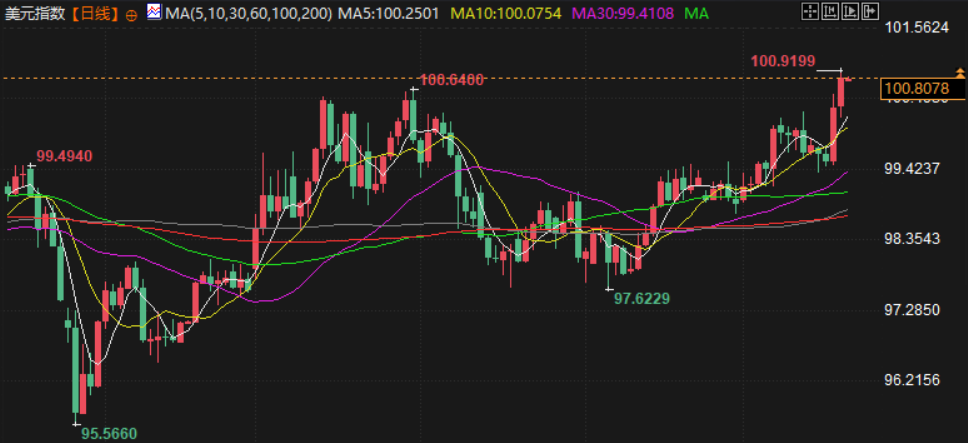
A stronger dollar dragged down the euro, which fell 0.31% to $1.1463, and the pound fell 0.62% to $1.3206, both hitting their lowest levels in more than two months. The yen even touched a new low of 161.45 yen to the dollar since July 2024, almost erasing all gains from previous interventions and approaching its lowest level since 1986 at 161.99. This prompted Chief Cabinet Secretary Minoru Kihara to reiterate Japan's readiness to take appropriate measures to address exchange rate fluctuations.
Meanwhile, the interim agreement between the US and Iran pushed oil prices down to pre-war levels, and about 12.5 million barrels of crude oil passed through the Strait of Hormuz overnight, which limited the further rise of the US dollar to some extent. However, the hawkish stance of the Federal Reserve still dominates the direction of the foreign exchange market, and analysts believe that the US dollar still has room to strengthen further.
Sources: Iran postpones trip to Switzerland due to ongoing Israeli attacks on Lebanon.
On the 18th local time, an informed source stated that the Iranian negotiating delegation has postponed its trip to Switzerland due to Israel's continued attacks on southern Lebanon. The source indicated that the delegation was preparing to depart and planned to launch the first round of 60-day negotiations before deciding to suspend the trip. Iran had previously informed the United States and mediators that the Lebanese issue remains a core component of the Iran-US negotiations and will directly affect whether the negotiations continue or are suspended. The source also said that Iran warned that Israeli forces have penetrated approximately 10 kilometers into Lebanon, continuing their military operations and attacks, which blatantly violates Article 1 of the memorandum of understanding. (CCTV News)
Iran: Free passage through the Strait of Hormuz for 60 days
According to a report by the Islamic Republic News Agency (IRNA) on the 18th, Iran's Supreme National Security Council issued a statement saying that, in accordance with the Iran-US Memorandum of Understanding (MOU), vessels applying to pass through the Strait of Hormuz will be exempt from relevant fees for the next 60 days. The statement said that, according to Article 5 of the MOU, merchant ships applying to pass through the Strait of Hormuz must submit an application to the Persian Gulf Straits Authority (PERA). During the 60-day period, no fees will be charged to vessels applying to pass through the Strait of Hormuz, and the relevant costs will be borne by the Iranian government. Based on this, Iran has instructed PERA to review and respond to the relevant applications as soon as possible. The statement indicated that, given the current special circumstances and the continued security risks in some areas of the waterway, to ensure navigational safety and avoid maritime accidents, vessels must pass through the Strait of Hormuz according to designated routes and times. The statement also said that specific implementation arrangements and technical details regarding navigation through the Strait of Hormuz will be announced separately by PERA. Regarding other matters, including mine clearance, Iran will take necessary measures in accordance with Article 5 of the MOU. (Xinhua)
Vance: The 60-day negotiation period begins on the 18th; he will lead the US team.
U.S. Vice President Vance said at a White House press conference on the 18th that the 60-day deadline for reaching a final agreement stipulated in the memorandum of understanding between the U.S. and Iran began on the 18th, and he will lead the U.S. negotiating team in the upcoming negotiations. Vance said, "I think the 60-day deadline officially began today. Technically, I think it was signed today according to Iranian time, given the late signing time and time difference." Vance indicated that he still plans to travel to Switzerland, but the specific date is yet to be determined. Technical negotiations between the U.S. and Iran are expected to begin this weekend. He pointed out that both Iran and the U.S. have so far been fulfilling their military commitments in the memorandum of understanding. Iran has not fired on any ships in the Strait of Hormuz for two consecutive nights, and the U.S. military has allowed numerous ships to pass through its maritime blockade. Vance said that the final agreement with Iran will resolve the long-standing operational issues of the Strait of Hormuz and it is essential to ensure that this crucial waterway "will never again become a bottleneck for the global economy." He emphasized that the U.S. believes that international waterways should not be subject to tolls. When asked who would contribute the $300 billion mentioned in the memorandum of understanding for Iran's reconstruction and economic development, Vance said that the negotiations were still in their early stages and he could not give a definitive answer. He also emphasized that the economic benefits of the agreement could only be realized if Iran "fully complies" and "changes its behavior." Vance also stated that Israel's military operations in Lebanon had sometimes hindered breakthroughs in US-Iran negotiations, which frustrated US President Trump. He reiterated Israel's right to self-defense but urged Israel to "respect this peace process that is beneficial to them and the entire region." (Xinhua)
Trump stated that he expects "a complete ceasefire on all fronts."
On June 18 local time, US President Trump posted on social media that the United States is committed to peace and called on all parties in the Middle East to continue to fulfill their commitments and ensure that current negotiations "proceed smoothly." He stated that the US expects "a comprehensive ceasefire on all fronts," including those in Lebanon, Hezbollah, and Israel. (CCTV News)
Iran's Supreme Leader: Face-to-face negotiations do not mean accepting the enemy's views
Iran's Supreme Leader Mojtaba Khamenei issued a statement on the 18th regarding the Iran-US memorandum of understanding, saying that future face-to-face negotiations do not mean accepting the views of the "enemy." (Xinhua)
Russian Foreign Minister says Russia will launch regular large-scale strikes against Ukraine.
Russian Foreign Minister Sergey Lavrov stated today (June 18) that Russia will launch "frequent and large-scale coordinated strikes" against Ukraine in response to the country's massive drone attacks on Moscow. (CCTV International News)
US lifts naval blockade against Iran
On June 18 local time, the U.S. Central Command issued a statement on social media, saying, "Today, following instructions from President Trump, the U.S. military lifted all blockades on maritime traffic to and from Iranian ports and coastal areas. The U.S. military is no longer obstructing shipping to and from Iranian ports in the Arabian Gulf and the Gulf of Oman. All U.S. military blockade operations have ceased. U.S. warships will remain in the region to ensure that all aspects of the agreement (the U.S.-Iran Memorandum of Understanding) are observed, implemented, and fully effective." (CCTV International News)
OPEC believes that global oil demand has not yet peaked, and energy security outweighs climate considerations.
OPEC maintains that global oil demand has not yet peaked, anticipating "strong growth" as governments in the US, Europe, and elsewhere prioritize energy security and affordability in addition to climate goals. "The rising focus on energy security and affordability has transformed the global energy policy landscape," OPEC stated. "In many cases, these shifts reflect the reversal, postponement, or cancellation of previously ambitious targets and commitments to reduce oil demand." In its annual World Oil Outlook, OPEC projects oil demand will increase from 105.1 million barrels per day in 2025 to 113.3 million barrels per day in 2030, reaching 124.1 million barrels per day by 2050. This optimistic view contrasts sharply with other forecasting agencies, such as the International Energy Agency (IEA). The Paris-based IEA recently predicted that the US-Israel war against Iran will have a far more severe impact on global oil demand than previously anticipated, projecting a 1.1 million barrel per day reduction in global oil consumption this year.
Iran will be allowed to use $6 billion in frozen funds, limited to purchasing US products.
According to reports, under a provisional agreement between the US and Iran, the Trump administration will allow Iran to use $6 billion in oil revenue held in Qatar to purchase US humanitarian aid and unsanctioned goods. This move is part of a multi-billion dollar economic incentive package offered by the Trump administration to ensure Iran adheres to its commitments in the memorandum of understanding and subsequent nuclear negotiations. The funds will be unfrozen in phases, with the specific timing scheduled within the 60-day ceasefire extension stipulated in the agreement, and depending on the reopening of the Strait of Hormuz and the progress of negotiations aimed at reaching a final solution. A diplomat familiar with the agreement stated that the funds can only be used to purchase US products. The White House declined to comment on specific details when asked about the matter, but a US official stated that Washington will unfreeze some assets during the final negotiations, provided Iran demonstrates good behavior (such as transferring its enriched uranium). The Trump administration will also grant waivers allowing Iran to export oil during the aforementioned 60 days and lift the maritime blockade on Iranian ports.
my country is accelerating the deployment of hyperspectral satellites.
This year, my country's commercial space program has maintained a high-density launch pace, successfully completing nine launches this month alone, sending various types of payloads into space. Currently, my country's commercial remote sensing satellite technology capabilities are constantly iterating, with multiple technological paths such as optics, radar, and hyperspectral imaging advancing simultaneously. The constellation network is continuously expanding, and a number of key technologies are leading globally. On June 15th, the Lijian-1 Y14 carrier rocket launched from the Dongfeng Commercial Space Innovation Test Zone, successfully sending eight satellites, including the "Jixing" Gaofen 07C04 satellite, into their predetermined orbits. These are the latest generation of high-resolution commercial remote sensing satellites, equipped with high-precision optical remote sensing cameras. Less than two hours after launch, these satellites transmitted their first batch of clear images. In the future, these satellites will routinely monitor the changes in the physical structures and surrounding environment of key immovable cultural relics across the country, upgrading the once-every-few-years "human patrols" of some remote areas to high-frequency "satellite patrols" revisiting multiple times a day. If optical satellites represent "improved clarity," then synthetic aperture radar (SAR) satellites are breaking through the boundaries of observation capabilities. It observes the ground by actively emitting microwaves and receiving signals reflected back from the ground, even at night and in foggy conditions. In March of this year, the SAR satellites Gaofen-2 05 and 06 were successfully launched, possessing high-resolution radar image acquisition capabilities better than 1 meter, enabling all-weather, three-dimensional, and all-scenario Earth observation. Beyond optical and SAR satellites, remote sensing capabilities are expanding to higher dimensions—upgrading from "seeing images" to "identifying information." In recent years, China has been accelerating the deployment of hyperspectral satellites. Two of these "Eastern Insight" hyperspectral satellites are scheduled for launch in the second half of this year. Their hyperspectral lenses can capture spectral information beyond visible light, enabling detailed analysis of vegetation, soil, and other information based on spectral characteristics. (CCTV Finance)
The price of domestically produced satellite engines has been reduced.
my country's commercial remote sensing technology capabilities for Earth observation are constantly iterating and network deployment is accelerating. According to incomplete statistics, the total planned number of remote sensing satellites exceeds 10,000. To overcome bottlenecks in remote sensing data utilization, some remote sensing constellations are also deploying AI chips on their satellites. Industry analysts believe that if remote sensing data can be fully processed and analyzed by AI in orbit, the amount of data that needs to be transmitted can be reduced to 5% to 10% of the original amount. From electric propulsion systems that "engine" satellites to flexible solar panels that provide energy, a batch of platform-level hard technologies are rapidly moving from the laboratory to the production line, supporting the large-scale deployment of my country's satellite constellations. In an aerospace product laboratory in Hangzhou, Zhejiang, an electric propulsion system is undergoing a simulated space environment for so-called ignition testing. The bluish plasma halo is the effect of ionizing inert gases such as xenon and krypton, and then using a magnetic field to accelerate and eject the ions. The thrust generated is sufficient for the satellite to navigate in space. This is also one of the most advanced space propulsion technologies currently available. Low-Earth orbit satellites rely on thrusters to maintain their orbit, switch orbits, and deorbit at the end of their orbit. This domestically produced electric propulsion system can eject ions at speeds of 15 to 30 kilometers per second, with an efficiency more than five times that of chemical propulsion. Although the thrust is only a few millinewtons, equivalent to the force required to lift an A4 sheet of paper, its advantage lies in its continuous output. Today, this electric propulsion product, with its independent intellectual property rights, has reached internationally advanced levels in performance and can be adapted to the different mission requirements of the commercial aerospace field. The price has also dropped from nearly 2 million yuan per unit for traditional aerospace missions to 500,000 to 700,000 yuan. (CCTV Finance)
Sales of fitness stair climbers have surged by nearly 300%.
Data from JD.com shows that the pet economy performed exceptionally well during this year's 618 shopping festival, with segmented demand continuing to be released: During the 618 period, JD.com's sales of small and exotic pet supplies increased by 67% year-on-year, senior pet food sales increased by 61% year-on-year, and smart pet appliances sales increased by 28% year-on-year. Besides spending money on their furry friends, consumers this year also focused more on self-improvement and enjoyment: JD.com's sales of fitness stair climbers increased by 276% year-on-year during the 618 period, and jade necklace sales increased by 116% year-on-year. Searches for "super delicious snacks" on Tmall surged 1800 times during the 618 period. (CCTV Finance)
Key Focus Today
stock market
U.S. stocks rebounded strongly on Thursday, with the Nasdaq rising 1.9% to 26,517.93, the S&P 500 gaining 1.08% to 7,500.58, and the Dow Jones Industrial Average edged up 0.14% to 51,564.70, mainly boosted by a surge in semiconductor stocks.
The Philadelphia Semiconductor Index surged 6.4%, with Intel shares jumping 10.6% to a record high after Trump announced that Apple had agreed to partner with them to design and manufacture chips in the United States. Meanwhile, the US and Iran signed a temporary agreement extending the ceasefire for 60 days, and the first ships began transiting the Strait of Hormuz. Oil prices fell to their lowest level since early March, easing inflation concerns. However, the market is still digesting Federal Reserve Chairman Warsh's emphasis on curbing inflation. Traders estimate a roughly 50% probability of a 25-basis-point rate hike in September and a roughly 20% probability of a 50-basis-point hike.
Technology and consumer discretionary sectors led the gains, while travel-related stocks rose due to a lower outlook for fuel prices. The Russell 2000 small-cap index hit a new closing high, while initial jobless claims data showed that layoffs remained low. Overall, the S&P 500 rose 0.93% this week, the Nasdaq rose 2.43%, and the Dow Jones rose 0.71%. The market was closed on Friday for the Juneteenth holiday.
Gold Market
Gold prices fell on Thursday, with spot gold closing down 1.18% at $4,208.92 an ounce, mainly as hawkish signals from the Federal Reserve pushed the dollar index to a one-year high, putting pressure on dollar-denominated gold.
The Federal Reserve kept interest rates unchanged on Wednesday, but nine of its 19 policymakers believed a rate hike would be necessary later this year. Market expectations for a December rate hike have risen from 61% before the statement to 85%, and the high-interest-rate environment continues to suppress the performance of gold, a non-interest-bearing asset.
However, the signing of a temporary agreement between the US and Iran to extend the ceasefire for 60 days and allow ships to pass through the Strait of Hormuz, along with oil prices falling to multi-month lows, alleviated inflation concerns to some extent and provided some support for gold prices.
Other precious metals also declined, with spot silver falling 3% to $65.96, platinum down 1.9% to $1703.94, and palladium down 2.2% to $1285.96.
oil market
Oil prices fluctuated on Thursday. Brent crude rose 0.96% to settle at $79.37 a barrel, after hitting its lowest level since February 27 during the session. WTI crude rose 0.68% to settle at $75.52, after hitting a three-month low of $72.83 a barrel during the session.
The market was under pressure in early trading as the 14-point interim agreement reached between the US and Iran, which extended the ceasefire for 60 days and pledged to restore navigation in the Strait of Hormuz, initially sparked expectations of a supply recovery. However, subsequent warnings from US Vice President Vance against further attacks on Hezbollah, which is supported by Iran in Lebanon, raised doubts about the sustainability of the ceasefire agreement, and geopolitical risk premiums once again supported a rebound in oil prices. The agreement requires the strait's navigation capacity to be restored to full capacity within 30 days, and analysts expect oil transportation to gradually recover. However, industry experts warned that with the recovery in demand and inventory replenishment, oil prices may not fall sharply. In addition, the second drone attack this week on a Moscow refinery added to geopolitical tensions.
Foreign exchange market
The dollar index rose 0.45% to 100.83 on Thursday, driven by hawkish signals from the Federal Reserve, marking a one-year high since May 2025. This was driven by the fact that nearly half of Fed policymakers expect interest rate hikes this year, with the federal funds futures market showing a 68% probability of a September rate hike. Recent nonfarm payroll reports, which far exceeded expectations, and initial jobless claims remaining low, further boosted the outlook for U.S. economic growth.
A stronger dollar dragged down the euro, which fell 0.31% to $1.1463, and the pound fell 0.62% to $1.3206, both hitting their lowest levels in more than two months. The yen even touched a new low of 161.45 yen to the dollar since July 2024, almost erasing all gains from previous interventions and approaching its lowest level since 1986 at 161.99. This prompted Chief Cabinet Secretary Minoru Kihara to reiterate Japan's readiness to take appropriate measures to address exchange rate fluctuations.
Meanwhile, the interim agreement between the US and Iran pushed oil prices down to pre-war levels, and about 12.5 million barrels of crude oil passed through the Strait of Hormuz overnight, which limited the further rise of the US dollar to some extent. However, the hawkish stance of the Federal Reserve still dominates the direction of the foreign exchange market, and analysts believe that the US dollar still has room to strengthen further.
International News
Sources: Iran postpones trip to Switzerland due to ongoing Israeli attacks on Lebanon.
On the 18th local time, an informed source stated that the Iranian negotiating delegation has postponed its trip to Switzerland due to Israel's continued attacks on southern Lebanon. The source indicated that the delegation was preparing to depart and planned to launch the first round of 60-day negotiations before deciding to suspend the trip. Iran had previously informed the United States and mediators that the Lebanese issue remains a core component of the Iran-US negotiations and will directly affect whether the negotiations continue or are suspended. The source also said that Iran warned that Israeli forces have penetrated approximately 10 kilometers into Lebanon, continuing their military operations and attacks, which blatantly violates Article 1 of the memorandum of understanding. (CCTV News)
Iran: Free passage through the Strait of Hormuz for 60 days
According to a report by the Islamic Republic News Agency (IRNA) on the 18th, Iran's Supreme National Security Council issued a statement saying that, in accordance with the Iran-US Memorandum of Understanding (MOU), vessels applying to pass through the Strait of Hormuz will be exempt from relevant fees for the next 60 days. The statement said that, according to Article 5 of the MOU, merchant ships applying to pass through the Strait of Hormuz must submit an application to the Persian Gulf Straits Authority (PERA). During the 60-day period, no fees will be charged to vessels applying to pass through the Strait of Hormuz, and the relevant costs will be borne by the Iranian government. Based on this, Iran has instructed PERA to review and respond to the relevant applications as soon as possible. The statement indicated that, given the current special circumstances and the continued security risks in some areas of the waterway, to ensure navigational safety and avoid maritime accidents, vessels must pass through the Strait of Hormuz according to designated routes and times. The statement also said that specific implementation arrangements and technical details regarding navigation through the Strait of Hormuz will be announced separately by PERA. Regarding other matters, including mine clearance, Iran will take necessary measures in accordance with Article 5 of the MOU. (Xinhua)
Vance: The 60-day negotiation period begins on the 18th; he will lead the US team.
U.S. Vice President Vance said at a White House press conference on the 18th that the 60-day deadline for reaching a final agreement stipulated in the memorandum of understanding between the U.S. and Iran began on the 18th, and he will lead the U.S. negotiating team in the upcoming negotiations. Vance said, "I think the 60-day deadline officially began today. Technically, I think it was signed today according to Iranian time, given the late signing time and time difference." Vance indicated that he still plans to travel to Switzerland, but the specific date is yet to be determined. Technical negotiations between the U.S. and Iran are expected to begin this weekend. He pointed out that both Iran and the U.S. have so far been fulfilling their military commitments in the memorandum of understanding. Iran has not fired on any ships in the Strait of Hormuz for two consecutive nights, and the U.S. military has allowed numerous ships to pass through its maritime blockade. Vance said that the final agreement with Iran will resolve the long-standing operational issues of the Strait of Hormuz and it is essential to ensure that this crucial waterway "will never again become a bottleneck for the global economy." He emphasized that the U.S. believes that international waterways should not be subject to tolls. When asked who would contribute the $300 billion mentioned in the memorandum of understanding for Iran's reconstruction and economic development, Vance said that the negotiations were still in their early stages and he could not give a definitive answer. He also emphasized that the economic benefits of the agreement could only be realized if Iran "fully complies" and "changes its behavior." Vance also stated that Israel's military operations in Lebanon had sometimes hindered breakthroughs in US-Iran negotiations, which frustrated US President Trump. He reiterated Israel's right to self-defense but urged Israel to "respect this peace process that is beneficial to them and the entire region." (Xinhua)
Trump stated that he expects "a complete ceasefire on all fronts."
On June 18 local time, US President Trump posted on social media that the United States is committed to peace and called on all parties in the Middle East to continue to fulfill their commitments and ensure that current negotiations "proceed smoothly." He stated that the US expects "a comprehensive ceasefire on all fronts," including those in Lebanon, Hezbollah, and Israel. (CCTV News)
Iran's Supreme Leader: Face-to-face negotiations do not mean accepting the enemy's views
Iran's Supreme Leader Mojtaba Khamenei issued a statement on the 18th regarding the Iran-US memorandum of understanding, saying that future face-to-face negotiations do not mean accepting the views of the "enemy." (Xinhua)
Russian Foreign Minister says Russia will launch regular large-scale strikes against Ukraine.
Russian Foreign Minister Sergey Lavrov stated today (June 18) that Russia will launch "frequent and large-scale coordinated strikes" against Ukraine in response to the country's massive drone attacks on Moscow. (CCTV International News)
US lifts naval blockade against Iran
On June 18 local time, the U.S. Central Command issued a statement on social media, saying, "Today, following instructions from President Trump, the U.S. military lifted all blockades on maritime traffic to and from Iranian ports and coastal areas. The U.S. military is no longer obstructing shipping to and from Iranian ports in the Arabian Gulf and the Gulf of Oman. All U.S. military blockade operations have ceased. U.S. warships will remain in the region to ensure that all aspects of the agreement (the U.S.-Iran Memorandum of Understanding) are observed, implemented, and fully effective." (CCTV International News)
OPEC believes that global oil demand has not yet peaked, and energy security outweighs climate considerations.
OPEC maintains that global oil demand has not yet peaked, anticipating "strong growth" as governments in the US, Europe, and elsewhere prioritize energy security and affordability in addition to climate goals. "The rising focus on energy security and affordability has transformed the global energy policy landscape," OPEC stated. "In many cases, these shifts reflect the reversal, postponement, or cancellation of previously ambitious targets and commitments to reduce oil demand." In its annual World Oil Outlook, OPEC projects oil demand will increase from 105.1 million barrels per day in 2025 to 113.3 million barrels per day in 2030, reaching 124.1 million barrels per day by 2050. This optimistic view contrasts sharply with other forecasting agencies, such as the International Energy Agency (IEA). The Paris-based IEA recently predicted that the US-Israel war against Iran will have a far more severe impact on global oil demand than previously anticipated, projecting a 1.1 million barrel per day reduction in global oil consumption this year.
Iran will be allowed to use $6 billion in frozen funds, limited to purchasing US products.
According to reports, under a provisional agreement between the US and Iran, the Trump administration will allow Iran to use $6 billion in oil revenue held in Qatar to purchase US humanitarian aid and unsanctioned goods. This move is part of a multi-billion dollar economic incentive package offered by the Trump administration to ensure Iran adheres to its commitments in the memorandum of understanding and subsequent nuclear negotiations. The funds will be unfrozen in phases, with the specific timing scheduled within the 60-day ceasefire extension stipulated in the agreement, and depending on the reopening of the Strait of Hormuz and the progress of negotiations aimed at reaching a final solution. A diplomat familiar with the agreement stated that the funds can only be used to purchase US products. The White House declined to comment on specific details when asked about the matter, but a US official stated that Washington will unfreeze some assets during the final negotiations, provided Iran demonstrates good behavior (such as transferring its enriched uranium). The Trump administration will also grant waivers allowing Iran to export oil during the aforementioned 60 days and lift the maritime blockade on Iranian ports.
Domestic News
my country is accelerating the deployment of hyperspectral satellites.
This year, my country's commercial space program has maintained a high-density launch pace, successfully completing nine launches this month alone, sending various types of payloads into space. Currently, my country's commercial remote sensing satellite technology capabilities are constantly iterating, with multiple technological paths such as optics, radar, and hyperspectral imaging advancing simultaneously. The constellation network is continuously expanding, and a number of key technologies are leading globally. On June 15th, the Lijian-1 Y14 carrier rocket launched from the Dongfeng Commercial Space Innovation Test Zone, successfully sending eight satellites, including the "Jixing" Gaofen 07C04 satellite, into their predetermined orbits. These are the latest generation of high-resolution commercial remote sensing satellites, equipped with high-precision optical remote sensing cameras. Less than two hours after launch, these satellites transmitted their first batch of clear images. In the future, these satellites will routinely monitor the changes in the physical structures and surrounding environment of key immovable cultural relics across the country, upgrading the once-every-few-years "human patrols" of some remote areas to high-frequency "satellite patrols" revisiting multiple times a day. If optical satellites represent "improved clarity," then synthetic aperture radar (SAR) satellites are breaking through the boundaries of observation capabilities. It observes the ground by actively emitting microwaves and receiving signals reflected back from the ground, even at night and in foggy conditions. In March of this year, the SAR satellites Gaofen-2 05 and 06 were successfully launched, possessing high-resolution radar image acquisition capabilities better than 1 meter, enabling all-weather, three-dimensional, and all-scenario Earth observation. Beyond optical and SAR satellites, remote sensing capabilities are expanding to higher dimensions—upgrading from "seeing images" to "identifying information." In recent years, China has been accelerating the deployment of hyperspectral satellites. Two of these "Eastern Insight" hyperspectral satellites are scheduled for launch in the second half of this year. Their hyperspectral lenses can capture spectral information beyond visible light, enabling detailed analysis of vegetation, soil, and other information based on spectral characteristics. (CCTV Finance)
The price of domestically produced satellite engines has been reduced.
my country's commercial remote sensing technology capabilities for Earth observation are constantly iterating and network deployment is accelerating. According to incomplete statistics, the total planned number of remote sensing satellites exceeds 10,000. To overcome bottlenecks in remote sensing data utilization, some remote sensing constellations are also deploying AI chips on their satellites. Industry analysts believe that if remote sensing data can be fully processed and analyzed by AI in orbit, the amount of data that needs to be transmitted can be reduced to 5% to 10% of the original amount. From electric propulsion systems that "engine" satellites to flexible solar panels that provide energy, a batch of platform-level hard technologies are rapidly moving from the laboratory to the production line, supporting the large-scale deployment of my country's satellite constellations. In an aerospace product laboratory in Hangzhou, Zhejiang, an electric propulsion system is undergoing a simulated space environment for so-called ignition testing. The bluish plasma halo is the effect of ionizing inert gases such as xenon and krypton, and then using a magnetic field to accelerate and eject the ions. The thrust generated is sufficient for the satellite to navigate in space. This is also one of the most advanced space propulsion technologies currently available. Low-Earth orbit satellites rely on thrusters to maintain their orbit, switch orbits, and deorbit at the end of their orbit. This domestically produced electric propulsion system can eject ions at speeds of 15 to 30 kilometers per second, with an efficiency more than five times that of chemical propulsion. Although the thrust is only a few millinewtons, equivalent to the force required to lift an A4 sheet of paper, its advantage lies in its continuous output. Today, this electric propulsion product, with its independent intellectual property rights, has reached internationally advanced levels in performance and can be adapted to the different mission requirements of the commercial aerospace field. The price has also dropped from nearly 2 million yuan per unit for traditional aerospace missions to 500,000 to 700,000 yuan. (CCTV Finance)
Sales of fitness stair climbers have surged by nearly 300%.
Data from JD.com shows that the pet economy performed exceptionally well during this year's 618 shopping festival, with segmented demand continuing to be released: During the 618 period, JD.com's sales of small and exotic pet supplies increased by 67% year-on-year, senior pet food sales increased by 61% year-on-year, and smart pet appliances sales increased by 28% year-on-year. Besides spending money on their furry friends, consumers this year also focused more on self-improvement and enjoyment: JD.com's sales of fitness stair climbers increased by 276% year-on-year during the 618 period, and jade necklace sales increased by 116% year-on-year. Searches for "super delicious snacks" on Tmall surged 1800 times during the 618 period. (CCTV Finance)
- Risk Warning and Disclaimer
- The market involves risk, and trading may not be suitable for all investors. This article is for reference only and does not constitute personal investment advice, nor does it take into account certain users’ specific investment objectives, financial situation, or other needs. Any investment decisions made based on this information are at your own risk.