"The dumbest deal in history?" Trump attacked by his own people; oil prices fall 10% this week.
2026-06-19 08:46:16
On Friday (June 19) during Asian trading hours, US crude oil futures fluctuated and fell, currently down about 0.7% to $75.30 per barrel, with a weekly decline of more than 10%.
US President Trump reached a provisional peace agreement with Iran at the Palace of Versailles in France on Wednesday. Officials released the full details of the cooperation, and the agreement clearly states that the Strait of Hormuz will allow safe, free, and regular navigation.
The interim agreement reached by US President Trump to end the conflict with Iran sparked strong backlash on Capitol Hill on Thursday.
As copies of the agreement circulated among lawmakers, several Republican colleagues publicly criticized the framework agreement, resulting in a rare confrontation between top party members and the White House. Lawmakers from both parties expressed a desire for more information from the White House. As of Thursday, Congress had not received any briefings, and the administration had not announced any briefing schedules.
Critics have focused their criticism on the same issue: the agreement grants Iran significant economic benefits but fails to deliver any substantial new commitments.
According to media reports, the Trump administration agreed to unfreeze Iranian assets, allow the establishment of a private wealth fund of up to $300 billion to promote investment in Iran, and ease several sanctions. Iran, however, only pledged to keep the Strait of Hormuz open and not to develop nuclear weapons—both of which critics argue were pre-war conditions, and the US has not made any breakthrough progress.
According to the Iran Nuclear Agreement Review Act (INARA) passed in 2015, any agreement involving Iran's nuclear program and the easing of sanctions must be reviewed by Congress, and several members of Congress have indicated that the agreement must be submitted to Congress for consideration.
Louisiana Republican Senator Bill Cassidy posted a particularly strong message on the X platform. He pointed out that before the war, the Strait of Hormuz remained open and Iran was subject to severe sanctions; but now, "13 Americans have died, Americans have paid billions more for high oil prices, sanctions are about to be lifted, and the bombing has stopped"—he bluntly stated that this is "the worst foreign policy mistake in decades."
Senate Armed Services Committee Chairman Roger Wick expressed concern that the memorandum would "sell out" the military achievements already made by the United States through negotiations, and explicitly opposed lifting sanctions or unfreezing funds on the condition that "Iran only agrees to renegotiate for 60 days."
Conservative commentator Ben Shapiro called the agreement "a disaster," while media commentator Mark Levin criticized the government for not including ballistic missiles in the agreement, calling the decision "outrageous."
Facing attacks from within his own party, Trump lashed out on social media, calling his critics "either jealous, bad people, or idiots." He also emphasized that the stock market was hitting record highs and oil prices were falling, using these as evidence that the agreement was valid.
On the other hand, some Republicans still expressed their support—Kansas Senator Roger Marshall said that Trump had chosen "the path to lasting peace—rather than another endless war," showing that there was no monolithic opposition to the agreement within the party.
This fierce criticism from within the Republican Party is extremely rare during Trump's presidency. Behind it lies the economic impact of the Iran conflict eroding the Republican Party's chances ahead of the November midterm elections, while Democrats have joined the criticism, attempting to regain lost ground in Congress.
The next step, whether the memorandum is formally submitted to Congress for review and how it is responded to inquiries from members of both parties, will determine whether this interim agreement can truly translate into lasting peace or become a deep rift in Trump's foreign policy legacy. Regardless of the outcome, the political struggle surrounding the Iran agreement has only just begun.
The ongoing geopolitical maneuvering behind the agreement directly influences the risk pricing of international crude oil, and this is reflected in the market, with the technical trend of US crude oil futures already releasing a clear bearish signal.
According to the daily chart, US crude oil futures have shown a sustained downward trend after peaking at a high level. After reaching a high of $119.48 in March, bullish momentum completely exhausted, and prices gradually declined, recently hitting a low of $72.83, with the current price at $75.29. The moving average system is entirely bearish, with the short-term MA5 and MA10 continuously suppressing prices, while the medium- and long-term MA30, MA60, MA100, and MA200 have all turned downwards, forming layers of resistance and severely limiting the potential for a rebound.
The candlestick pattern shows consecutive bearish candles, with only slight, weak rebounds during the decline, lacking any effective signs of a bottoming out or reversal. The bears dominate the market. The MACD indicator remains below the zero line, with the DIFF line below the DEA line and the green bars continuing to expand, indicating that the bearish momentum has not yet significantly weakened and no bullish divergence or stabilization structure has been observed.
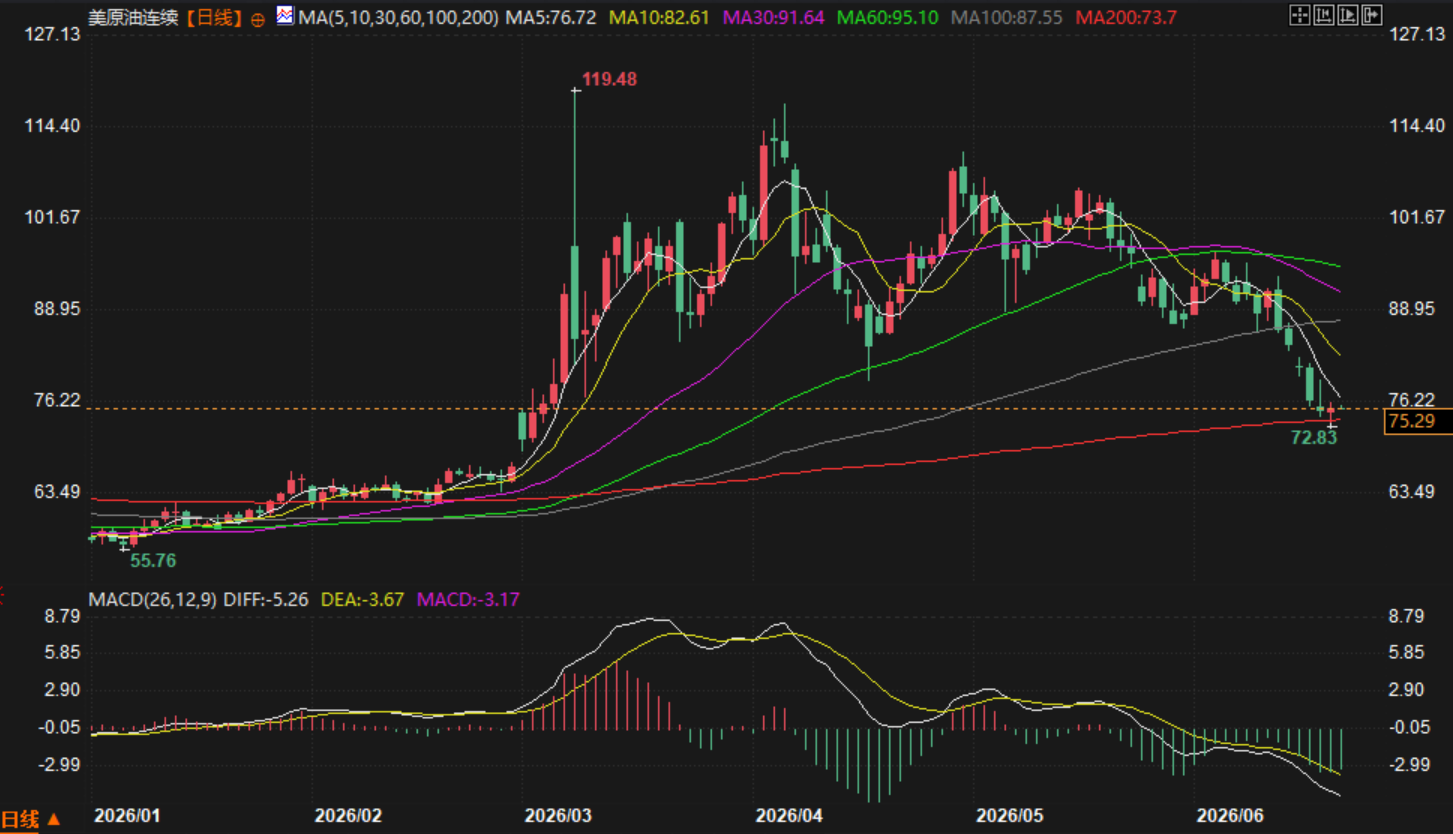
(US crude oil futures daily chart, source: FX678)
At 8:20 a.m. Beijing time on June 19, US crude oil futures were trading at $75.13 per barrel.
US President Trump reached a provisional peace agreement with Iran at the Palace of Versailles in France on Wednesday. Officials released the full details of the cooperation, and the agreement clearly states that the Strait of Hormuz will allow safe, free, and regular navigation.
The interim agreement reached by US President Trump to end the conflict with Iran sparked strong backlash on Capitol Hill on Thursday.
As copies of the agreement circulated among lawmakers, several Republican colleagues publicly criticized the framework agreement, resulting in a rare confrontation between top party members and the White House. Lawmakers from both parties expressed a desire for more information from the White House. As of Thursday, Congress had not received any briefings, and the administration had not announced any briefing schedules.
The core controversy of the agreement: What did the United States get in return?
Critics have focused their criticism on the same issue: the agreement grants Iran significant economic benefits but fails to deliver any substantial new commitments.
According to media reports, the Trump administration agreed to unfreeze Iranian assets, allow the establishment of a private wealth fund of up to $300 billion to promote investment in Iran, and ease several sanctions. Iran, however, only pledged to keep the Strait of Hormuz open and not to develop nuclear weapons—both of which critics argue were pre-war conditions, and the US has not made any breakthrough progress.
According to the Iran Nuclear Agreement Review Act (INARA) passed in 2015, any agreement involving Iran's nuclear program and the easing of sanctions must be reviewed by Congress, and several members of Congress have indicated that the agreement must be submitted to Congress for consideration.
Rarely criticized within the party: "The most serious diplomatic blunder in decades"
Louisiana Republican Senator Bill Cassidy posted a particularly strong message on the X platform. He pointed out that before the war, the Strait of Hormuz remained open and Iran was subject to severe sanctions; but now, "13 Americans have died, Americans have paid billions more for high oil prices, sanctions are about to be lifted, and the bombing has stopped"—he bluntly stated that this is "the worst foreign policy mistake in decades."
Senate Armed Services Committee Chairman Roger Wick expressed concern that the memorandum would "sell out" the military achievements already made by the United States through negotiations, and explicitly opposed lifting sanctions or unfreezing funds on the condition that "Iran only agrees to renegotiate for 60 days."
Conservative commentator Ben Shapiro called the agreement "a disaster," while media commentator Mark Levin criticized the government for not including ballistic missiles in the agreement, calling the decision "outrageous."
Trump lashes out, calling critics "stupid," citing a stock market rally.
Facing attacks from within his own party, Trump lashed out on social media, calling his critics "either jealous, bad people, or idiots." He also emphasized that the stock market was hitting record highs and oil prices were falling, using these as evidence that the agreement was valid.
On the other hand, some Republicans still expressed their support—Kansas Senator Roger Marshall said that Trump had chosen "the path to lasting peace—rather than another endless war," showing that there was no monolithic opposition to the agreement within the party.
Political maneuvering under election pressure: The test has only just begun.
This fierce criticism from within the Republican Party is extremely rare during Trump's presidency. Behind it lies the economic impact of the Iran conflict eroding the Republican Party's chances ahead of the November midterm elections, while Democrats have joined the criticism, attempting to regain lost ground in Congress.
The next step, whether the memorandum is formally submitted to Congress for review and how it is responded to inquiries from members of both parties, will determine whether this interim agreement can truly translate into lasting peace or become a deep rift in Trump's foreign policy legacy. Regardless of the outcome, the political struggle surrounding the Iran agreement has only just begun.
Technical Analysis
The ongoing geopolitical maneuvering behind the agreement directly influences the risk pricing of international crude oil, and this is reflected in the market, with the technical trend of US crude oil futures already releasing a clear bearish signal.
According to the daily chart, US crude oil futures have shown a sustained downward trend after peaking at a high level. After reaching a high of $119.48 in March, bullish momentum completely exhausted, and prices gradually declined, recently hitting a low of $72.83, with the current price at $75.29. The moving average system is entirely bearish, with the short-term MA5 and MA10 continuously suppressing prices, while the medium- and long-term MA30, MA60, MA100, and MA200 have all turned downwards, forming layers of resistance and severely limiting the potential for a rebound.
The candlestick pattern shows consecutive bearish candles, with only slight, weak rebounds during the decline, lacking any effective signs of a bottoming out or reversal. The bears dominate the market. The MACD indicator remains below the zero line, with the DIFF line below the DEA line and the green bars continuing to expand, indicating that the bearish momentum has not yet significantly weakened and no bullish divergence or stabilization structure has been observed.
(US crude oil futures daily chart, source: FX678)
At 8:20 a.m. Beijing time on June 19, US crude oil futures were trading at $75.13 per barrel.
- Risk Warning and Disclaimer
- The market involves risk, and trading may not be suitable for all investors. This article is for reference only and does not constitute personal investment advice, nor does it take into account certain users’ specific investment objectives, financial situation, or other needs. Any investment decisions made based on this information are at your own risk.