The yen has rebounded strongly in the short term, but the extent of the USD/JPY pullback remains uncertain.
2026-06-19 11:21:37
The USD/JPY pair retreated in Asian trading on Friday. This article analyzes the multiple supports for the yen's short-term strength, taking into account the Bank of Japan's meeting minutes, official statements, domestic inflation data, and the differences in US-Japan monetary policy. It also points out that the huge interest rate differential between the US and Japan will limit the downside of the exchange rate, and the market should not prematurely conclude that the short-term trend of USD/JPY has reversed.
During Friday's Asian trading session, the USD/JPY pair continued its decline from the previous session's high of 161.80, the highest level since July 2024, with the market maintaining a downward trend. USD/JPY briefly fell to the key psychological level of 161.00, ending a five-day winning streak.
Despite the obvious pullback in the market, the bulls still have the upper hand in the overall short-term technical trend, and a deep downward trend has not yet formed a definite trend.
The core driver of this round of yen strengthening comes from the release of the minutes of the Bank of Japan's April policy meeting. The minutes revealed that several policy committee members stated that the pace of interest rate hikes should be accelerated to prevent core inflation from significantly exceeding the policy target. The market generally anticipates that rising raw material procurement costs for businesses will gradually be passed on to downstream consumer goods, putting upward pressure on Japanese inflation in the coming months. This provides ample logical support for the Bank of Japan's continued tightening of monetary policy.
Bank of Japan Deputy Governor Himino stated that the central bank will continue to raise interest rates based on the overall situation of the domestic economy, prices, and financial markets. Himino added that exchange rate fluctuations are one of the core variables affecting Japan's domestic economic performance and price trends.
Japanese Chief Cabinet Secretary Minoru Kihara stated on Thursday that the government is fully prepared to implement corresponding control measures in response to abnormal exchange rate fluctuations. This statement fueled market expectations of foreign exchange market intervention, further supporting the yen and partially offsetting the negative impact of weaker domestic inflation data. Data released by Japan's Ministry of Internal Affairs and Communications showed that the national consumer price index rose 1.5% year-on-year in May, while the core consumer price index, excluding fresh food, rose 1.4% year-on-year.
Core inflation data, excluding the highly volatile categories of fresh food and energy, was even weaker, with the year-on-year increase falling to 1.8% in May, a significant decline from the 1.9% year-on-year growth rate in April. This indicator has remained below the Bank of Japan's 2% annual inflation target for four consecutive months, marking the lowest growth rate in four years. Even with weak inflation fundamentals, the data failed to exert significant downward pressure on the yen.
The US dollar's gains this week have been solid, with the exchange rate holding above its highest level since May 2025, continuing to exert downward pressure on the USD/JPY pair. However, the exchange rate has not yet experienced a sustained and deep depreciation.
The persistently large interest rate differential between the US and Japan has kept carry trades shorting the yen active.
The Bank of Japan raised its interest rate to 1% on Tuesday, a new high since 1995; the Federal Reserve Chairman maintained the benchmark interest rate range at 3.5% to 3.75%, and the policy rate differential remains significant. This persistent interest rate differential will discourage large-scale entry of yen bulls, indirectly limiting the downside potential of the USD/JPY exchange rate.
In summary, multiple policy-related positive factors propelled the yen's rebound in Asian trading on Friday, briefly ending the USD/JPY's winning streak. However, the interest rate differential resulting from US-Japan monetary policy remains the core factor suppressing the yen's strength in the long term. Until a sustained sell-off signal appears on the charts, it cannot be confirmed that the USD/JPY has peaked in the short term. Investors should not blindly position themselves for a significant pullback and should continue to monitor price levels, policy statements, and official foreign exchange market adjustments in both countries.
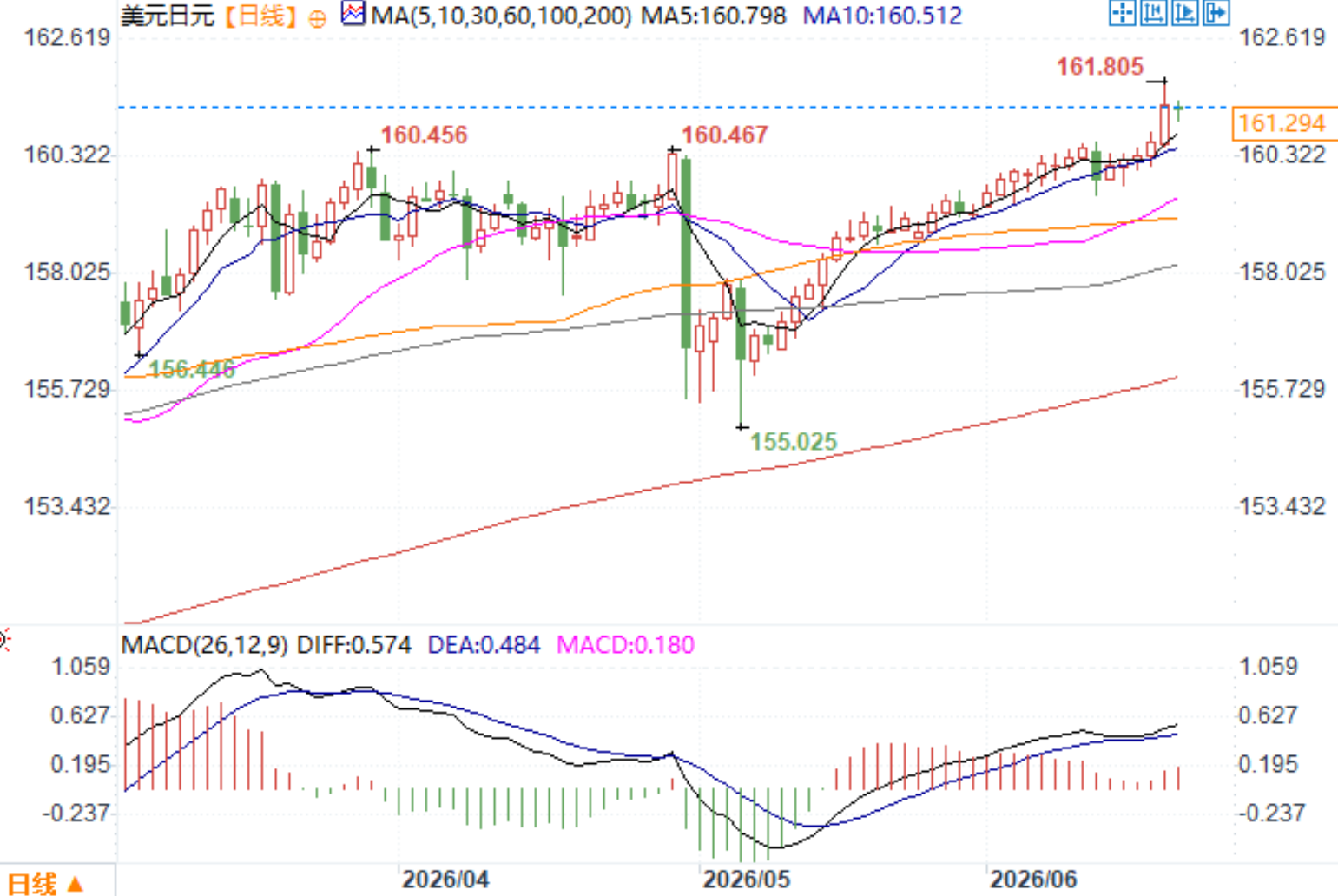
USD/JPY Daily Chart Source: EasyForex
At 11:17 AM Beijing time on June 19, the USD/JPY exchange rate was 161.29/29.
The USD/JPY pair rose initially in Asian trading but then fell back, temporarily halting its five-day winning streak.
During Friday's Asian trading session, the USD/JPY pair continued its decline from the previous session's high of 161.80, the highest level since July 2024, with the market maintaining a downward trend. USD/JPY briefly fell to the key psychological level of 161.00, ending a five-day winning streak.
Despite the obvious pullback in the market, the bulls still have the upper hand in the overall short-term technical trend, and a deep downward trend has not yet formed a definite trend.
Central bank minutes and officials signaling interest rate hikes, along with expectations of currency intervention, simultaneously boosted the yen.
The core driver of this round of yen strengthening comes from the release of the minutes of the Bank of Japan's April policy meeting. The minutes revealed that several policy committee members stated that the pace of interest rate hikes should be accelerated to prevent core inflation from significantly exceeding the policy target. The market generally anticipates that rising raw material procurement costs for businesses will gradually be passed on to downstream consumer goods, putting upward pressure on Japanese inflation in the coming months. This provides ample logical support for the Bank of Japan's continued tightening of monetary policy.
Bank of Japan Deputy Governor Himino stated that the central bank will continue to raise interest rates based on the overall situation of the domestic economy, prices, and financial markets. Himino added that exchange rate fluctuations are one of the core variables affecting Japan's domestic economic performance and price trends.
Japanese Chief Cabinet Secretary Minoru Kihara stated on Thursday that the government is fully prepared to implement corresponding control measures in response to abnormal exchange rate fluctuations. This statement fueled market expectations of foreign exchange market intervention, further supporting the yen and partially offsetting the negative impact of weaker domestic inflation data. Data released by Japan's Ministry of Internal Affairs and Communications showed that the national consumer price index rose 1.5% year-on-year in May, while the core consumer price index, excluding fresh food, rose 1.4% year-on-year.
Despite persistently weak inflation data, the yen's short-term strengthening trend has not been reversed.
Core inflation data, excluding the highly volatile categories of fresh food and energy, was even weaker, with the year-on-year increase falling to 1.8% in May, a significant decline from the 1.9% year-on-year growth rate in April. This indicator has remained below the Bank of Japan's 2% annual inflation target for four consecutive months, marking the lowest growth rate in four years. Even with weak inflation fundamentals, the data failed to exert significant downward pressure on the yen.
The US dollar's gains this week have been solid, with the exchange rate holding above its highest level since May 2025, continuing to exert downward pressure on the USD/JPY pair. However, the exchange rate has not yet experienced a sustained and deep depreciation.
The interest rate differential between the US and Japan is constraining the downside potential of the USD/JPY exchange rate.
The persistently large interest rate differential between the US and Japan has kept carry trades shorting the yen active.
The Bank of Japan raised its interest rate to 1% on Tuesday, a new high since 1995; the Federal Reserve Chairman maintained the benchmark interest rate range at 3.5% to 3.75%, and the policy rate differential remains significant. This persistent interest rate differential will discourage large-scale entry of yen bulls, indirectly limiting the downside potential of the USD/JPY exchange rate.
Summarize
In summary, multiple policy-related positive factors propelled the yen's rebound in Asian trading on Friday, briefly ending the USD/JPY's winning streak. However, the interest rate differential resulting from US-Japan monetary policy remains the core factor suppressing the yen's strength in the long term. Until a sustained sell-off signal appears on the charts, it cannot be confirmed that the USD/JPY has peaked in the short term. Investors should not blindly position themselves for a significant pullback and should continue to monitor price levels, policy statements, and official foreign exchange market adjustments in both countries.
USD/JPY Daily Chart Source: EasyForex
At 11:17 AM Beijing time on June 19, the USD/JPY exchange rate was 161.29/29.
- Risk Warning and Disclaimer
- The market involves risk, and trading may not be suitable for all investors. This article is for reference only and does not constitute personal investment advice, nor does it take into account certain users’ specific investment objectives, financial situation, or other needs. Any investment decisions made based on this information are at your own risk.