The seventh prime minister in ten years is coming! Can Burnham become the "firefighter" for the British economy?
2026-06-23 11:34:39
On Tuesday (June 23) during the Asian session, the British pound traded in a narrow range against the US dollar, currently around 1.3240, after recording two consecutive days of gains.
Political uncertainty did not weigh on the pound as expected, and the market remained cautiously optimistic about Burnham's prospects of taking over.
British Prime Minister Keir Starmer announced his resignation on Monday, paving the way for an orderly transfer of power. Andy Burnham, the Mayor of Greater Manchester and the frontrunner to succeed him, could become Britain's seventh prime minister in a decade as early as next month.
Starmer announced the decision at 10 Downing Street, saying he had listened to the opinions within the Labour Party and realized that he was no longer the right person to lead the party in the next general election.
The pressure on Starmer to resign had been mounting for months and intensified dramatically last Friday. Greater Manchester Mayor Burnham secured a decisive victory in the parliamentary by-election that day, returning to Westminster and defeating Nigel Farage's Reform Party candidate, who had led national polls for over a year.
This victory gave Labour MPs hope—they believed Burnham, known for his communication skills, could reverse the party's decline. Under Starmer's leadership, Labour's support had continued to fall, and voters were increasingly dissatisfied with the party's failure to deliver on its promises of change.
Starmer stated that he will ask the Labour Party's organizing committee to develop a timetable for the leadership election. Nominations will begin on July 9 and end in mid-July; if an election is held, the new leader will be in place by September; if appointed directly, the new leader may take office in mid-July.
"The question my party is now asking is: am I the best person to lead us into the next general election? I have heard the parliamentary group's answer to this question, and I accept the result," he said in a statement. After reviewing the government's achievements over the past two years, Starmer, often criticized for being "taciturn," became visibly emotional, choking back tears as he thanked his family for their support.
Several Labour MPs said that Starmer's resignation could have turned into a leadership battle that tore the Labour Party apart, but now they expect it to be more of a "coronation."
56-year-old veteran politician Burnham quickly won the support of his potential rival, former Health Secretary Wes Streeting. A Labour MP said Burnham is now more likely to be elected party leader. On Monday, Burnham walked into Parliament to cheers from Labour MPs and was sworn in as a Member of Parliament—a necessary step for him to become the new leader of the Labour Party and Britain.
Following news that Burnham had secured Stratington's support, the pound rose against most other currencies, and UK government bond prices also rebounded. Investors welcomed a clearer path for Burnham to become prime minister.
The new prime minister will be the seventh prime minister since the 2016 Brexit referendum – a number that itself highlights the ongoing political turmoil in Britain since the end of the EU.
Ten years after the Brexit referendum, the Labour government has become the latest to be taught a lesson by voters for failing to deliver on its promises of change.
While all parties hope for a smooth transfer of power, this transition is not without risk. Burnham has yet to develop a comprehensive policy agenda – aside from stating that Britain needs fundamental change and that he wants to lower the cost of living, his specific policies on foreign policy, the economy, and defense remain unclear. Reform Party leader Nigel Farage immediately called for a general election.
Like Starmer, Burnham may find his political space very limited: on the one hand, he is constrained by bond market investors who oppose increasing borrowing, and on the other hand, he faces pressure from angry voters who believe the country is not functioning well.
Due to high debt and interest payments, years of sluggish economic growth, difficulties in cutting spending, and the need to invest in areas such as defense, the UK has the highest borrowing costs among the G7 countries. This fiscal reality will significantly limit the new prime minister's policy space.
A heavy debt burden and weak economic growth together constitute a fiscal ceiling that the new prime minister finds difficult to overcome. Technically, the pound is also struggling against the dollar.
According to the daily chart, the GBP/USD pair rose to a high of 1.3867 before trending downwards, currently trading around 1.3240. The recent low of 1.3162 has formed short-term support. The moving average system shows clear bearish pressure, with the price consistently trading below the 20-day, 50-day, 100-day, and 200-day moving averages. All moving averages are turning downwards, with the 20-day moving average (1.3368) acting as the primary resistance level. The overall downtrend is clear.
The indicators are simultaneously releasing bearish signals. The MACD indicator's DIFF continues to run below the DEA, and the green bars below the zero axis maintain bearish momentum. The RSI value is 36.62, which is below the 50 midline and has not yet entered the deep oversold zone, indicating that the short-term downward momentum still has room to continue.
The key support level is the recent low of 1.3162. If this support is broken, further downside potential will be unlocked. The first resistance level is the 20-day moving average (MA20) at 1.3368, followed by the 50-day moving average (MA50) at 1.3450. The combination of short-term moving average resistance and bearish indicators suggests a generally weak and volatile market. Even if a slight rebound occurs based on the 1.3162 support, the probability of a pullback near the short-term moving averages is high.
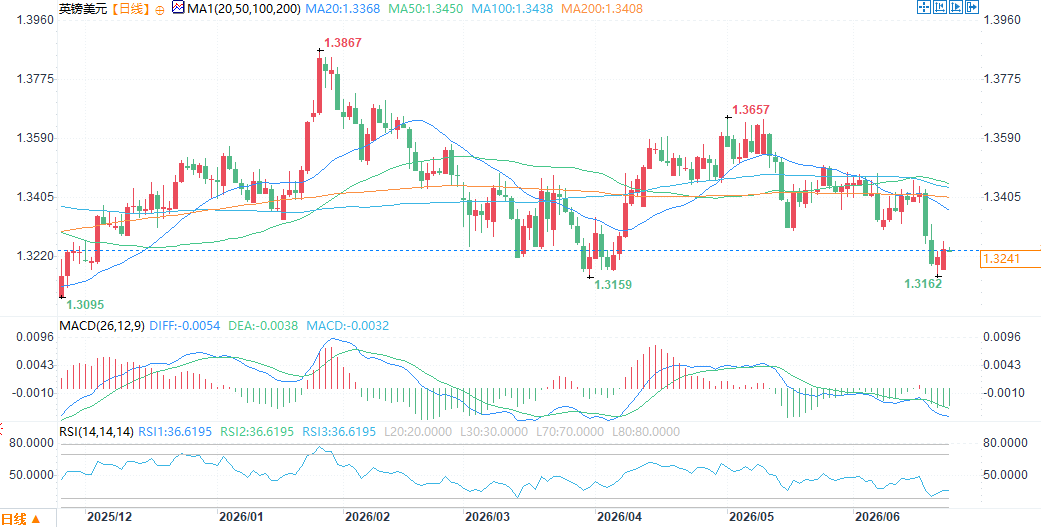
(GBP/USD daily chart, source: FX678)
At 11:34 AM Beijing time on June 23, the British pound was trading at 1.3240/41 against the US dollar.
Political uncertainty did not weigh on the pound as expected, and the market remained cautiously optimistic about Burnham's prospects of taking over.
British Prime Minister Keir Starmer announced his resignation on Monday, paving the way for an orderly transfer of power. Andy Burnham, the Mayor of Greater Manchester and the frontrunner to succeed him, could become Britain's seventh prime minister in a decade as early as next month.
Starmer announced the decision at 10 Downing Street, saying he had listened to the opinions within the Labour Party and realized that he was no longer the right person to lead the party in the next general election.
Background to resignation: Months of accumulated pressure, with the by-election victory serving as a catalyst.
The pressure on Starmer to resign had been mounting for months and intensified dramatically last Friday. Greater Manchester Mayor Burnham secured a decisive victory in the parliamentary by-election that day, returning to Westminster and defeating Nigel Farage's Reform Party candidate, who had led national polls for over a year.
This victory gave Labour MPs hope—they believed Burnham, known for his communication skills, could reverse the party's decline. Under Starmer's leadership, Labour's support had continued to fall, and voters were increasingly dissatisfied with the party's failure to deliver on its promises of change.
Starmer stated that he will ask the Labour Party's organizing committee to develop a timetable for the leadership election. Nominations will begin on July 9 and end in mid-July; if an election is held, the new leader will be in place by September; if appointed directly, the new leader may take office in mid-July.
"The question my party is now asking is: am I the best person to lead us into the next general election? I have heard the parliamentary group's answer to this question, and I accept the result," he said in a statement. After reviewing the government's achievements over the past two years, Starmer, often criticized for being "taciturn," became visibly emotional, choking back tears as he thanked his family for their support.
Succession race: Burnham receives crucial support, potentially becoming his "coronation"
Several Labour MPs said that Starmer's resignation could have turned into a leadership battle that tore the Labour Party apart, but now they expect it to be more of a "coronation."
56-year-old veteran politician Burnham quickly won the support of his potential rival, former Health Secretary Wes Streeting. A Labour MP said Burnham is now more likely to be elected party leader. On Monday, Burnham walked into Parliament to cheers from Labour MPs and was sworn in as a Member of Parliament—a necessary step for him to become the new leader of the Labour Party and Britain.
Market reaction
Following news that Burnham had secured Stratington's support, the pound rose against most other currencies, and UK government bond prices also rebounded. Investors welcomed a clearer path for Burnham to become prime minister.
The new prime minister will be the seventh prime minister since the 2016 Brexit referendum – a number that itself highlights the ongoing political turmoil in Britain since the end of the EU.
Ten years after the Brexit referendum, the Labour government has become the latest to be taught a lesson by voters for failing to deliver on its promises of change.
Governance challenges: unclear policy framework and limited fiscal space
While all parties hope for a smooth transfer of power, this transition is not without risk. Burnham has yet to develop a comprehensive policy agenda – aside from stating that Britain needs fundamental change and that he wants to lower the cost of living, his specific policies on foreign policy, the economy, and defense remain unclear. Reform Party leader Nigel Farage immediately called for a general election.
Like Starmer, Burnham may find his political space very limited: on the one hand, he is constrained by bond market investors who oppose increasing borrowing, and on the other hand, he faces pressure from angry voters who believe the country is not functioning well.
Due to high debt and interest payments, years of sluggish economic growth, difficulties in cutting spending, and the need to invest in areas such as defense, the UK has the highest borrowing costs among the G7 countries. This fiscal reality will significantly limit the new prime minister's policy space.
Technical Analysis
A heavy debt burden and weak economic growth together constitute a fiscal ceiling that the new prime minister finds difficult to overcome. Technically, the pound is also struggling against the dollar.
According to the daily chart, the GBP/USD pair rose to a high of 1.3867 before trending downwards, currently trading around 1.3240. The recent low of 1.3162 has formed short-term support. The moving average system shows clear bearish pressure, with the price consistently trading below the 20-day, 50-day, 100-day, and 200-day moving averages. All moving averages are turning downwards, with the 20-day moving average (1.3368) acting as the primary resistance level. The overall downtrend is clear.
The indicators are simultaneously releasing bearish signals. The MACD indicator's DIFF continues to run below the DEA, and the green bars below the zero axis maintain bearish momentum. The RSI value is 36.62, which is below the 50 midline and has not yet entered the deep oversold zone, indicating that the short-term downward momentum still has room to continue.
The key support level is the recent low of 1.3162. If this support is broken, further downside potential will be unlocked. The first resistance level is the 20-day moving average (MA20) at 1.3368, followed by the 50-day moving average (MA50) at 1.3450. The combination of short-term moving average resistance and bearish indicators suggests a generally weak and volatile market. Even if a slight rebound occurs based on the 1.3162 support, the probability of a pullback near the short-term moving averages is high.
(GBP/USD daily chart, source: FX678)
At 11:34 AM Beijing time on June 23, the British pound was trading at 1.3240/41 against the US dollar.
- Risk Warning and Disclaimer
- The market involves risk, and trading may not be suitable for all investors. This article is for reference only and does not constitute personal investment advice, nor does it take into account certain users’ specific investment objectives, financial situation, or other needs. Any investment decisions made based on this information are at your own risk.