The economic divergence between the US and Europe is set to widen! JPMorgan Chase is bearish on the euro to 1.13, while Goldman Sachs is bullish to 1.20—who should we believe?
2026-06-23 11:09:26
The euro traded in a narrow range against the US dollar in early Asian trading on Tuesday (June 23), currently hovering around 1.1425. This follows a decline of more than 1.5% over the previous four trading days.
The euro faced pressure against the dollar on PMI data day, after several Federal Reserve officials called for further interest rate hikes, which boosted the dollar. With the 1.1400 level fast approaching, today's PMI surveys from Europe and the US may determine whether this support level holds or ultimately falls.
The PMI data day has arrived—perhaps the most meticulously orchestrated non-event in the financial markets. S&P Global has strategically placed a sentiment survey during one of the traditionally quietest periods for economic data releases, resulting in it receiving far more attention than it should have.
This doesn't mean these surveys are worthless. There is indeed a correlation between PMIs and subsequent hard data, and the market reacts readily when results significantly deviate from expectations. But they are still essentially just surveys. In the US, traders pay more attention to the broader and longer-established ISM report; in Europe, PMI data day still can shake the market, especially the euro exchange rate.
Today's focus is on two key sub-indices: For the Eurozone, the market expects a slight improvement in the composite PMI and services PMI, but both will remain below the 50-point threshold separating expansion from contraction; the manufacturing PMI is expected to be slightly above that threshold. In addition to the overall readings, the new orders and price sub-indices will be key areas of focus.
The recent energy shock has pushed up costs across Europe, and traders will be looking for clues as to whether demand is beginning to weaken and whether inflationary pressures are stickier than expected.
In the US, both manufacturing and services are expected to continue expanding. Similar to the new orders and price sub-indices, strong demand and firm price pressures will align with the prevailing narrative that the US economy remains resilient and the Federal Reserve may need to resume rate hikes this year. Any signal challenging this view could marginally weaken the dollar.
Monday's dollar strength is noteworthy—this rally coincided with a sharp drop in oil prices, breaking the common correlation between the two in recent months. Despite falling energy prices, dollar buying surged in early Asian trading, pushing the dollar higher across the board.
Part of the reason may stem from a further shift in the Federal Reserve's expectations. Reports indicate that both Bank of America and Deutsche Bank now anticipate the Fed will resume rate hikes this year, further reinforcing the trend already priced in by the market. Following Fed Chairman Warsh's hawkish shift last week, expectations of multiple rate hikes have provided support for demand for the dollar.
From a fundamental perspective, this shift in expectations is not surprising. The Citi Economic Surprise Index—which tracks whether economic data beats or falls short of expectations—continues to tilt towards the US, reflecting a series of stronger-than-expected economic data. Combined with signs of renewed inflation, this helps explain why the market is increasingly discussing further tightening by the Federal Reserve. Unlike European policymakers who are struggling with weak growth and energy-driven inflation shocks, the case for US rate hikes is supported by both economic resilience and persistent price pressures.
This divergence is clearly reflected in the euro-dollar exchange rate.
JP Morgan Global Research expects the euro to fluctuate between 1.13 and 1.15 against the dollar in the second half of 2026, with its full-year target lowered from the earlier 1.20.
The agency believes that although the US dollar is in a net bear market overall, the relatively weak economic growth in Europe compared to the US, the limited fiscal expansion in Germany, and the political uncertainty in the Eurozone will limit the euro's appreciation potential.
The euro is currently fluctuating around 1.14-1.16 against the US dollar. Institutions recommend reducing euro holdings on rallies and paying attention to the divergence between the Federal Reserve's labor market data and European growth. In the short term, if US data remains strong, the euro faces significant downside risks; in the medium to long term, policy divergence and global risk appetite will determine the extent of any rebound.
JP Morgan emphasized that Europe needs to avoid new shocks to stabilize the euro, but in the current environment, the dollar remains relatively resilient.
Goldman Sachs believes that slowing demand for US assets, fiscal deficit pressures, and the Federal Reserve's gradual easing will drive capital flows to Europe, supporting the appreciation of the euro. While Eurozone growth faces energy shocks, relatively stable ECB policies and German fiscal expansion provide support.
The current exchange rate level is considered a reasonable entry point, and the institution recommends establishing long positions in the euro during pullbacks. Risks include European political uncertainty and unexpected resilience in the US economy, but the overall bearish logic for the US dollar remains unchanged, and the euro/dollar exchange rate is expected to test the 1.20-1.25 range.
Goldman Sachs points out that the structural de-dollarization trend and global growth rebalancing will benefit the euro's medium- to long-term performance.
Whether considering price movements, oscillator signals, or the fact that the exchange rate has broken below all key medium- and long-term moving averages and is in a clear downtrend, the current situation continues to favor shorting the euro against the US dollar. This makes the March low of 1.1410 and the important psychological level of 1.1400 the focus of market attention.
Downside Scenario: A daily close below the lower edge of the 1.1400 support zone for EUR/USD could bolster bears' confidence in seeking a larger decline. Below the March lows, there is little meaningful technical support until 1.1200 – making it the next major downside target. Short positions can be initiated on a break below 1.1400, with stop-loss orders above that level, targeting even lower levels.
Upside Scenario: If the support zone of 1.1412 to 1.1400 holds, the focus will shift to 1.1500, then 1.1558, near the 20-day moving average. Further up, there is a strong resistance zone formed by the 50-day, 100-day, and 200-day moving averages.
The indicators are showing a bearish signal: the MACD indicator's DIFF line remains below the DEA line, and the green bars below the zero line maintain bearish momentum; the RSI value is 32.03, below the 50 midline and approaching the oversold zone. The short-term downward momentum has slowed down, but there is no clear bottoming and reversal signal.
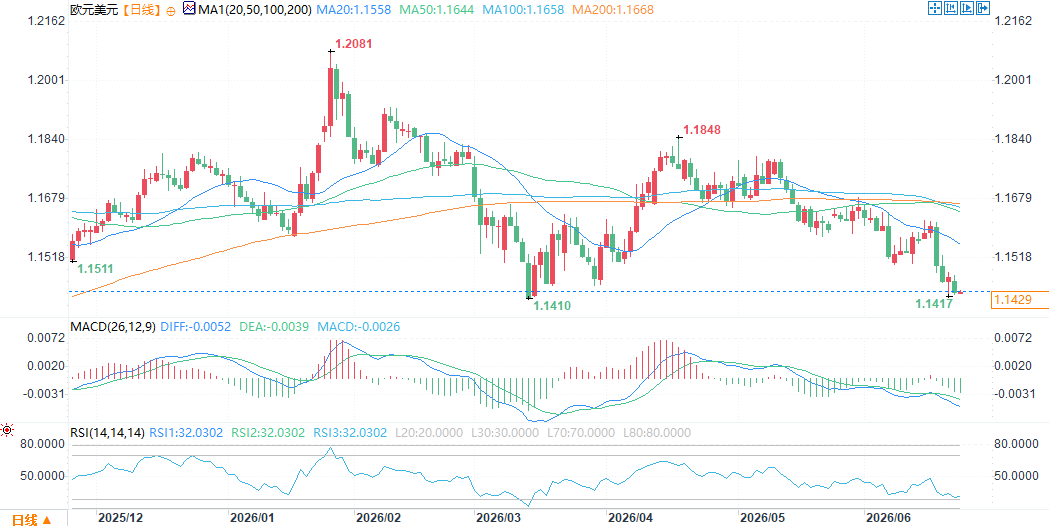
(Euro/USD daily chart, source: FX678)
At 11:08 Beijing time on June 23, the euro was trading at 1.1425/26 against the US dollar.
The euro faced pressure against the dollar on PMI data day, after several Federal Reserve officials called for further interest rate hikes, which boosted the dollar. With the 1.1400 level fast approaching, today's PMI surveys from Europe and the US may determine whether this support level holds or ultimately falls.
PMI Data Release Day: Market Focuses on Two Key Sub-Indicators
The PMI data day has arrived—perhaps the most meticulously orchestrated non-event in the financial markets. S&P Global has strategically placed a sentiment survey during one of the traditionally quietest periods for economic data releases, resulting in it receiving far more attention than it should have.
This doesn't mean these surveys are worthless. There is indeed a correlation between PMIs and subsequent hard data, and the market reacts readily when results significantly deviate from expectations. But they are still essentially just surveys. In the US, traders pay more attention to the broader and longer-established ISM report; in Europe, PMI data day still can shake the market, especially the euro exchange rate.
Today's focus is on two key sub-indices: For the Eurozone, the market expects a slight improvement in the composite PMI and services PMI, but both will remain below the 50-point threshold separating expansion from contraction; the manufacturing PMI is expected to be slightly above that threshold. In addition to the overall readings, the new orders and price sub-indices will be key areas of focus.
The recent energy shock has pushed up costs across Europe, and traders will be looking for clues as to whether demand is beginning to weaken and whether inflationary pressures are stickier than expected.
In the US, both manufacturing and services are expected to continue expanding. Similar to the new orders and price sub-indices, strong demand and firm price pressures will align with the prevailing narrative that the US economy remains resilient and the Federal Reserve may need to resume rate hikes this year. Any signal challenging this view could marginally weaken the dollar.
Fed rate hike expectations: repricing is accelerating
Monday's dollar strength is noteworthy—this rally coincided with a sharp drop in oil prices, breaking the common correlation between the two in recent months. Despite falling energy prices, dollar buying surged in early Asian trading, pushing the dollar higher across the board.
Part of the reason may stem from a further shift in the Federal Reserve's expectations. Reports indicate that both Bank of America and Deutsche Bank now anticipate the Fed will resume rate hikes this year, further reinforcing the trend already priced in by the market. Following Fed Chairman Warsh's hawkish shift last week, expectations of multiple rate hikes have provided support for demand for the dollar.
From a fundamental perspective, this shift in expectations is not surprising. The Citi Economic Surprise Index—which tracks whether economic data beats or falls short of expectations—continues to tilt towards the US, reflecting a series of stronger-than-expected economic data. Combined with signs of renewed inflation, this helps explain why the market is increasingly discussing further tightening by the Federal Reserve. Unlike European policymakers who are struggling with weak growth and energy-driven inflation shocks, the case for US rate hikes is supported by both economic resilience and persistent price pressures.
This divergence is clearly reflected in the euro-dollar exchange rate.
Institutional Views
JP Morgan Global Research expects the euro to fluctuate between 1.13 and 1.15 against the dollar in the second half of 2026, with its full-year target lowered from the earlier 1.20.
The agency believes that although the US dollar is in a net bear market overall, the relatively weak economic growth in Europe compared to the US, the limited fiscal expansion in Germany, and the political uncertainty in the Eurozone will limit the euro's appreciation potential.
The euro is currently fluctuating around 1.14-1.16 against the US dollar. Institutions recommend reducing euro holdings on rallies and paying attention to the divergence between the Federal Reserve's labor market data and European growth. In the short term, if US data remains strong, the euro faces significant downside risks; in the medium to long term, policy divergence and global risk appetite will determine the extent of any rebound.
JP Morgan emphasized that Europe needs to avoid new shocks to stabilize the euro, but in the current environment, the dollar remains relatively resilient.
Goldman Sachs believes that slowing demand for US assets, fiscal deficit pressures, and the Federal Reserve's gradual easing will drive capital flows to Europe, supporting the appreciation of the euro. While Eurozone growth faces energy shocks, relatively stable ECB policies and German fiscal expansion provide support.
The current exchange rate level is considered a reasonable entry point, and the institution recommends establishing long positions in the euro during pullbacks. Risks include European political uncertainty and unexpected resilience in the US economy, but the overall bearish logic for the US dollar remains unchanged, and the euro/dollar exchange rate is expected to test the 1.20-1.25 range.
Goldman Sachs points out that the structural de-dollarization trend and global growth rebalancing will benefit the euro's medium- to long-term performance.
1.1400 Pass Attack and Defense Battle
Whether considering price movements, oscillator signals, or the fact that the exchange rate has broken below all key medium- and long-term moving averages and is in a clear downtrend, the current situation continues to favor shorting the euro against the US dollar. This makes the March low of 1.1410 and the important psychological level of 1.1400 the focus of market attention.
Downside Scenario: A daily close below the lower edge of the 1.1400 support zone for EUR/USD could bolster bears' confidence in seeking a larger decline. Below the March lows, there is little meaningful technical support until 1.1200 – making it the next major downside target. Short positions can be initiated on a break below 1.1400, with stop-loss orders above that level, targeting even lower levels.
Upside Scenario: If the support zone of 1.1412 to 1.1400 holds, the focus will shift to 1.1500, then 1.1558, near the 20-day moving average. Further up, there is a strong resistance zone formed by the 50-day, 100-day, and 200-day moving averages.
Technical signal: Bears have a clear advantage.
The indicators are showing a bearish signal: the MACD indicator's DIFF line remains below the DEA line, and the green bars below the zero line maintain bearish momentum; the RSI value is 32.03, below the 50 midline and approaching the oversold zone. The short-term downward momentum has slowed down, but there is no clear bottoming and reversal signal.
(Euro/USD daily chart, source: FX678)
At 11:08 Beijing time on June 23, the euro was trading at 1.1425/26 against the US dollar.
- Risk Warning and Disclaimer
- The market involves risk, and trading may not be suitable for all investors. This article is for reference only and does not constitute personal investment advice, nor does it take into account certain users’ specific investment objectives, financial situation, or other needs. Any investment decisions made based on this information are at your own risk.