The US dollar strengthened due to geopolitical tensions and expectations of interest rate hikes, putting downward pressure on the New Zealand dollar, which fluctuated.
2026-06-30 12:19:25
On Tuesday (June 30), the New Zealand dollar encountered slight selling pressure against the US dollar in Asian trading, but the bearish momentum was insufficient, and the exchange rate continued to be trapped in the trading range formed over the past week.
China's official PMI data for June showed a slight rebound, but this failed to boost commodity currencies, as weak domestic demand offset the positive impact of improved economic conditions. The US dollar received safe-haven support due to the complex geopolitical situation and expectations of a Fed rate hike. Conflicting news regarding the US-Iran talks and the attack in Lebanon increased risk premiums, with the market heavily pricing in a rate hike this year. However, the exchange rate held above previous lows, limiting further downside potential in the short term; caution is advised when shorting.

A small number of sell orders for the New Zealand dollar appeared in the Asian trading session on Tuesday, but overall short-selling sentiment was not strong, and the exchange rate continued to fluctuate narrowly within the familiar range of the past week. Following the release of China's official June PMI data by the National Bureau of Statistics, the spot NZD/USD exchange rate saw minimal fluctuations, currently trading below 0.5650, with a daily decline of only 0.05%.
From an economic data perspective, China's manufacturing PMI rose to 50.3 in June from 50.0 in May, slightly exceeding market expectations of 50.1; the non-manufacturing business activity index recorded 50.2, also higher than the previous value and forecast. Both indicators remained above the expansion/contraction threshold, indicating that economic activity continued to expand. However, the data also reflects weak domestic end-user demand and a slow recovery in consumer spending, with overall expansion being very weak. This made it difficult to boost commodity-related currencies like the Australian and New Zealand dollars, and the New Zealand dollar did not gain any upward momentum from the data.
The US dollar received sustained buying support, primarily driven by geopolitical uncertainties and conflicting information regarding US-Iran negotiations.
US President Trump stated on social media that Iran had requested a meeting, and the two sides were scheduled to meet on Tuesday in Doha, the capital of Qatar. However, Iranian Deputy Foreign Minister Kazem Gharibabadi immediately clarified that no technical consultations were scheduled for this week. These two conflicting news items exacerbated market demand for risk hedging.
The renewed Israeli strikes against Lebanon have further increased geopolitical risk premiums, leading to a flow of funds into the safe-haven US dollar. Meanwhile, the market continues to bet on the Federal Reserve tightening monetary policy, and these two factors combined are putting downward pressure on the New Zealand dollar against the US dollar.
Data from the CME Group's FedWatch tool shows that traders are currently pricing in a 63% probability of a Fed rate hike in September, with the probability of a rate hike this year exceeding 80%. This tightening expectation is providing long-term support for the US dollar. The escalating tensions between the US and Iran, coupled with market concerns that oil supply disruptions could push up global inflation, reinforce the logic behind the Fed maintaining high interest rates, further attracting dollar bulls to the market.
Despite a confluence of negative factors weighing on the New Zealand dollar, the exchange rate held above its lowest level since November 2025, as recorded last week, without breaking through key support. This suggests that the downtrend has not fully materialized, and investors should not rashly bet on a new round of depreciation. Instead, they should remain cautious and observe the market.
In summary, the moderate improvement in China's PMI cannot offset the negative impact of weak domestic demand on commodity currencies. Geopolitical conflicts and expectations of a Fed rate hike continue to support the US dollar, clearly putting downward pressure on the NZD/USD exchange rate in the short term. However, key support levels are strong, and short-selling pressure is insufficient, maintaining a range-bound trading pattern. A one-sided downward trend is unlikely to materialize unless there are significant changes in geopolitical tensions or interest rate expectations.
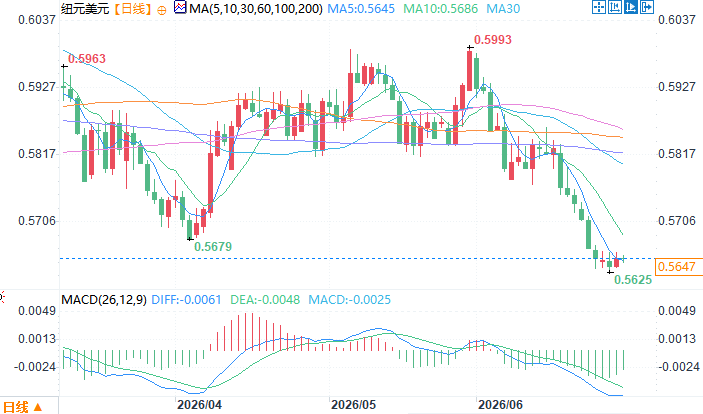
NZD/USD daily chart source: EasyTrade
At 12:19 Beijing time on June 30, the New Zealand dollar was trading at 0.5647/48 against the US dollar.
China's official PMI data for June showed a slight rebound, but this failed to boost commodity currencies, as weak domestic demand offset the positive impact of improved economic conditions. The US dollar received safe-haven support due to the complex geopolitical situation and expectations of a Fed rate hike. Conflicting news regarding the US-Iran talks and the attack in Lebanon increased risk premiums, with the market heavily pricing in a rate hike this year. However, the exchange rate held above previous lows, limiting further downside potential in the short term; caution is advised when shorting.
The New Zealand dollar weakened slightly during Asian trading hours, with positive news from China's major PMI failing to provide effective support.
A small number of sell orders for the New Zealand dollar appeared in the Asian trading session on Tuesday, but overall short-selling sentiment was not strong, and the exchange rate continued to fluctuate narrowly within the familiar range of the past week. Following the release of China's official June PMI data by the National Bureau of Statistics, the spot NZD/USD exchange rate saw minimal fluctuations, currently trading below 0.5650, with a daily decline of only 0.05%.
From an economic data perspective, China's manufacturing PMI rose to 50.3 in June from 50.0 in May, slightly exceeding market expectations of 50.1; the non-manufacturing business activity index recorded 50.2, also higher than the previous value and forecast. Both indicators remained above the expansion/contraction threshold, indicating that economic activity continued to expand. However, the data also reflects weak domestic end-user demand and a slow recovery in consumer spending, with overall expansion being very weak. This made it difficult to boost commodity-related currencies like the Australian and New Zealand dollars, and the New Zealand dollar did not gain any upward momentum from the data.
Diverging geopolitical news events continue to support a stronger US dollar, driven by safe-haven demand.
The US dollar received sustained buying support, primarily driven by geopolitical uncertainties and conflicting information regarding US-Iran negotiations.
US President Trump stated on social media that Iran had requested a meeting, and the two sides were scheduled to meet on Tuesday in Doha, the capital of Qatar. However, Iranian Deputy Foreign Minister Kazem Gharibabadi immediately clarified that no technical consultations were scheduled for this week. These two conflicting news items exacerbated market demand for risk hedging.
The renewed Israeli strikes against Lebanon have further increased geopolitical risk premiums, leading to a flow of funds into the safe-haven US dollar. Meanwhile, the market continues to bet on the Federal Reserve tightening monetary policy, and these two factors combined are putting downward pressure on the New Zealand dollar against the US dollar.
Interest rate hike expectations are fully priced in, and inflation concerns further benefit dollar bulls.
Data from the CME Group's FedWatch tool shows that traders are currently pricing in a 63% probability of a Fed rate hike in September, with the probability of a rate hike this year exceeding 80%. This tightening expectation is providing long-term support for the US dollar. The escalating tensions between the US and Iran, coupled with market concerns that oil supply disruptions could push up global inflation, reinforce the logic behind the Fed maintaining high interest rates, further attracting dollar bulls to the market.
Despite a confluence of negative factors weighing on the New Zealand dollar, the exchange rate held above its lowest level since November 2025, as recorded last week, without breaking through key support. This suggests that the downtrend has not fully materialized, and investors should not rashly bet on a new round of depreciation. Instead, they should remain cautious and observe the market.
Summarize
In summary, the moderate improvement in China's PMI cannot offset the negative impact of weak domestic demand on commodity currencies. Geopolitical conflicts and expectations of a Fed rate hike continue to support the US dollar, clearly putting downward pressure on the NZD/USD exchange rate in the short term. However, key support levels are strong, and short-selling pressure is insufficient, maintaining a range-bound trading pattern. A one-sided downward trend is unlikely to materialize unless there are significant changes in geopolitical tensions or interest rate expectations.
NZD/USD daily chart source: EasyTrade
At 12:19 Beijing time on June 30, the New Zealand dollar was trading at 0.5647/48 against the US dollar.
- Risk Warning and Disclaimer
- The market involves risk, and trading may not be suitable for all investors. This article is for reference only and does not constitute personal investment advice, nor does it take into account certain users’ specific investment objectives, financial situation, or other needs. Any investment decisions made based on this information are at your own risk.