As the yen fell to a new low since 1986, the Bank of Japan welcomed a new member who is a proponent of reflation, adding further uncertainty to the suspense surrounding a July interest rate hike.
2026-06-30 13:39:35
On Tuesday (June 30) during Asian trading hours, the US dollar touched 162.40 against the Japanese yen, the highest intraday level since 1986, and is currently trading around 162.20.
On Tuesday, the government of Japanese Prime Minister Sanae Takaichi officially appointed academic Ayano Sato as a member of the Bank of Japan's policy board, adding an important variable to the key debate within the policy committee on whether to raise interest rates further.
Sato is considered a representative of the reflation school that supports loose monetary policy. She is the second central bank board member appointed during Kaohsiung's tenure—the previous appointee, Toshiro Asada, voted against raising interest rates in June.
The market is closely watching whether Sato will continue Asada's opposition at the first policy meeting on July 30-31.
If this is indeed the case, any future interest rate hike proposals may face opposition from two committee members. However, the term of the hawkish camp will expire next July, and the evolution of the policy landscape remains uncertain.
Ayano Sato, an academic by training, is widely regarded by the market as a representative of the reflation school that supports loose monetary policy.
Her addition has strengthened the voices within the policy committee advocating for maintaining low interest rates to support economic growth.
Sato is the second Bank of China board member nominated during Sanae Takaichi's tenure. The previous nominee, Toshiro Asada, voted against raising interest rates at the June policy meeting, demonstrating a divergence from the current majority.
The nine-member policy committee is currently closely monitoring the ongoing inflationary pressures from the Middle East conflict and the impact of rising import costs due to the yen's depreciation on price stability.
Nomura Securities interest rate strategist Mari Iwashita said, "With Sato, who advocates reflation, joining the board, it is very likely that if the president proposes a rate hike in the future, two committee members will vote against it." This means that the threshold for passing any future rate hike proposal will be further raised.
However, she added, "There will still be two hawkish members on the committee until July next year, so the overall stance will not be too unbalanced." The most hawkish members on the policy committee are Naoki Tamura and Hajime Takada—both of whom proposed raising interest rates in April but were not approved, and both of their terms will expire in July next year.
Sato was replaced by Junko Nakagawa, who had voted in April, along with two other hawkish members, to support raising interest rates.
The first policy meeting that Sato will attend is scheduled for July 30-31.
While the Bank of Japan is widely expected to keep interest rates unchanged at this meeting, the policy board will also release its latest quarterly economic growth and inflation forecasts—data that could provide key clues as to when the next rate hike will occur.
The Bank of Japan raised interest rates to a 31-year high in June, but the pace and timing of future rate hikes remain uncertain.
The Sanae government in Kaohsiung has hinted at caution regarding any moves that could increase the financing costs of its key investment programs, adding a political constraint to the central bank's further tightening of policy.
JPMorgan analysts believe that the Bank of Japan is highly likely to keep interest rates unchanged at its July meeting, but the quarterly outlook report will provide important forward guidance.
The bank expects the BOJ to remain one of the few central banks in developed markets to continue tightening policy in 2026, potentially raising interest rates again this year to combat sticky inflation. However, the Kaohsiung Sanae government's emphasis on controlling financing costs for key investment programs adds political constraints to the BOJ's policy, which may lead the central bank to be more cautious in its pace of interest rate hikes.
Goldman Sachs economists expect the Bank of Japan to keep interest rates unchanged at its July 30-31 meeting, but will focus on updating quarterly economic growth and inflation forecasts.
Following the June rate hike, the current policy rate is at a 31-year high, but Goldman Sachs believes that the BOJ will still take a cautious and gradual normalization path, and expects the next rate hike to be in late 2026 or early 2027, with a terminal interest rate target of around 1.5%.
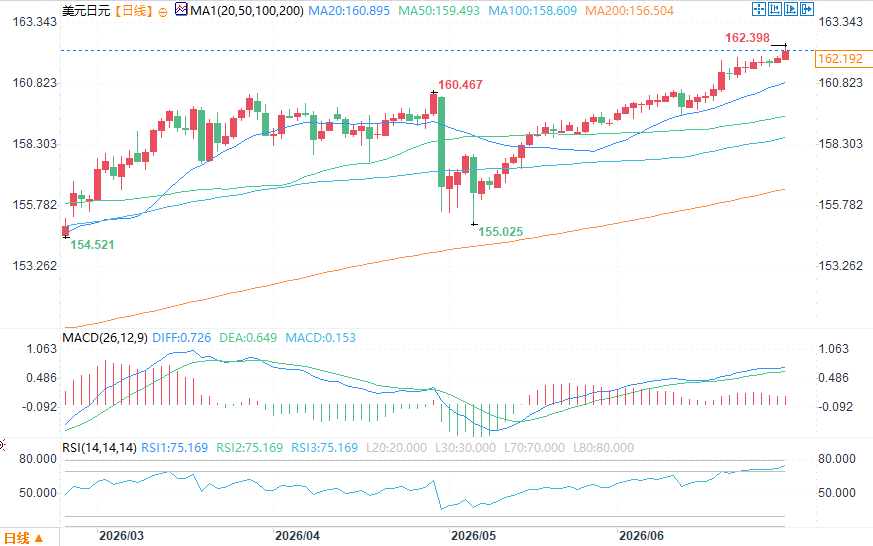
(USD/JPY daily chart, source: FX678)
At 13:39 Beijing time on June 30, the USD/JPY exchange rate was 162.19/20.
On Tuesday, the government of Japanese Prime Minister Sanae Takaichi officially appointed academic Ayano Sato as a member of the Bank of Japan's policy board, adding an important variable to the key debate within the policy committee on whether to raise interest rates further.
Sato is considered a representative of the reflation school that supports loose monetary policy. She is the second central bank board member appointed during Kaohsiung's tenure—the previous appointee, Toshiro Asada, voted against raising interest rates in June.
The market is closely watching whether Sato will continue Asada's opposition at the first policy meeting on July 30-31.
If this is indeed the case, any future interest rate hike proposals may face opposition from two committee members. However, the term of the hawkish camp will expire next July, and the evolution of the policy landscape remains uncertain.
Background of the new candidate: Representative of the reflation school, inclined towards a dovish stance.
Ayano Sato, an academic by training, is widely regarded by the market as a representative of the reflation school that supports loose monetary policy.
Her addition has strengthened the voices within the policy committee advocating for maintaining low interest rates to support economic growth.
Sato is the second Bank of China board member nominated during Sanae Takaichi's tenure. The previous nominee, Toshiro Asada, voted against raising interest rates at the June policy meeting, demonstrating a divergence from the current majority.
The nine-member policy committee is currently closely monitoring the ongoing inflationary pressures from the Middle East conflict and the impact of rising import costs due to the yen's depreciation on price stability.
Market Interpretation: The number of dissenting votes on the interest rate hike may rise to two, but the overall balance remains largely unbalanced.
Nomura Securities interest rate strategist Mari Iwashita said, "With Sato, who advocates reflation, joining the board, it is very likely that if the president proposes a rate hike in the future, two committee members will vote against it." This means that the threshold for passing any future rate hike proposal will be further raised.
However, she added, "There will still be two hawkish members on the committee until July next year, so the overall stance will not be too unbalanced." The most hawkish members on the policy committee are Naoki Tamura and Hajime Takada—both of whom proposed raising interest rates in April but were not approved, and both of their terms will expire in July next year.
Sato was replaced by Junko Nakagawa, who had voted in April, along with two other hawkish members, to support raising interest rates.
First meeting imminent: Rates expected to remain unchanged in July; quarterly forecasts provide clues about rate hikes.
The first policy meeting that Sato will attend is scheduled for July 30-31.
While the Bank of Japan is widely expected to keep interest rates unchanged at this meeting, the policy board will also release its latest quarterly economic growth and inflation forecasts—data that could provide key clues as to when the next rate hike will occur.
The Bank of Japan raised interest rates to a 31-year high in June, but the pace and timing of future rate hikes remain uncertain.
The Sanae government in Kaohsiung has hinted at caution regarding any moves that could increase the financing costs of its key investment programs, adding a political constraint to the central bank's further tightening of policy.
Institutional Views
JPMorgan analysts believe that the Bank of Japan is highly likely to keep interest rates unchanged at its July meeting, but the quarterly outlook report will provide important forward guidance.
The bank expects the BOJ to remain one of the few central banks in developed markets to continue tightening policy in 2026, potentially raising interest rates again this year to combat sticky inflation. However, the Kaohsiung Sanae government's emphasis on controlling financing costs for key investment programs adds political constraints to the BOJ's policy, which may lead the central bank to be more cautious in its pace of interest rate hikes.
Goldman Sachs economists expect the Bank of Japan to keep interest rates unchanged at its July 30-31 meeting, but will focus on updating quarterly economic growth and inflation forecasts.
Following the June rate hike, the current policy rate is at a 31-year high, but Goldman Sachs believes that the BOJ will still take a cautious and gradual normalization path, and expects the next rate hike to be in late 2026 or early 2027, with a terminal interest rate target of around 1.5%.
(USD/JPY daily chart, source: FX678)
At 13:39 Beijing time on June 30, the USD/JPY exchange rate was 162.19/20.
- Risk Warning and Disclaimer
- The market involves risk, and trading may not be suitable for all investors. This article is for reference only and does not constitute personal investment advice, nor does it take into account certain users’ specific investment objectives, financial situation, or other needs. Any investment decisions made based on this information are at your own risk.