Escalating tensions between the US and Iran boosted the safe-haven dollar, while strong Canadian employment data limited the dollar's gains against the Canadian dollar.
2026-07-13 13:57:15
The US dollar rose against the Canadian dollar during Monday's Asian trading session, recovering to around 1.4165 and ending a four-day losing streak. As the military conflict between the US and Iran escalated, risk aversion in the market continued to rise, pushing the US dollar back into buying support. Meanwhile, the Canadian dollar was limited by rising international oil prices and positive domestic economic data, which restricted further gains for the USD/CAD pair.

The US military recently launched another round of military strikes against multiple targets within Iran, focusing on weakening Iran's ability to disrupt commercial shipping in the Strait of Hormuz. Subsequently, Iran launched drone and missile attacks against US allies in the Middle East, targeting Kuwait, Qatar, Bahrain, and Jordan, further escalating regional tensions. Simultaneously, Iran announced the closure of the Strait of Hormuz until further notice , rapidly fueling market concerns about the stability of global energy supplies. The Strait of Hormuz handles approximately 20% of global seaborne crude oil transport ; continued disruptions to this transport could keep international crude oil prices high and further push up global inflation expectations. Against the backdrop of rising safe-haven demand, the US dollar, as a traditional safe-haven asset, continues to attract capital, providing support for the USD/CAD exchange rate.
However, the Canadian dollar's fundamentals remain robust. Data released by Statistics Canada showed that Canada added 18,200 jobs in June , higher than the market expectation of 10,000, continuing the job growth momentum from May; at the same time, the unemployment rate fell from 6.6% to 6.5% , better than market expectations, indicating that the Canadian labor market remains resilient. This data eased market concerns about a slowdown in the Canadian economy and provided some support for the Canadian dollar.
Regarding monetary policy, the market widely expects the Bank of Canada to maintain its overnight interest rate at 2.25% at this week's policy meeting and likely continue to maintain its current policy stance for some time to come. Given the generally moderate inflationary pressures and gradual recovery of economic activity in Canada, the market believes there is limited need for the Bank of Canada to adjust its policy in the short term, which also helps stabilize the Canadian dollar.
This week, the market's focus will shift to the US June Consumer Price Index (CPI) data. If the US inflation data is lower than market expectations, bets on further tightening by the Federal Reserve may cool, putting pressure on the dollar and posing a risk of decline against the Canadian dollar. Conversely, if inflation remains strong, it could further reinforce expectations that the Fed will maintain high interest rates, providing new upward momentum for the dollar.
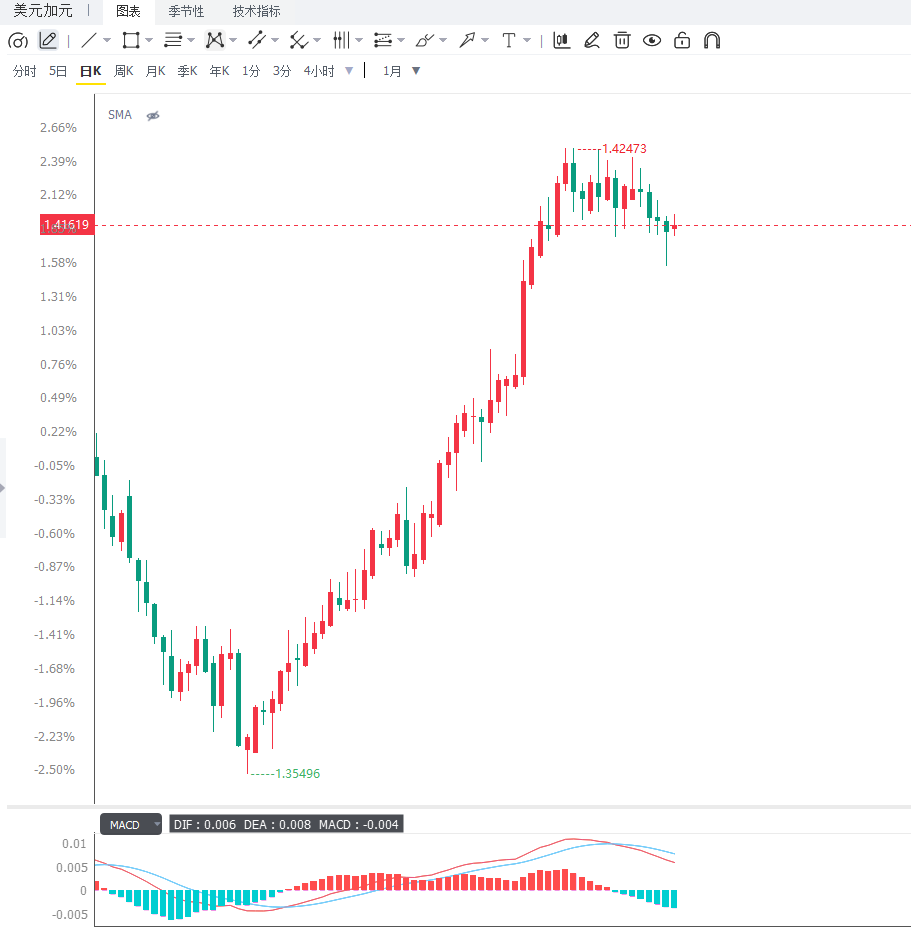
From a technical perspective, the USD/CAD pair has shown signs of stabilization after a period of consolidation, with the exchange rate returning to the vicinity of its short- and medium-term moving averages. The MACD indicator shows a continued shortening of the green bars, with the two lines showing signs of forming a golden cross, indicating a weakening of bearish momentum. The RSI has rebounded to near the neutral zone, suggesting improved short-term market sentiment. If the exchange rate breaks through 1.4200 , it is expected to further test the resistance areas of 1.4250 and 1.4300 . On the downside, key support levels to watch are 1.4120 , 1.4050 , and 1.4000 . A break below these levels could open up further downside potential.
From a 4-hour chart perspective, the USD/CAD pair has rebounded after a decline, with the price regaining its position above the short-term moving average. The MACD is near the zero line and gradually strengthening, while the RSI has risen above 50, indicating increased short-term buying pressure. However, considering the robust Canadian employment data and the support for the Canadian dollar from rising international oil prices, the exchange rate is likely to remain range-bound in the short term. If US CPI data pushes the US dollar further stronger, the exchange rate could break through 1.4200; if inflation data is lower than expected, the USD/CAD pair may retest the support level around 1.4120.
Editor's Summary : The USD/CAD exchange rate is currently influenced by both risk aversion and the fundamentals of the Canadian economy. Escalating tensions between the US and Iran have strengthened the US dollar, while continued improvement in the Canadian job market and expectations of a stable policy from the Bank of Canada have enhanced the resilience of the Canadian dollar , keeping the exchange rate within a generally volatile range. Looking ahead, the US June CPI data, the Bank of Canada's interest rate decision, and developments in the Middle East will remain the core factors influencing the USD/CAD exchange rate. If US inflation remains resilient, the US dollar is likely to maintain its advantage; if inflation cools and international oil prices continue to rise, the Canadian dollar's performance is expected to improve further.
The US military recently launched another round of military strikes against multiple targets within Iran, focusing on weakening Iran's ability to disrupt commercial shipping in the Strait of Hormuz. Subsequently, Iran launched drone and missile attacks against US allies in the Middle East, targeting Kuwait, Qatar, Bahrain, and Jordan, further escalating regional tensions. Simultaneously, Iran announced the closure of the Strait of Hormuz until further notice , rapidly fueling market concerns about the stability of global energy supplies. The Strait of Hormuz handles approximately 20% of global seaborne crude oil transport ; continued disruptions to this transport could keep international crude oil prices high and further push up global inflation expectations. Against the backdrop of rising safe-haven demand, the US dollar, as a traditional safe-haven asset, continues to attract capital, providing support for the USD/CAD exchange rate.
However, the Canadian dollar's fundamentals remain robust. Data released by Statistics Canada showed that Canada added 18,200 jobs in June , higher than the market expectation of 10,000, continuing the job growth momentum from May; at the same time, the unemployment rate fell from 6.6% to 6.5% , better than market expectations, indicating that the Canadian labor market remains resilient. This data eased market concerns about a slowdown in the Canadian economy and provided some support for the Canadian dollar.
Regarding monetary policy, the market widely expects the Bank of Canada to maintain its overnight interest rate at 2.25% at this week's policy meeting and likely continue to maintain its current policy stance for some time to come. Given the generally moderate inflationary pressures and gradual recovery of economic activity in Canada, the market believes there is limited need for the Bank of Canada to adjust its policy in the short term, which also helps stabilize the Canadian dollar.
This week, the market's focus will shift to the US June Consumer Price Index (CPI) data. If the US inflation data is lower than market expectations, bets on further tightening by the Federal Reserve may cool, putting pressure on the dollar and posing a risk of decline against the Canadian dollar. Conversely, if inflation remains strong, it could further reinforce expectations that the Fed will maintain high interest rates, providing new upward momentum for the dollar.
From a technical perspective, the USD/CAD pair has shown signs of stabilization after a period of consolidation, with the exchange rate returning to the vicinity of its short- and medium-term moving averages. The MACD indicator shows a continued shortening of the green bars, with the two lines showing signs of forming a golden cross, indicating a weakening of bearish momentum. The RSI has rebounded to near the neutral zone, suggesting improved short-term market sentiment. If the exchange rate breaks through 1.4200 , it is expected to further test the resistance areas of 1.4250 and 1.4300 . On the downside, key support levels to watch are 1.4120 , 1.4050 , and 1.4000 . A break below these levels could open up further downside potential.
From a 4-hour chart perspective, the USD/CAD pair has rebounded after a decline, with the price regaining its position above the short-term moving average. The MACD is near the zero line and gradually strengthening, while the RSI has risen above 50, indicating increased short-term buying pressure. However, considering the robust Canadian employment data and the support for the Canadian dollar from rising international oil prices, the exchange rate is likely to remain range-bound in the short term. If US CPI data pushes the US dollar further stronger, the exchange rate could break through 1.4200; if inflation data is lower than expected, the USD/CAD pair may retest the support level around 1.4120.
Editor's Summary : The USD/CAD exchange rate is currently influenced by both risk aversion and the fundamentals of the Canadian economy. Escalating tensions between the US and Iran have strengthened the US dollar, while continued improvement in the Canadian job market and expectations of a stable policy from the Bank of Canada have enhanced the resilience of the Canadian dollar , keeping the exchange rate within a generally volatile range. Looking ahead, the US June CPI data, the Bank of Canada's interest rate decision, and developments in the Middle East will remain the core factors influencing the USD/CAD exchange rate. If US inflation remains resilient, the US dollar is likely to maintain its advantage; if inflation cools and international oil prices continue to rise, the Canadian dollar's performance is expected to improve further.
- Risk Warning and Disclaimer
- The market involves risk, and trading may not be suitable for all investors. This article is for reference only and does not constitute personal investment advice, nor does it take into account certain users’ specific investment objectives, financial situation, or other needs. Any investment decisions made based on this information are at your own risk.