The rebound in the US dollar pressured silver back to the lower edge of its trading range; be wary of another breakout.
2026-07-13 14:02:36
On Monday during Asian trading hours, international spot silver continued its downward trend, trading around $58.00 per ounce , marking its second consecutive day of decline. While geopolitical risks increased market demand for safe-haven assets, rising energy prices and resulting inflationary pressures strengthened market expectations that US interest rates would remain high, leading to a short-term consolidation pattern for silver at low levels.
U.S. Central Command launched another round of military strikes against Iranian targets on Sunday evening, aimed at weakening Iran's ability to attack commercial vessels in the Strait of Hormuz. Meanwhile, the U.S. military has struck more than 300 targets over the past three days, including approximately 140 targets on Saturday alone. The significant differences between the U.S. and Iran over whether to maintain normal navigation in the Strait of Hormuz have further exacerbated market concerns about global energy supply security.
The Strait of Hormuz handles approximately 20% of global seaborne crude oil transport . With continued tensions in the Middle East, international crude oil prices have rebounded, and rising energy costs have made the market more cautious about the global inflation outlook. Rising inflation expectations mean the Federal Reserve may need to maintain a tighter monetary policy for a longer period. The high-interest-rate environment, to some extent, increases the opportunity cost of holding non-interest-bearing assets, thus limiting the rise in silver prices.
Previously, the US and Iran had reached a phase-one agreement, leading the market to anticipate a gradual return to normal energy supplies in the Middle East, which caused international oil prices to fall. However, the recent escalation of military conflict has quickly cooled these optimistic expectations. Iran has stated that further negotiations are unlikely to resume until the US fulfills its previous commitments regarding ensuring shipping safety and resuming Iranian crude oil exports, indicating that significant uncertainty remains in the regional situation in the short term.
The market is currently focusing on the US June Consumer Price Index (CPI) to be released this week. The market expects the overall CPI to decline by 0.1% month-on-month, while the core CPI is expected to rise by 0.3% month-on-month. If the actual data is lower than market expectations, it will alleviate concerns about further tightening by the Federal Reserve, potentially causing the dollar and US Treasury yields to fall, thus supporting silver prices. However, if inflation data remains resilient, it may strengthen market expectations for further interest rate hikes this year, limiting the upside potential for silver.
In addition, the market will also be watching Federal Reserve Chairman Kevin Warsh's first address to Congress this week. Investors will focus on his latest remarks regarding the US economy, inflation trends, and the future path of monetary policy to further determine the Fed's subsequent policy direction.
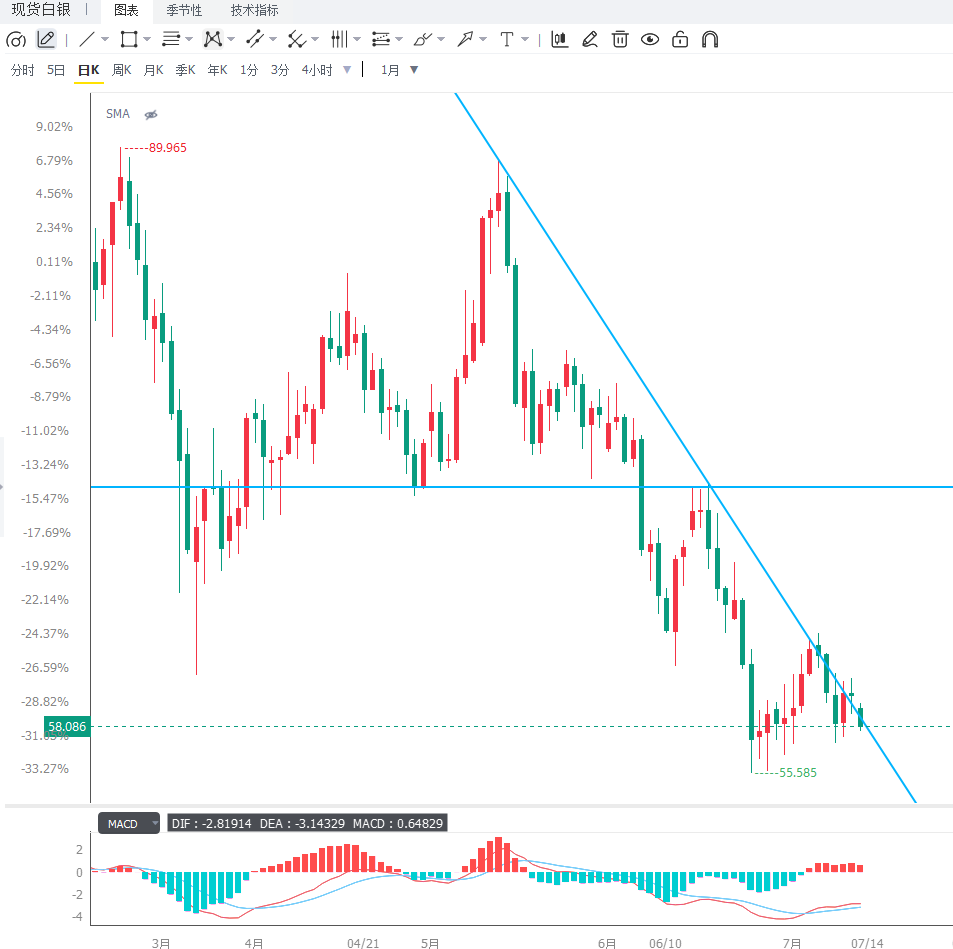
From a technical perspective, spot silver remains in a weak and volatile pattern on the daily chart, with prices trading below the medium- and long-term moving average system, and the downtrend has not yet changed significantly. The MACD indicator continues to be below the zero line, but the growth rate of the red bars has slowed, indicating that the upward momentum is stabilizing; the RSI remains in the neutral-to-strong zone, suggesting some upward momentum in the short term. If the silver price breaks through $60.00 , it is expected to further challenge the resistance areas of $61.20 and $62.50 ; on the downside, key support levels to watch are $58.00 , $57.00 , and $55.80 , and a break below these levels could trigger a short-term pullback.
From a 4-hour chart perspective, silver is maintaining a low-level consolidation trend, with prices trading near short-term moving averages. The MACD is above the zero line, but the red bars are narrowing, and the RSI remains around 55, indicating a balance between bullish and bearish forces. If US CPI data is lower than market expectations, silver is expected to break through the $60 mark and continue its upward trend; however, if inflation is strong and pushes the dollar higher, silver prices may retest the support level around $57.20, and short-term volatility is expected to increase further.
Editor's Summary : The silver market is currently influenced by both safe-haven demand and high interest rate expectations. Escalating tensions between the US and Iran have increased market risk aversion, but rising energy prices and resulting inflationary pressures have reinforced expectations that the Federal Reserve will maintain a tight monetary policy , causing silver to remain in a low-level consolidation phase in the short term. This week's US June CPI data and Federal Reserve Chairman Kevin Warsh's congressional speech will be crucial catalysts for determining the next stage of silver's price movement. If US inflation continues to slow, silver is expected to strengthen further; if high interest rate expectations continue to rise, silver may remain in a low-level consolidation phase.
U.S. Central Command launched another round of military strikes against Iranian targets on Sunday evening, aimed at weakening Iran's ability to attack commercial vessels in the Strait of Hormuz. Meanwhile, the U.S. military has struck more than 300 targets over the past three days, including approximately 140 targets on Saturday alone. The significant differences between the U.S. and Iran over whether to maintain normal navigation in the Strait of Hormuz have further exacerbated market concerns about global energy supply security.
The Strait of Hormuz handles approximately 20% of global seaborne crude oil transport . With continued tensions in the Middle East, international crude oil prices have rebounded, and rising energy costs have made the market more cautious about the global inflation outlook. Rising inflation expectations mean the Federal Reserve may need to maintain a tighter monetary policy for a longer period. The high-interest-rate environment, to some extent, increases the opportunity cost of holding non-interest-bearing assets, thus limiting the rise in silver prices.
Previously, the US and Iran had reached a phase-one agreement, leading the market to anticipate a gradual return to normal energy supplies in the Middle East, which caused international oil prices to fall. However, the recent escalation of military conflict has quickly cooled these optimistic expectations. Iran has stated that further negotiations are unlikely to resume until the US fulfills its previous commitments regarding ensuring shipping safety and resuming Iranian crude oil exports, indicating that significant uncertainty remains in the regional situation in the short term.
The market is currently focusing on the US June Consumer Price Index (CPI) to be released this week. The market expects the overall CPI to decline by 0.1% month-on-month, while the core CPI is expected to rise by 0.3% month-on-month. If the actual data is lower than market expectations, it will alleviate concerns about further tightening by the Federal Reserve, potentially causing the dollar and US Treasury yields to fall, thus supporting silver prices. However, if inflation data remains resilient, it may strengthen market expectations for further interest rate hikes this year, limiting the upside potential for silver.
In addition, the market will also be watching Federal Reserve Chairman Kevin Warsh's first address to Congress this week. Investors will focus on his latest remarks regarding the US economy, inflation trends, and the future path of monetary policy to further determine the Fed's subsequent policy direction.
From a technical perspective, spot silver remains in a weak and volatile pattern on the daily chart, with prices trading below the medium- and long-term moving average system, and the downtrend has not yet changed significantly. The MACD indicator continues to be below the zero line, but the growth rate of the red bars has slowed, indicating that the upward momentum is stabilizing; the RSI remains in the neutral-to-strong zone, suggesting some upward momentum in the short term. If the silver price breaks through $60.00 , it is expected to further challenge the resistance areas of $61.20 and $62.50 ; on the downside, key support levels to watch are $58.00 , $57.00 , and $55.80 , and a break below these levels could trigger a short-term pullback.
From a 4-hour chart perspective, silver is maintaining a low-level consolidation trend, with prices trading near short-term moving averages. The MACD is above the zero line, but the red bars are narrowing, and the RSI remains around 55, indicating a balance between bullish and bearish forces. If US CPI data is lower than market expectations, silver is expected to break through the $60 mark and continue its upward trend; however, if inflation is strong and pushes the dollar higher, silver prices may retest the support level around $57.20, and short-term volatility is expected to increase further.
Editor's Summary : The silver market is currently influenced by both safe-haven demand and high interest rate expectations. Escalating tensions between the US and Iran have increased market risk aversion, but rising energy prices and resulting inflationary pressures have reinforced expectations that the Federal Reserve will maintain a tight monetary policy , causing silver to remain in a low-level consolidation phase in the short term. This week's US June CPI data and Federal Reserve Chairman Kevin Warsh's congressional speech will be crucial catalysts for determining the next stage of silver's price movement. If US inflation continues to slow, silver is expected to strengthen further; if high interest rate expectations continue to rise, silver may remain in a low-level consolidation phase.
- Risk Warning and Disclaimer
- The market involves risk, and trading may not be suitable for all investors. This article is for reference only and does not constitute personal investment advice, nor does it take into account certain users’ specific investment objectives, financial situation, or other needs. Any investment decisions made based on this information are at your own risk.