The situation in the Middle East weighed on the euro's performance, and the euro remained range-bound against the pound.
2026-07-13 15:54:56
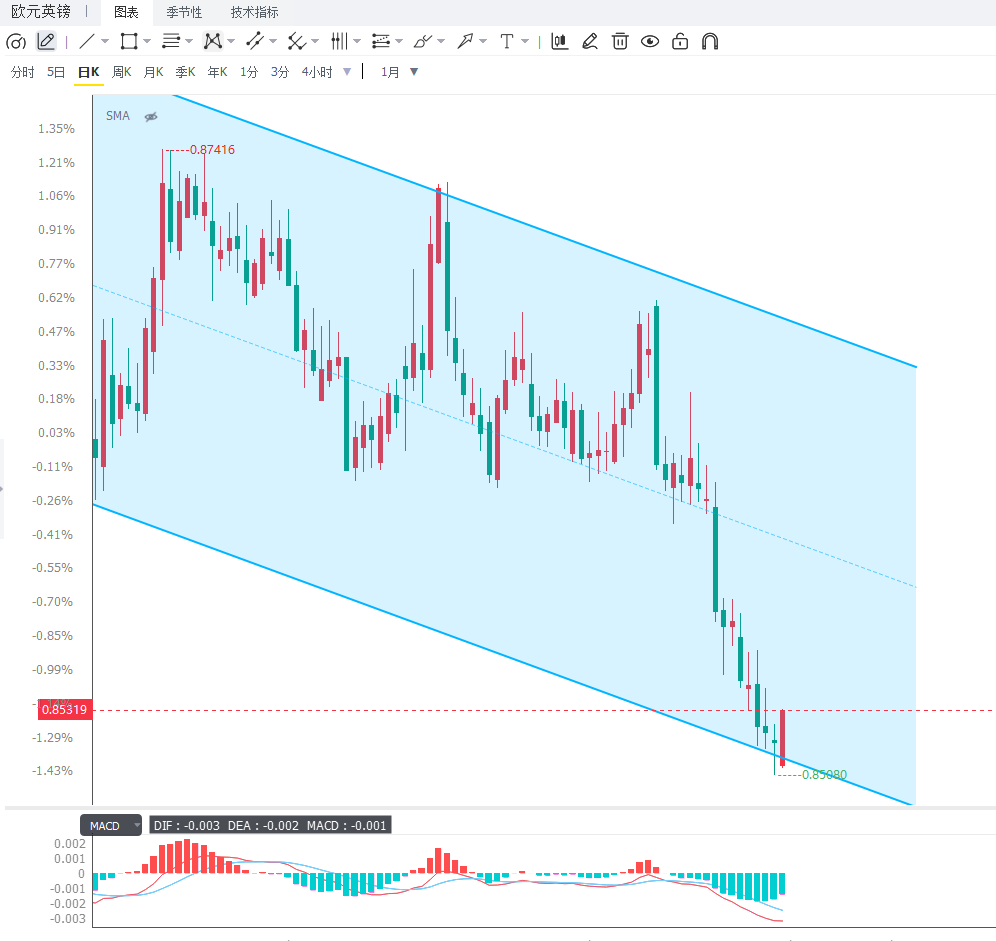
On Monday, the euro traded sideways against the pound, hovering around 0.8530 . Over the previous three weeks, the euro had fallen by approximately 2% against the pound, primarily due to continued tensions in the Middle East, rising international oil prices, and pressure on the eurozone's economic growth outlook. However, as the exchange rate approached the key support level of 0.8500, the downward momentum began to weaken.  The escalating military conflict between the US and Iran has increased shipping risks in the Strait of Hormuz, keeping international crude oil prices high. The Strait of Hormuz handles approximately 20% of global seaborne crude oil shipments , and heightened energy supply concerns are putting greater imported inflationary pressure on Europe, a net energy importer. Rising energy prices could push up inflation in the Eurozone, further increase production costs for businesses, and weaken consumer spending, posing further challenges to already weak economic growth. The market believes the European Central Bank (ECB) may need to maintain a relatively tight policy stance to address inflationary pressures from rising energy prices, but its policy space remains limited given the slowing economic growth, putting downward pressure on the euro. In contrast, the pound has performed relatively well. The market believes the UK's domestic political situation is gradually stabilizing. Andy Burnham is expected to gain leadership of the Labour Party this week and is likely to become Prime Minister on July 20th. Reduced political uncertainty helps improve market expectations for the continuity of UK economic policy and strengthens investor confidence in the pound. Meanwhile, the Bank of England is still widely expected to maintain a tight monetary policy in the future. UK inflation remains above the policy target, and wage growth remains resilient, leading the market to expect the Bank of England to maintain its restrictive interest rate level in the short term. This is one of the key reasons why the pound has outperformed the euro recently. This week, the market will also closely watch the US June Consumer Price Index (CPI) , speeches by European Central Bank officials, and UK economic data. If US inflation continues to exceed market expectations, global risk aversion may intensify further, pushing up the dollar and impacting risk appetite in European markets. Continued increases in energy prices will also continue to affect future ECB policy expectations and the euro's trajectory. Technically, the euro/pound pair maintains a downward trend on the daily chart, but the downward momentum has shown signs of slowing. The MACD indicator's green bars are shortening, and the two lines are converging, indicating a weakening of bearish pressure. The RSI has rebounded to near the neutral zone, suggesting improved market sentiment. If the exchange rate can break through 0.8535 again, it is expected to further challenge the 0.8570 and 0.8600 areas. Key support levels to watch are 0.8510 and 0.8500 ; a break below these levels could lead to a further decline to around 0.8420 . From a 4-hour chart perspective, the EUR/GBP pair remains within a descending wedge pattern. The MACD is near the zero line, indicating a continued weakening of short-term bearish momentum. The RSI shows some signs of bullish divergence and is gradually rising to around 50, suggesting a potential technical rebound. If the exchange rate breaks through the resistance above 0.8535, a short-term corrective rebound is expected; however, if it falls below 0.8500 again, the downtrend may resume.
  Editor's Summary: The euro/pound exchange rate remains influenced by multiple factors, including rising energy prices, the Eurozone economic outlook, and improving UK fundamentals. Escalating tensions in the Middle East continue to push up international oil prices, putting pressure on the Eurozone economy, while stabilizing political expectations in the UK and expectations of the Bank of England maintaining a tight policy continue to strengthen the pound's relative advantage. However, from a technical perspective, the bearish momentum in the euro/pound exchange rate has shown signs of weakening. If market risk sentiment improves, a short-term technical correction and rebound is possible, but the medium- to long-term trend will still depend on European economic performance, changes in UK policy, and the development of global geopolitical risks.
The escalating military conflict between the US and Iran has increased shipping risks in the Strait of Hormuz, keeping international crude oil prices high. The Strait of Hormuz handles approximately 20% of global seaborne crude oil shipments , and heightened energy supply concerns are putting greater imported inflationary pressure on Europe, a net energy importer. Rising energy prices could push up inflation in the Eurozone, further increase production costs for businesses, and weaken consumer spending, posing further challenges to already weak economic growth. The market believes the European Central Bank (ECB) may need to maintain a relatively tight policy stance to address inflationary pressures from rising energy prices, but its policy space remains limited given the slowing economic growth, putting downward pressure on the euro. In contrast, the pound has performed relatively well. The market believes the UK's domestic political situation is gradually stabilizing. Andy Burnham is expected to gain leadership of the Labour Party this week and is likely to become Prime Minister on July 20th. Reduced political uncertainty helps improve market expectations for the continuity of UK economic policy and strengthens investor confidence in the pound. Meanwhile, the Bank of England is still widely expected to maintain a tight monetary policy in the future. UK inflation remains above the policy target, and wage growth remains resilient, leading the market to expect the Bank of England to maintain its restrictive interest rate level in the short term. This is one of the key reasons why the pound has outperformed the euro recently. This week, the market will also closely watch the US June Consumer Price Index (CPI) , speeches by European Central Bank officials, and UK economic data. If US inflation continues to exceed market expectations, global risk aversion may intensify further, pushing up the dollar and impacting risk appetite in European markets. Continued increases in energy prices will also continue to affect future ECB policy expectations and the euro's trajectory. Technically, the euro/pound pair maintains a downward trend on the daily chart, but the downward momentum has shown signs of slowing. The MACD indicator's green bars are shortening, and the two lines are converging, indicating a weakening of bearish pressure. The RSI has rebounded to near the neutral zone, suggesting improved market sentiment. If the exchange rate can break through 0.8535 again, it is expected to further challenge the 0.8570 and 0.8600 areas. Key support levels to watch are 0.8510 and 0.8500 ; a break below these levels could lead to a further decline to around 0.8420 . From a 4-hour chart perspective, the EUR/GBP pair remains within a descending wedge pattern. The MACD is near the zero line, indicating a continued weakening of short-term bearish momentum. The RSI shows some signs of bullish divergence and is gradually rising to around 50, suggesting a potential technical rebound. If the exchange rate breaks through the resistance above 0.8535, a short-term corrective rebound is expected; however, if it falls below 0.8500 again, the downtrend may resume. Editor's Summary: The euro/pound exchange rate remains influenced by multiple factors, including rising energy prices, the Eurozone economic outlook, and improving UK fundamentals. Escalating tensions in the Middle East continue to push up international oil prices, putting pressure on the Eurozone economy, while stabilizing political expectations in the UK and expectations of the Bank of England maintaining a tight policy continue to strengthen the pound's relative advantage. However, from a technical perspective, the bearish momentum in the euro/pound exchange rate has shown signs of weakening. If market risk sentiment improves, a short-term technical correction and rebound is possible, but the medium- to long-term trend will still depend on European economic performance, changes in UK policy, and the development of global geopolitical risks.
- Risk Warning and Disclaimer
- The market involves risk, and trading may not be suitable for all investors. This article is for reference only and does not constitute personal investment advice, nor does it take into account certain users’ specific investment objectives, financial situation, or other needs. Any investment decisions made based on this information are at your own risk.