The clash between capital inflows and declining yields has led to a complex pricing scenario for the yen.
2026-07-13 16:24:56
On Monday, July 13, the USD/JPY pair was trading above 162, having risen to around 162.35 in early trading before retreating due to comments from the Japanese government regarding pension fund allocation. Meanwhile, the Middle East conflict caused Brent crude oil to rise to $79.78 per barrel during the session, with energy input costs and safe-haven demand simultaneously impacting the yen's pricing. 
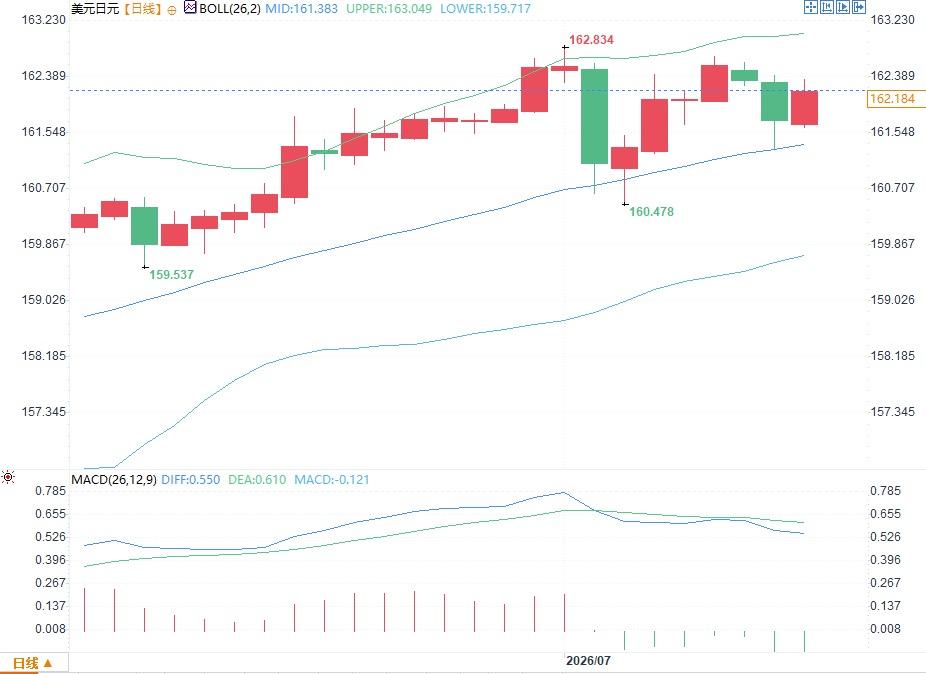 The MACD's DIF is 0.550, lower than the DEA's 0.610, and the histogram is -0.121, indicating that the medium-term upward structure remains intact, but marginal momentum has weakened compared to the previous period. The current state is closer to high-level consolidation than sustained acceleration. Subsequent pricing will be determined by the details of the GPIF implementation, US inflation, and the Bank of Japan's expectations.
Why do policy statements trigger exchange rate fluctuations?
Japanese Finance Minister Satsuki Katayama proposed increasing the allocation of domestic financial assets in the Government Pension Investment Fund (GPIF). Subsequently, the government released information that "there is no immediate plan to modify the target ratio," but Chief Cabinet Secretary Minoru Kihara stated that the fund can adjust its basic investment portfolio as needed. The difference between the two statements lies in whether the long-term target is changed, not whether it can be rebalanced within the existing range. The impact on foreign exchange depends on the source of funds. If the fund sells unhedged overseas assets and converts them back into yen, it will create direct demand for foreign exchange; if the increase comes from cash, maturing funds, or already hedged assets, the exchange rate effect will be much weaker. Therefore, the statement can only change expectations initially; the lasting impact still depends on the scale of implementation, asset classes, and methods of currency exchange.With a fund pool of nearly 294 trillion yen, how much real potential does it hold?
As of the end of March 2026, GPIF's investment assets totaled ¥293.6437 trillion. In actual allocation, domestic bonds accounted for 26.91%, overseas bonds 24.48%, domestic stocks 23.81%, and overseas stocks 24.80%, indicating the portfolio has already deviated from a mechanical four-part division. The current target remains 25% for each of the four asset classes, with domestic bonds allowed to fluctuate between 19% and 31%. Based on the actual weight of 26.91%, statically, this is approximately 4.09 percentage points away from the upper limit, corresponding to a theoretical capacity of approximately ¥12 trillion, but this is not an approved purchase plan. In fiscal year 2025, the fund net increased its allocation to domestic bonds by ¥14.7532 trillion while net reducing its holdings of overseas stocks by ¥4.2013 trillion. The market must distinguish between existing rebalancing and new policy flows. A hedging mechanism exists here. The repatriation of overseas assets can increase demand for the yen, but concentrated purchases of Japanese government bonds may lower long-term yields, weakening the support for the yen from narrowing interest rate differentials. The same policy has both a positive effect on capital inflows and a negative effect on yields, and cannot be simply equated with a one-sided strengthening of the yen.Interest rate differentials remain the main driver, while inflation determines the policy slope.
The Bank of Japan raised its policy rate to 1.0% in June, while the Federal Reserve's target range was 3.50% to 3.75%, leaving a short-term nominal interest rate spread of 2.50 to 2.75 percentage points. This means that while the cost advantage of yen financing is weakening, it has not yet reversed. Japan's producer price index (PPI) rose 0.4% month-on-month and 7.1% year-on-year in June, while import prices denominated in yen rose 29.7% year-on-year; the yield on 10-year Japanese government bonds was approximately 2.78% on July 13. High oil prices, a weak yen, and rising domestic yields have fueled discussions about further tightening by the Bank of Japan. US consumer prices rose 4.2% year-on-year in May, with core inflation rising 2.9% year-on-year; June data will be released on July 14. If inflation remains sticky, the narrowing of interest rate spreads may slow, and news from the GPIF exchange rate is more likely to create a temporary pullback than independently rewrite the medium-term framework of the USD/JPY exchange rate.The daily chart structure is relatively strong, but the momentum has cooled down.
In the chart, the Bollinger Bands have a middle band at 161.383, an upper band at 163.049, and a lower band at 159.717. The price of 162.184 remains above the middle band. The previous high of 162.834 is close to the upper band, indicating that the area between 162.83 and 163.05 is a high-volatility zone; the recent low of 160.478 serves as a reference point for the lower structure. The MACD's DIF is 0.550, lower than the DEA's 0.610, and the histogram is -0.121, indicating that the medium-term upward structure remains intact, but marginal momentum has weakened compared to the previous period. The current state is closer to high-level consolidation than sustained acceleration. Subsequent pricing will be determined by the details of the GPIF implementation, US inflation, and the Bank of Japan's expectations.Frequently Asked Questions
Question 1: Will GPIF's increased allocation to domestic assets lead to a sustained appreciation of the yen? Answer: Not necessarily. Demand for foreign exchange is only significant when unhedged overseas assets are sold and converted back to yen; if funds come from cash or already hedged assets, the impact is weaker. Buying Japanese government bonds may also lower yields, offsetting some of the repatriation effect. Question 2: Why is the USD/JPY exchange rate still high despite rising Japanese interest rates? Answer: The Bank of Japan's interest rate is 1.0%, while the Federal Reserve's remains at 3.50% to 3.75%, resulting in a still wide short-term interest rate differential. Energy import costs and existing positions are also delaying the yen's recovery.- Risk Warning and Disclaimer
- The market involves risk, and trading may not be suitable for all investors. This article is for reference only and does not constitute personal investment advice, nor does it take into account certain users’ specific investment objectives, financial situation, or other needs. Any investment decisions made based on this information are at your own risk.