Improved UK fiscal prospects supported the pound, causing it to rise sharply against the yen.
2026-07-16 15:54:11
The British pound traded in a narrow range around 219.50 against the Japanese yen during Thursday's European trading session, entering a consolidation phase after a sharp rise in the previous session. Although short-term bullish sentiment has cooled somewhat, the overall fundamentals still support the exchange rate's strength, and the market generally believes that the medium- to long-term upward trend remains unchanged.  The pound has been supported recently, mainly due to a more stable political environment and improved expectations for fiscal policy in the UK. The market anticipates Andy Burnham will officially become Prime Minister soon, and investors generally expect him to appoint a conservative Chancellor of the Exchequer, which is expected to boost market confidence in UK fiscal discipline. The improved UK fiscal outlook has increased market risk appetite, providing continued support for the pound. Meanwhile, the significant interest rate differential between the UK and Japan remains a key factor driving the continued rise of the pound against the yen. Currently, the Bank of England's benchmark interest rate remains at 3.75% , while the Bank of Japan, although raising its policy rate to 1.00% in June, the highest level since 1995, still maintains a spread of approximately 275 basis points . This significant interest rate advantage continues to attract carry trade funds into pound assets, and the yen's status as a funding currency has not fundamentally changed; therefore, the pound against the yen is still supported by capital flows. Economic data released by the UK on the same day showed that GDP grew by 0.1% month-on-month in May, an improvement from the previous contraction of 0.1%, indicating that the UK economy is maintaining a moderate recovery. However, industrial production data slightly missed market expectations, with industrial output falling 0.5% month-on-month in May, while manufacturing output grew by 0.1% . Overall, the economic data had a relatively limited impact on the exchange rate. On the other hand, Japan continues to signal its commitment to stabilizing the exchange rate. The Japanese government has repeatedly stated recently that it will closely monitor exchange rate fluctuations and take appropriate measures to maintain market stability if necessary. With both the USD/JPY and GBP/JPY pairs near multi-year highs, the market remains highly vigilant about potential government intervention in the exchange rate market. The Japanese government's continued signals of intervention have made some investors cautious and limited further rapid gains in the GBP/JPY pair. However, from an overall fundamental perspective, the Bank of Japan's monetary policy remains significantly looser than the Bank of England's, and improved UK fiscal expectations continue to support the pound. Therefore, even if the exchange rate experiences a period of adjustment, the market generally believes that the pullback may attract bargain hunters back into the market. Going forward, investors will continue to focus on UK inflation and employment data, the Bank of Japan's policy moves, and the Japanese government's statements on the exchange rate. Changes in global risk sentiment will also affect arbitrage trading demand, thus determining the next direction of the GBP/JPY pair. From a daily chart perspective, the GBP/JPY pair continues its medium- to long-term upward trend, currently trading around 219.50 and remaining above key moving averages. The MACD indicator continues above the zero line, indicating that bullish momentum still dominates, although the expansion rate of the red bars has slowed. The RSI indicator has entered the high zone, showing some overbought conditions in the short term, and the exchange rate may enter a period of consolidation at higher levels. Key resistance levels to watch are 220.50, 221.80, and 223.00; key support levels are 218.20, 217.00, and 215.80. A break below 218.20 could lead to further technical corrections in the short term. From a 4-hour chart perspective, the exchange rate maintains an upward channel, with short-term moving averages remaining in a bullish alignment. The MACD is running at a high level, but momentum has weakened, and the RSI indicator has retreated from the overbought zone, indicating a slight slowdown in upward momentum. If the exchange rate can effectively break through 220.50, it is expected to continue to challenge the resistance around 221.80; if the Japanese government continues to release stronger intervention signals, it is possible that the exchange rate will retrace to the support around 218.20 and then stabilize and rebound.
 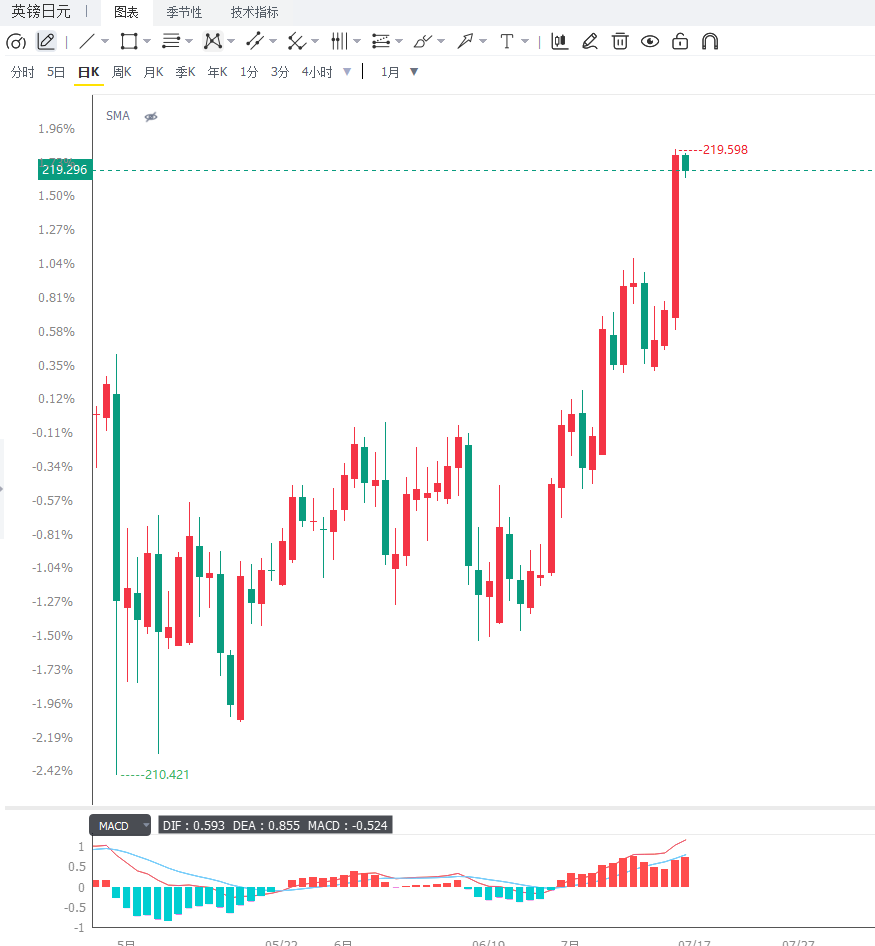 Editor's Summary: The British pound against the Japanese yen is currently supported by both improved UK fiscal expectations and the UK-Japan interest rate advantage, with carry trade demand remaining a significant driver of the exchange rate's strength. Although the Bank of Japan has gradually normalized its monetary policy, a significant interest rate gap remains between it and the Bank of England, causing the yen to continue its overall weakness. In the short term, potential intervention by the Japanese government in the foreign exchange market remains the biggest uncertainty facing the exchange rate. If the government continues to strengthen verbal or actual intervention, the pace of the pound's rise against the yen may slow; however, as long as the UK economy remains stable and the interest rate advantage does not change significantly, the exchange rate is expected to maintain a high-level, volatile, and upward trend, with pullbacks likely to be seen as buying opportunities.
The pound has been supported recently, mainly due to a more stable political environment and improved expectations for fiscal policy in the UK. The market anticipates Andy Burnham will officially become Prime Minister soon, and investors generally expect him to appoint a conservative Chancellor of the Exchequer, which is expected to boost market confidence in UK fiscal discipline. The improved UK fiscal outlook has increased market risk appetite, providing continued support for the pound. Meanwhile, the significant interest rate differential between the UK and Japan remains a key factor driving the continued rise of the pound against the yen. Currently, the Bank of England's benchmark interest rate remains at 3.75% , while the Bank of Japan, although raising its policy rate to 1.00% in June, the highest level since 1995, still maintains a spread of approximately 275 basis points . This significant interest rate advantage continues to attract carry trade funds into pound assets, and the yen's status as a funding currency has not fundamentally changed; therefore, the pound against the yen is still supported by capital flows. Economic data released by the UK on the same day showed that GDP grew by 0.1% month-on-month in May, an improvement from the previous contraction of 0.1%, indicating that the UK economy is maintaining a moderate recovery. However, industrial production data slightly missed market expectations, with industrial output falling 0.5% month-on-month in May, while manufacturing output grew by 0.1% . Overall, the economic data had a relatively limited impact on the exchange rate. On the other hand, Japan continues to signal its commitment to stabilizing the exchange rate. The Japanese government has repeatedly stated recently that it will closely monitor exchange rate fluctuations and take appropriate measures to maintain market stability if necessary. With both the USD/JPY and GBP/JPY pairs near multi-year highs, the market remains highly vigilant about potential government intervention in the exchange rate market. The Japanese government's continued signals of intervention have made some investors cautious and limited further rapid gains in the GBP/JPY pair. However, from an overall fundamental perspective, the Bank of Japan's monetary policy remains significantly looser than the Bank of England's, and improved UK fiscal expectations continue to support the pound. Therefore, even if the exchange rate experiences a period of adjustment, the market generally believes that the pullback may attract bargain hunters back into the market. Going forward, investors will continue to focus on UK inflation and employment data, the Bank of Japan's policy moves, and the Japanese government's statements on the exchange rate. Changes in global risk sentiment will also affect arbitrage trading demand, thus determining the next direction of the GBP/JPY pair. From a daily chart perspective, the GBP/JPY pair continues its medium- to long-term upward trend, currently trading around 219.50 and remaining above key moving averages. The MACD indicator continues above the zero line, indicating that bullish momentum still dominates, although the expansion rate of the red bars has slowed. The RSI indicator has entered the high zone, showing some overbought conditions in the short term, and the exchange rate may enter a period of consolidation at higher levels. Key resistance levels to watch are 220.50, 221.80, and 223.00; key support levels are 218.20, 217.00, and 215.80. A break below 218.20 could lead to further technical corrections in the short term. From a 4-hour chart perspective, the exchange rate maintains an upward channel, with short-term moving averages remaining in a bullish alignment. The MACD is running at a high level, but momentum has weakened, and the RSI indicator has retreated from the overbought zone, indicating a slight slowdown in upward momentum. If the exchange rate can effectively break through 220.50, it is expected to continue to challenge the resistance around 221.80; if the Japanese government continues to release stronger intervention signals, it is possible that the exchange rate will retrace to the support around 218.20 and then stabilize and rebound. Editor's Summary: The British pound against the Japanese yen is currently supported by both improved UK fiscal expectations and the UK-Japan interest rate advantage, with carry trade demand remaining a significant driver of the exchange rate's strength. Although the Bank of Japan has gradually normalized its monetary policy, a significant interest rate gap remains between it and the Bank of England, causing the yen to continue its overall weakness. In the short term, potential intervention by the Japanese government in the foreign exchange market remains the biggest uncertainty facing the exchange rate. If the government continues to strengthen verbal or actual intervention, the pace of the pound's rise against the yen may slow; however, as long as the UK economy remains stable and the interest rate advantage does not change significantly, the exchange rate is expected to maintain a high-level, volatile, and upward trend, with pullbacks likely to be seen as buying opportunities.
- Risk Warning and Disclaimer
- The market involves risk, and trading may not be suitable for all investors. This article is for reference only and does not constitute personal investment advice, nor does it take into account certain users’ specific investment objectives, financial situation, or other needs. Any investment decisions made based on this information are at your own risk.