The expectation of peace talks may fall through, and crude oil prices will continue their upward trend.
2026-07-16 17:20:11
On Thursday (July 16), during the Asian and European sessions, international oil prices remained volatile at high levels, with WTI crude oil currently trading around 79.58. The US and Iran are in a full-blown military standoff. The interim agreement previously intended to ease tensions with Iran has completely failed, and the risk of a full-scale regional war continues to rise. However, high-level officials have consistently signaled that further communication is possible. Trump stated early this morning that the current situation between the US and Iran is progressing well, and Iran is eager to reach a reconciliation with the US. He added that the situation will gradually become clearer, with both sides either reaching a peace agreement or completely ending the conflict (ending the war). The US has restarted a new round of military operations, granting 60 days of troop usage rights and re-blockading Iranian ships. Meanwhile, despite Trump's claims of smooth progress in negotiations, the Iranian Revolutionary Guard's military actions show no signs of abating, suggesting that the personnel responsible for US-Iran negotiations and the Revolutionary Guard may not be entirely aligned. In other words, in a war of attrition between the US and Iran, it will be difficult to truly negotiate until the Revolutionary Guard concedes defeat. 
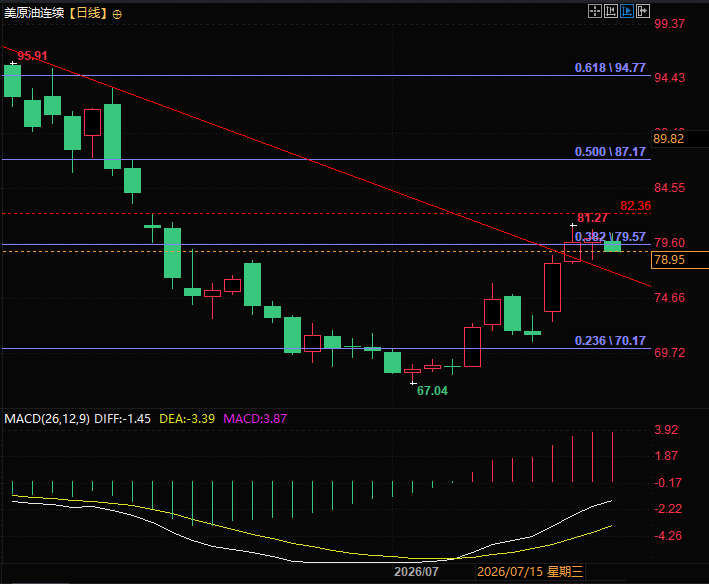 (WTI crude oil futures daily chart, source: EasyTrade) At 17:17 Beijing time, the WTI crude oil futures contract is currently trading at $79.10 per barrel.
US core strategy: blockade combined with bombing, testing the Revolutionary Guard's bottom line.
In this round of conflict, the core operational logic of the United States is clear and explicit: using a dual pressure strategy of maritime blockade combined with sustained bombing across the entire region, probing strikes against Iran's core infrastructure, and gradually expanding the depth of the operation. On Wednesday, the US military reinstated a comprehensive maritime blockade of Iran, strictly controlling shipping lanes in the Persian Gulf. On Thursday, the scope of air strikes was further extended northward, covering the area surrounding the Iranian capital, Tehran, for the first time in this round of conflict. Simultaneously, the US military precisely targeted key Iranian strategic facilities, focusing its air strikes on ballistic missile production bases and aerospace facilities in Semnan province, as well as military barracks, air defense, and missile sites in multiple locations, continuously weakening Iran's military infrastructure and combat capabilities. Furthermore, US naval forces simultaneously carried out blockade enforcement operations, precisely striking a Curaçao-flagged oil tanker that ignored repeated warnings and attempted to break through the blockade to reach Iran's Kharg Island oil port, destroying its smokestack and rendering it completely unable to navigate. The US military has now sent a clear signal that it will continue to escalate its actions, further targeting and bombing various core energy and military infrastructures in Iran, continuously compressing Iran's strategic living space.Iran retaliates strongly: defending control of the Strait of Hormuz, threatening reciprocal retaliation and energy containment.
Faced with the US's escalating blockade and bombing offensive, Iran has adopted a tough, reciprocal counterattack strategy, firmly upholding its core bottom line of controlling the Strait of Hormuz and issuing stern warnings of retaliation. Iranian leaders have repeatedly emphasized that control of the Strait of Hormuz is a strategically valuable asset that Iran will not easily relinquish. Regarding the US's continued attacks on its infrastructure, Iran has clearly stated that any US bombing of its core infrastructure will provoke a comprehensive retaliatory strike from Iran. To counter the US blockade and suppression, Iran not only launched cross-border strikes against Bahrain, Jordan, Kuwait, and other Middle Eastern countries hosting US troops in the early morning using missiles and drones, but its Revolutionary Guard has also resorted to extreme countermeasures, threatening to completely shut down all energy exports from the Middle East, achieving a situation where "regional oil and gas exports are either fully open or completely halted," using its energy trump card to counter US military pressure. A spokesperson for Iran's Supreme Joint Military Command stated: "If US President Trump continues to threaten attacks on Iranian infrastructure, Iran will target all infrastructure in the region." Iran stated that if the United States attacks its infrastructure, Iran will indiscriminately attack the infrastructure of other countries in the region, as if they had never been produced. At the same time, the Iranian parliament and its negotiating team stated that if the United States refuses to fulfill the terms of the interim agreement and continues to escalate the conflict, Iran is fully prepared for a full-scale military confrontation.The blockade has impacted shipping, resulting in a significant decrease in the volume of traffic through the strait.
The intense standoff between the US and Iran, coupled with the implementation of the US blockade policy, has directly led to a sharp drop in shipping efficiency in the Strait of Hormuz. Data shows that on the first trading day after the US reinstated its maritime blockade of Iran, the number of oil tankers passing through the strait plummeted from 13 the previous day to just 7, nearly halving the shipping capacity. Shipping industry insiders admit that global shipowners are currently highly vigilant about geopolitical risks, cautiously assessing the safety hazards of navigation through the strait, proactively slowing down their navigation plans and adjusting shipping routes, with risk aversion continuing to spread. This situation has further exacerbated capital markets' panic expectations regarding disruptions to the global crude oil supply chain, providing strong support for the continued rise in international oil prices. Summary and Technical Analysis: Overall, the escalation of the US-Iran geopolitical conflict and the disruption of shipping through the strait have created a strong resonance, directly dominating the recent trend in the international crude oil market. Currently, WTI oil prices are around $80, a cumulative increase of over 15% since the outbreak of the conflict, with the geopolitical risk premium continuing to be released. In the short term, the US military's escalating bombing and blockade operations, Iran's tough energy countermeasures and retaliatory stance, and the current sluggish navigation in the Strait of Hormuz will continue to support the resilience of oil prices. In the medium to long term, as long as the US-Iran conflict fails to ease and the shipping safety risks in the Strait of Hormuz are not completely eliminated, the uncertainty of global crude oil supply will persist, and oil prices may maintain a high-level fluctuation pattern. If the conflict between the two sides intensifies further and navigation in the Strait of Hormuz is almost at a standstill, the possibility of another sharp rise in oil prices cannot be ruled out. Currently, an internal conflict has emerged in Iran, with the government, responsible for civilian affairs, actively negotiating, while the Revolutionary Guard seeks to gain more ground. Whether this conflict will end depends on the Revolutionary Guard's stance. Since neither side is willing to take action on infrastructure, the US-Iran standoff has become a war of attrition, a test of who will succumb to the depletion of war assets first. Therefore, the Revolutionary Guard holds a strategic advantage in the Strait of Hormuz, which Iran has secured. If the Iranian military makes concessions, it could directly declare a US victory in this war of attrition. Conversely, if Iran maintains its hardline stance, the situation remains unclear. Technically, WTI crude oil has seen a significant rise followed by a slight consolidation, indicating strong bullish momentum and the potential for further gains. Target prices are at 82.3 and the subsequent 50% Fibonacci retracement level of 87.17. (WTI crude oil futures daily chart, source: EasyTrade) At 17:17 Beijing time, the WTI crude oil futures contract is currently trading at $79.10 per barrel.
- Risk Warning and Disclaimer
- The market involves risk, and trading may not be suitable for all investors. This article is for reference only and does not constitute personal investment advice, nor does it take into account certain users’ specific investment objectives, financial situation, or other needs. Any investment decisions made based on this information are at your own risk.