Why did Brident's statement "It's worth observing" put pound bulls in a dilemma?
2026-07-16 18:00:12
On Thursday, July 16, the pound was trading around 1.3510 against the dollar, still near a two-month high. Meanwhile, Bank of England Deputy Governor Sarah Briden's comments on the energy shock were cautiously cautious, and the policy focus has not shifted to proactive tightening. The pound's current relatively high level is more due to position adjustments and a decline in fiscal risk premiums than to a comprehensive improvement in the UK economic fundamentals. 
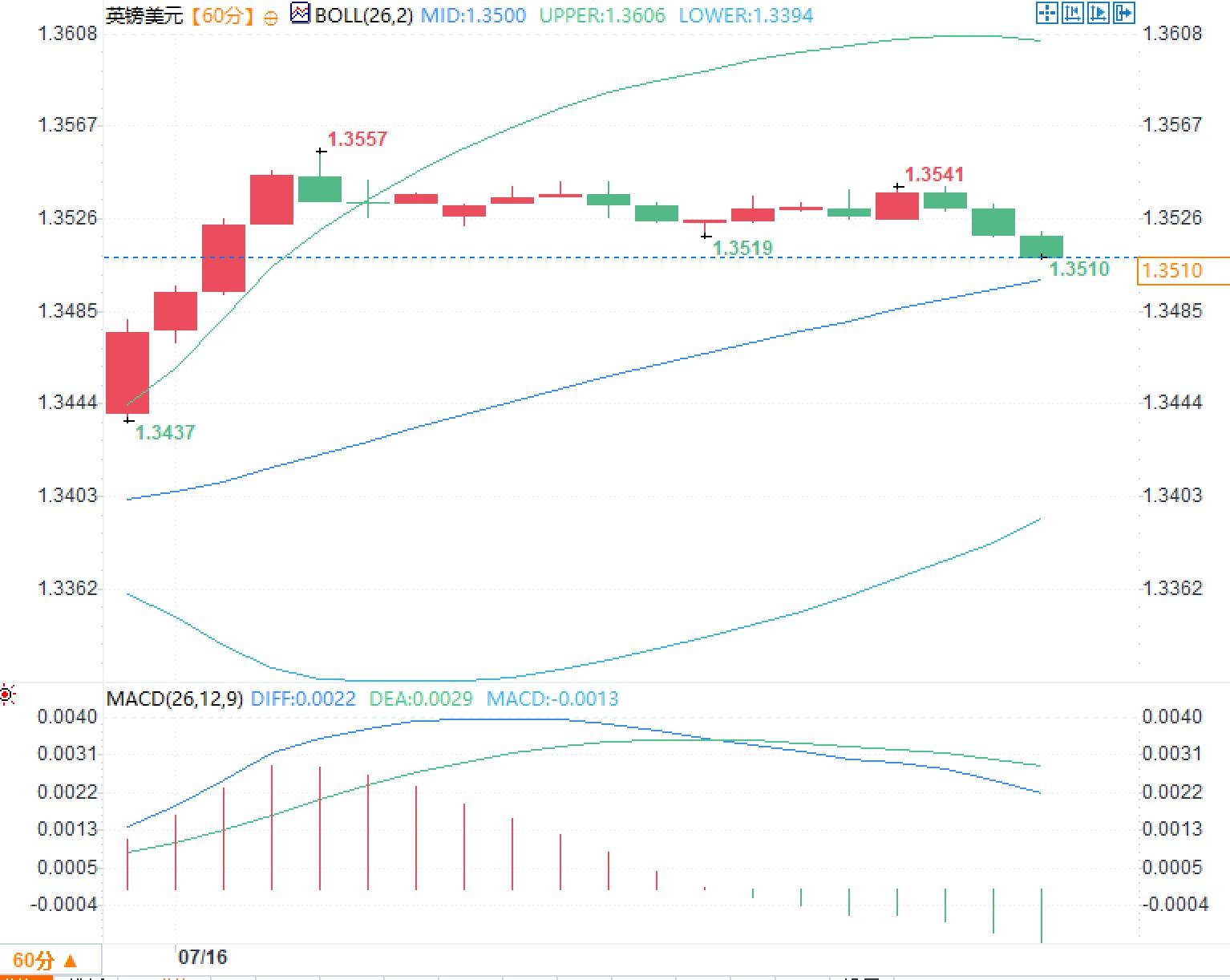 It's worth noting that the MACD fast line is at 0.0022, the slow line is at 0.0029, and the histogram has dropped to -0.0013, indicating that short-term momentum has shifted from accelerated upward movement to high-level consolidation. The price remains above the middle band, meaning the trend structure has not been broken. However, if it continues to fail to break through 1.3540 to 1.3560, the market may reassess the proportion of the previous rise contributed by a weaker dollar and short covering.
Brident signals patience, policy thresholds have not been lowered.
Briden's core assessment is that, excluding energy and supply shocks caused by external conflicts, UK inflation is already close to the 2% target. This means that recent price pressures are being attributed more to exogenous supply shocks at the policy level, rather than to overheating demand or a restart of the wage-price cycle. This distinction is crucial. Monetary policy can suppress demand, but it's difficult to directly increase energy supply. If the Bank of England raises interest rates solely because of rising energy prices, it may further suppress consumption, investment, and employment without quickly reducing energy inflation. Briden's emphasis on being in a suitable position for observation essentially indicates that the policy committee needs to confirm whether energy costs are spreading to wages, service prices, and inflation expectations, rather than mechanically following overall inflation fluctuations. In June, the Bank of England maintained its benchmark interest rate at 3.75% by a 7-2 vote, with two members supporting a 25 basis point rate hike, showing that there is indeed a force within the committee to prevent recurring inflation, but a majority has not yet been formed. The next interest rate decision will be announced on July 30th, and the market focus will be on whether the policy statement reinforces the risk of double-dip inflation, rather than simply focusing on whether interest rates change.Inflation is at 2.8%, but energy transmission will still determine policy direction.
The UK's Consumer Price Index (CPI) rose 2.8% year-on-year in May, unchanged from April and below some market expectations, but still above the 2% target. Current data is neither sufficient to support rapid easing nor to justify a renewed series of rate hikes. What truly influences sterling interest rate pricing is not the single figure of 2.8%, but the structure of inflation over the next few months. If energy price increases are primarily confined to transport, fuel, and utility bills, and the labor market continues to cool, the Bank of England may tolerate a short-term rise in overall inflation. Conversely, if businesses pass on costs across the board to service prices, and wage growth picks up again, the policy committee will find it more difficult to maintain its observation stance. Brident believes this shock is less likely to be embedded in wage and pricing behavior like the previous energy crisis, based on current weak demand, declining corporate bargaining power, and increased slack in the labor market. This assessment reduces the necessity for short-term rate hikes but does not eliminate tail risks. The market had previously priced in a tightening of approximately 27 basis points this year and projected the earliest rate hike to be in September, reflecting that the trading structure still retains a risk premium for inflation persistence rather than forming a definite consensus on rate hikes.Economic growth lacks elasticity, and the pound's interest rate differential has an upper limit.
UK GDP grew by only 0.1% month-on-month in May, a slight recovery from the 0.1% decline in April. Service sector output grew by 0.3%, but production and construction declined by 0.5% and 0.8% respectively. The economy grew by 0.7% in the three months to May, which seems acceptable on the surface, but the monthly structure shows a high concentration of growth and uneven expansion in the real sector. This is a key background to Brident's view that there is a lack of reason to raise interest rates. If the Bank of England further increases financing costs, the cash flow of the real estate, construction, manufacturing, and SME sectors may be the first to be pressured. For the pound, higher interest rates can provide nominal interest rate differential support, but if rising interest rates are accompanied by downward revisions in growth expectations and increased fiscal pressure, the exchange rate may not benefit sustainably. Therefore, the pound/dollar exchange rate currently faces an asymmetric policy mix. Inflation risks limit the Bank of England's room for interest rate cuts, while weak growth limits its room for rate hikes, and the policy rate may remain around 3.75% for an extended period. This environment usually favors maintaining the exchange rate within a range, but it is not easy for a sustained unilateral trend to form solely based on interest rate expectations.1.3500 becomes the dividing line for short-term pricing.
Observing the 60-minute chart, after a rapid rise from 1.3437, the exchange rate fluctuated repeatedly in the 1.3520 to 1.3540 range, with the previous highs at 1.3557 and 1.3541 respectively. The Bollinger Band middle line has risen to 1.3500, the upper line is at 1.3606, and the lower line is at 1.3394, indicating that the previous trend was still upward, but the expansion of volatility has slowed down. It's worth noting that the MACD fast line is at 0.0022, the slow line is at 0.0029, and the histogram has dropped to -0.0013, indicating that short-term momentum has shifted from accelerated upward movement to high-level consolidation. The price remains above the middle band, meaning the trend structure has not been broken. However, if it continues to fail to break through 1.3540 to 1.3560, the market may reassess the proportion of the previous rise contributed by a weaker dollar and short covering.
- Risk Warning and Disclaimer
- The market involves risk, and trading may not be suitable for all investors. This article is for reference only and does not constitute personal investment advice, nor does it take into account certain users’ specific investment objectives, financial situation, or other needs. Any investment decisions made based on this information are at your own risk.