Gold Trading Alert: Escalating US-Iran conflict causes a double whammy for oil and the dollar, with gold prices plummeting 2% and falling below the $4,000 mark. Is the next target $3,600?
2026-07-17 07:26:13
Amidst the current volatile global geopolitical landscape, gold, a traditional safe-haven asset, has experienced a rare and significant setback. On July 16, 2026, spot gold prices fell sharply by 2% to $3,976.26 per ounce, a two-week low; US gold futures also declined by 1.5%, closing at $3,992.10. This decline is the result of multiple factors, including the rapidly escalating situation in the Middle East, rising expectations of a Federal Reserve interest rate hike, and a strengthening US dollar. As a non-interest-bearing asset, gold's appeal is being significantly diminished by the high-yield environment and inflation concerns. The market is at a delicate and tense crossroads: short-term pressure is immense, but does the long-term logic still hold true? 
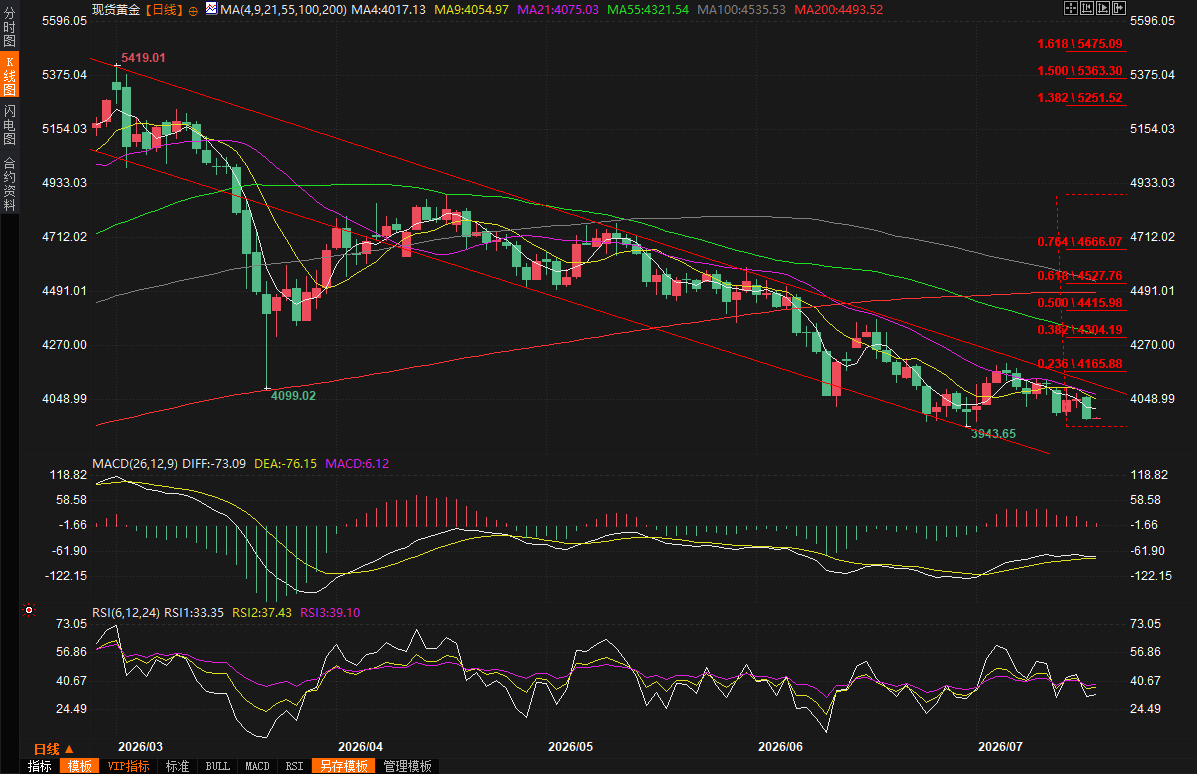 (Spot gold daily chart, source: FX678) At 07:23 Beijing time, spot gold is currently trading at $3978.12 per ounce.
Escalating Middle East conflict: The shadow of energy crisis looms over global markets
The escalating tensions between the US and Iran over the past week have been the direct trigger for the collapse of gold prices. The US launched large-scale airstrikes against targets along Iran's southern coast for several consecutive nights, targeting key facilities including Bandar Abbas, Qeshm Island, and Hamir. Iran retaliated with missiles and drones, threatening to block the Bab el-Mandeb Strait in the Red Sea through its Houthi allies, while also attempting to regain control of the Strait of Hormuz. The consequences of disrupting this crucial global oil shipping route would be dire. Oil prices reacted swiftly, although they retreated slightly on the day, remaining near one-month highs. Brent crude hovered around $84, while US crude was near $78. This volatility in energy prices has directly fueled global inflation expectations. Bart Melek, global head of commodities strategy at TD Securities, pointed out that further increases in oil prices could drive up government bond yields, potentially prompting the Federal Reserve to raise interest rates as early as September, thus putting continued pressure on gold. The conflict not only threatened energy supplies but also disrupted shipping, further amplifying market panic, yet surprisingly it did not translate into traditional safe-haven buying of gold.The strengthening of both the US dollar and US Treasury yields put double pressure on gold.
The strong rebound of the US dollar echoed the tensions in the Middle East. The dollar index rose 0.2% to 100.71 on the day, and although it may still close slightly lower this week, it has recovered from a near one-month low. A higher dollar exchange rate directly increases the cost of holding gold for non-US investors, weakening demand. Meanwhile, the yield on the 10-year US Treasury note rose slightly to 4.561%, and the two-year yield rose to 4.156%. Statements from Federal Reserve officials further reinforced market expectations: Chairman Warsh emphasized the determination to reduce inflation, and Kansas City Fed President Schmid and Dallas Fed President Logan both expressed concerns about the persistence of inflation, with the latter even calling for a slight increase in interest rates. According to the CME FedWatch tool, traders currently expect a 53% probability of a rate hike in September. While the probability of a rate hike in July fell to around 10%, the probability of at least a 25 basis point rate hike in September has rebounded to the 48%-55% range. A high-interest-rate environment is a fatal blow to gold. Because gold does not generate interest, its opportunity cost of holding it increases significantly when real yields rise. Although recent US CPI and PPI data showed a slowdown in June, retail sales rose 0.2% month-on-month (in line with expectations), and initial jobless claims fell to 208,000 (indicating labor market resilience). These data collectively confirm that the US economy has not stalled significantly and has instead demonstrated strong resilience in the face of energy shocks. This further solidifies the Federal Reserve's stance of maintaining relatively high interest rates.Interpreting US Economic Data: Resilience Remains, Inflationary Pressures Persist
A close analysis of recent US economic indicators reveals that consumer spending remains a major pillar of the economy. While June retail sales saw their smallest increase in five months, core retail sales (excluding volatile items like automobiles and gasoline) rose 0.5%, with online spending surging due to promotions like Amazon Prime Day, and automobile sales also performing strongly. The wealth effect of high-income groups, tax rebates, and a stable job market have collectively supported the resilience of consumption. Economists have therefore raised their second-quarter GDP growth forecasts to around 2.4% annualized. However, gasoline prices are facing renewed upward pressure following the escalation of the conflict, which could squeeze household budgets in the third quarter. The Federal Reserve's Beige Book also indicates that consumers are beginning to reduce discretionary spending and turn to cheaper alternatives. The persistence of inflation in the goods and services sector remains a core concern for monetary policy. Market expectations for the Federal Reserve are shifting from "interest rate cuts" to "maintaining high rates or even slight increases," which is the fundamental reason for the short-term pressure on gold.Gold Outlook: Short-term pressure, but still has long-term investment value.
In summary, this round of gold price decline is the result of a confluence of multiple negative factors: geopolitical conflicts have driven up oil prices and inflation expectations, the US dollar and US Treasury yields have strengthened in tandem, US economic data has shown resilience, and expectations for a Fed rate hike have increased. These factors have collectively weakened gold's safe-haven and inflation-hedging properties, causing prices to fall rapidly to their lowest levels since early July. A Bank of America report points out that since 1970, the three major bear markets in gold have all retraced at least 50% of their previous gains. If 2026 becomes a long-term cycle top similar to 1980 and 2011, the downside potential will be substantial. Bank of America technical analysts warn that the current correction in gold may take longer, and prices may eventually test support around $3,600 before a more solid bottom can be formed. However, from a medium- to long-term perspective, the fundamental logic of gold has not been completely broken. The complexity and persistence of the Middle East situation may still lead to greater uncertainty in the future. Once the conflict exceeds the current controllable range, or there is a substantial disruption to energy supplies, safe-haven demand will return. Meanwhile, global central bank gold-buying trends, long-term inflation concerns, and a fragmented geopolitical landscape all provide underlying support for gold. Investors should remain cautious at present. In the short term, attention should be paid to oil price trends, further statements from Federal Reserve officials, and any signs of easing tensions in the Middle East, all of which will be key catalysts for a gold price rebound or further correction. Gold cannot always perform exceptionally well, but in a world full of uncertainty, it remains an important asset for diversifying risk and coping with extreme scenarios. Overall, this flash crash in gold prices reminds the market that the performance of safe-haven assets is always closely linked to the macroeconomic environment. Before the Federal Reserve's policy path becomes clearer and the direction of the Middle East conflict becomes clearer, gold may continue to face volatility pressure. However, for long-term investors, the current price level may provide a noteworthy entry window. Future trends will depend on close monitoring of every geopolitical and monetary policy maneuver. (Spot gold daily chart, source: FX678) At 07:23 Beijing time, spot gold is currently trading at $3978.12 per ounce.
- Risk Warning and Disclaimer
- The market involves risk, and trading may not be suitable for all investors. This article is for reference only and does not constitute personal investment advice, nor does it take into account certain users’ specific investment objectives, financial situation, or other needs. Any investment decisions made based on this information are at your own risk.