Rising oil prices boosted the Canadian dollar, with USD/CAD undergoing a period of adjustment pending guidance from Canadian inflation data.
2026-07-20 13:48:14
The US dollar (USD/CAD) continued its downward trend in early Asian trading on Monday, falling to around 1.4005. Recent increases in oil prices have been a significant factor driving the Canadian dollar's strength. As Canada is one of the world's major oil exporters, rising energy prices typically improve Canada's terms of trade and increase market demand for Canadian dollar assets.  The international crude oil market has recently strengthened due to the escalating tensions in the Middle East. The further deterioration of tensions between the US and Iran has raised concerns about potential disruptions to regional energy transportation. Iran has stated that the Strait of Hormuz may not be safe for energy shipments during the ongoing US actions, warning of risks to petrochemical and crude oil transport. Meanwhile, the scope of regional conflict continues to expand. Recent reports of missile and drone attacks in Bahrain, Jordan, Kuwait, and Iraq have further fueled concerns about the stability of the energy supply chain. Rising oil prices provide direct support for the Canadian dollar. As a resource-based currency, the Canadian dollar's performance is typically strongly correlated with oil prices. When oil prices remain high, Canada's energy export revenue increases, helping to improve market expectations for the Canadian economy and thus pushing the Canadian dollar stronger against the US dollar. In addition to oil price factors, the US dollar has also recently faced pressure from changes in expectations regarding Federal Reserve policy. Recent US inflation data has shown signs of easing, leading the market to reduce its bets on a near-term Fed rate hike. Market surveys indicate that the probability of a Fed rate hike in July has fallen to approximately 14%, lower than the previous week's expectation of around 25%. Lower interest rate expectations have weakened the dollar's appeal and provided downward momentum for USD/CAD. However, Federal Reserve officials remain cautious. Fed Governor Christopher Waller stated that policymakers need to see signs of cooling inflation over several months before completely ruling out further interest rate adjustments. The market is currently awaiting Canadian inflation data. The Canadian Consumer Price Index (CPI) will be a key indicator of the Bank of Canada's future policy direction. If inflationary pressures remain resilient, the market may increase expectations that the Bank of Canada will maintain a tight policy, further supporting the Canadian dollar; however, if data shows a significant decline in price pressures, it may limit the Canadian dollar's upside potential. From a global market perspective, USD/CAD is currently influenced by two factors: firstly, rising oil prices and Canada's energy advantage are driving the Canadian dollar higher; secondly, safe-haven demand for the dollar and changes in Fed policy expectations are limiting the speed of the exchange rate's decline. In the short term, investors need to focus on changes in the oil market, Canadian CPI data, and signals from US monetary policy. If oil prices continue to be strong while Canadian inflation data remains high, USD/CAD may test lower levels further. From a daily chart perspective, USD/CAD has maintained a downward trend recently, with the price breaking below the support level around 1.4050 and continuing towards the 1.4000 area. Currently, bearish momentum dominates the market, with key support at the 1.4000 level. A break below this level could lead to further testing of 1.3950 or even 1.3900. Resistance levels to watch are 1.4050 and 1.4100. A return to 1.4100 could alleviate short-term downward pressure. Technically, the MACD continues its downward trend, and short-term moving averages are suppressing price rebounds, indicating an overall bearish market. On the 4-hour chart, USD/CAD continues its short-term weakness, trading within a descending channel, with the moving average system maintaining a bearish alignment. The RSI indicator is in weak territory, indicating continued selling pressure, but a technical rebound should be considered after approaching oversold levels. If the exchange rate holds above the 1.4000 support level, a short-term corrective rebound is possible, with a target of 1.4050. A break below this level could open up further downside potential, testing the 1.3950 area. Currently, the 4-hour chart still leans bearish, and market direction will primarily depend on oil price movements and the performance of Canadian CPI data.
 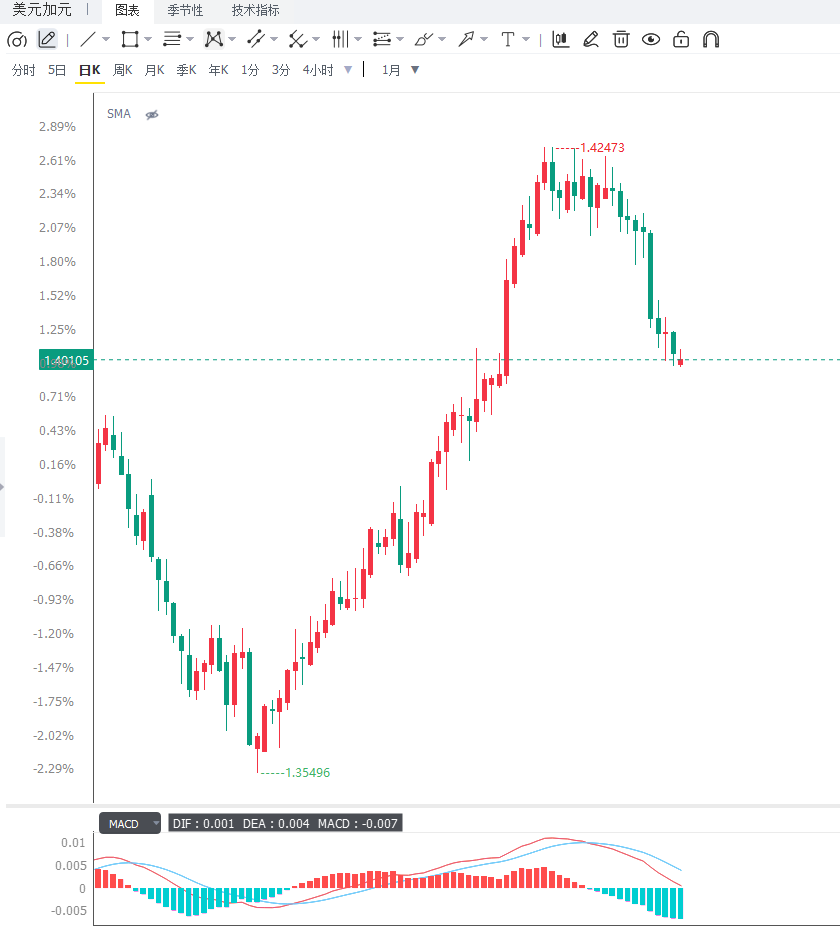 The USD/CAD pair is currently influenced by a combination of factors, including rising oil prices, Canada's export advantages, and changing expectations regarding Federal Reserve policy. The Middle East situation is driving up energy prices, supporting the Canadian dollar, while declining expectations of US interest rate hikes are weakening the US dollar, putting continued pressure on the exchange rate. In the short term, the USD/CAD's movement will primarily depend on two key factors: whether the oil market continues to strengthen, and whether Canadian CPI data supports the Bank of Canada's continued tightening stance. If oil prices remain high and Canadian inflation is strong, the exchange rate may decline further; conversely, if risk sentiment improves or the US dollar regains support, USD/CAD may rebound.
The international crude oil market has recently strengthened due to the escalating tensions in the Middle East. The further deterioration of tensions between the US and Iran has raised concerns about potential disruptions to regional energy transportation. Iran has stated that the Strait of Hormuz may not be safe for energy shipments during the ongoing US actions, warning of risks to petrochemical and crude oil transport. Meanwhile, the scope of regional conflict continues to expand. Recent reports of missile and drone attacks in Bahrain, Jordan, Kuwait, and Iraq have further fueled concerns about the stability of the energy supply chain. Rising oil prices provide direct support for the Canadian dollar. As a resource-based currency, the Canadian dollar's performance is typically strongly correlated with oil prices. When oil prices remain high, Canada's energy export revenue increases, helping to improve market expectations for the Canadian economy and thus pushing the Canadian dollar stronger against the US dollar. In addition to oil price factors, the US dollar has also recently faced pressure from changes in expectations regarding Federal Reserve policy. Recent US inflation data has shown signs of easing, leading the market to reduce its bets on a near-term Fed rate hike. Market surveys indicate that the probability of a Fed rate hike in July has fallen to approximately 14%, lower than the previous week's expectation of around 25%. Lower interest rate expectations have weakened the dollar's appeal and provided downward momentum for USD/CAD. However, Federal Reserve officials remain cautious. Fed Governor Christopher Waller stated that policymakers need to see signs of cooling inflation over several months before completely ruling out further interest rate adjustments. The market is currently awaiting Canadian inflation data. The Canadian Consumer Price Index (CPI) will be a key indicator of the Bank of Canada's future policy direction. If inflationary pressures remain resilient, the market may increase expectations that the Bank of Canada will maintain a tight policy, further supporting the Canadian dollar; however, if data shows a significant decline in price pressures, it may limit the Canadian dollar's upside potential. From a global market perspective, USD/CAD is currently influenced by two factors: firstly, rising oil prices and Canada's energy advantage are driving the Canadian dollar higher; secondly, safe-haven demand for the dollar and changes in Fed policy expectations are limiting the speed of the exchange rate's decline. In the short term, investors need to focus on changes in the oil market, Canadian CPI data, and signals from US monetary policy. If oil prices continue to be strong while Canadian inflation data remains high, USD/CAD may test lower levels further. From a daily chart perspective, USD/CAD has maintained a downward trend recently, with the price breaking below the support level around 1.4050 and continuing towards the 1.4000 area. Currently, bearish momentum dominates the market, with key support at the 1.4000 level. A break below this level could lead to further testing of 1.3950 or even 1.3900. Resistance levels to watch are 1.4050 and 1.4100. A return to 1.4100 could alleviate short-term downward pressure. Technically, the MACD continues its downward trend, and short-term moving averages are suppressing price rebounds, indicating an overall bearish market. On the 4-hour chart, USD/CAD continues its short-term weakness, trading within a descending channel, with the moving average system maintaining a bearish alignment. The RSI indicator is in weak territory, indicating continued selling pressure, but a technical rebound should be considered after approaching oversold levels. If the exchange rate holds above the 1.4000 support level, a short-term corrective rebound is possible, with a target of 1.4050. A break below this level could open up further downside potential, testing the 1.3950 area. Currently, the 4-hour chart still leans bearish, and market direction will primarily depend on oil price movements and the performance of Canadian CPI data. The USD/CAD pair is currently influenced by a combination of factors, including rising oil prices, Canada's export advantages, and changing expectations regarding Federal Reserve policy. The Middle East situation is driving up energy prices, supporting the Canadian dollar, while declining expectations of US interest rate hikes are weakening the US dollar, putting continued pressure on the exchange rate. In the short term, the USD/CAD's movement will primarily depend on two key factors: whether the oil market continues to strengthen, and whether Canadian CPI data supports the Bank of Canada's continued tightening stance. If oil prices remain high and Canadian inflation is strong, the exchange rate may decline further; conversely, if risk sentiment improves or the US dollar regains support, USD/CAD may rebound.
- Risk Warning and Disclaimer
- The market involves risk, and trading may not be suitable for all investors. This article is for reference only and does not constitute personal investment advice, nor does it take into account certain users’ specific investment objectives, financial situation, or other needs. Any investment decisions made based on this information are at your own risk.