British Pound Analysis: The market is really betting on more than just a change of prime minister.
2026-07-20 20:58:15
On Monday, July 20th, the British pound remained around 1.3450 against the US dollar, currently consolidating. The core driver of the pound market has gradually shifted from simple interest rate expectations to changes in the UK's political structure and the direction of future fiscal policy. With Burnham officially taking office as the seventh British Prime Minister in nearly 10 years, his first speech emphasized ending the long period of instability through a new political and economic model, and he planned to launch a 10-year economic recovery plan. Market focus is now shifting to the balance between the new government's fiscal discipline, economic growth policies, and the Bank of England's future interest rate path. 
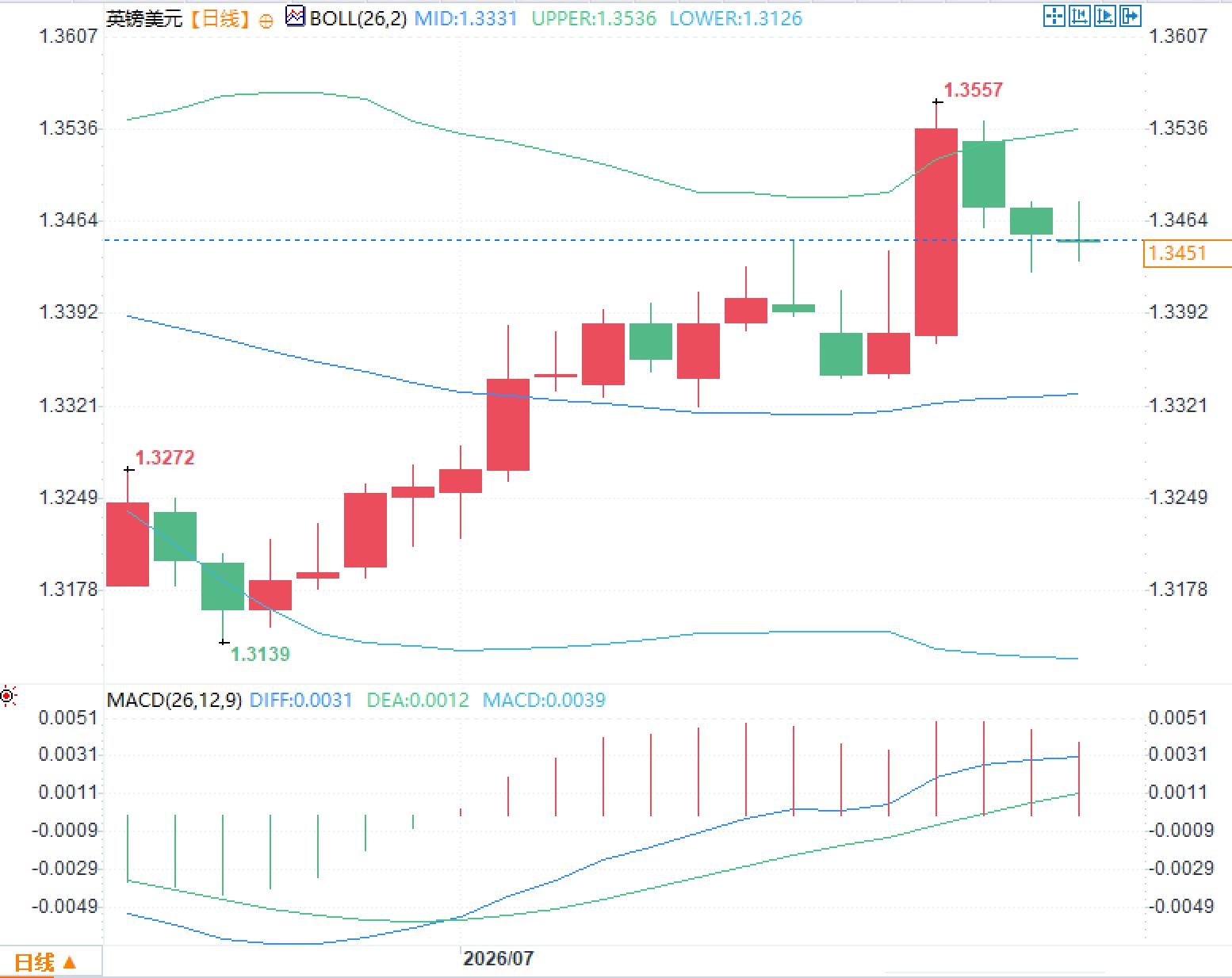 Currently, the Bollinger Bands indicator shows that the exchange rate has reached the upper-middle band area, indicating a consolidation after a rapid short-term rise. Observing the chart structure, there is significant selling pressure above 1.35, with the price falling back to around 1.3450, suggesting the market is digesting the rapid rise driven by previous political news. As for the MACD indicator, the fast and slow lines have entered above the zero axis, showing some improvement in short-term momentum, but the slowing growth rate of the histogram suggests that upward momentum is weakening. The market is currently more focused on whether the rebound can transform into a trend or is merely a temporary correction following a political event. From a medium-term perspective, the pound's movement still depends on fundamental changes. If UK economic growth expectations improve and the Bank of England maintains a relatively tight policy, the pound may find support. However, if the new government's fiscal plan leads the market to reassess debt pressure, the pound's previous gains may be affected.
Political transition becomes a new valuation variable for the pound, with the market focusing on economic model restructuring.
In recent years, UK asset prices have been persistently affected by political uncertainty. Frequent government changes, inconsistent fiscal policies, and weak growth expectations have led to a persistent risk premium for the pound. However, Burnham's appointment as Prime Minister did not trigger a sharp risk aversion reaction in the market; instead, it helped keep the pound relatively stable. This is because investors are more focused on the potential for improvement in policy continuity and governance stability. In his first public speech, Burnham stated that he would view this political change as the starting point for adjustments to the UK economic system and would announce a 10-year economic plan later this year. This means that future market assessments of the pound will not only focus on short-term fiscal spending but also on whether the government can improve productivity, the investment environment, and economic growth potential. For the foreign exchange market, political changes affect exchange rates primarily through three channels. First, they affect expectations of capital inflows. If the new government can improve policy stability, overseas funds' risk assessment of UK assets may improve. Second, they affect fiscal credit. If the market believes that public spending expansion exceeds the economy's capacity, long-term government bond yields may rise, which in turn will suppress the pound's valuation. Third, they affect the Bank of England's policy space; the degree of coordination between fiscal and monetary policies will become a key factor. The market had previously experienced sharp fluctuations due to uncertainty surrounding the UK's fiscal policy. Therefore, investors' biggest concern regarding the new government is not the scale of its policies, but whether their implementation adheres to the principles of fiscal sustainability.Technical analysis indicates a rebalancing between bulls and bears, with the 1.35 area becoming a key psychological level.
From a technical perspective, the British pound has recently formed a clear rebound structure against the US dollar. On the daily chart, the exchange rate has rebounded from a low near 1.3139, breaking through the key areas of 1.33 and 1.34, and testing the resistance level near 1.3557. Currently, the Bollinger Bands indicator shows that the exchange rate has reached the upper-middle band area, indicating a consolidation after a rapid short-term rise. Observing the chart structure, there is significant selling pressure above 1.35, with the price falling back to around 1.3450, suggesting the market is digesting the rapid rise driven by previous political news. As for the MACD indicator, the fast and slow lines have entered above the zero axis, showing some improvement in short-term momentum, but the slowing growth rate of the histogram suggests that upward momentum is weakening. The market is currently more focused on whether the rebound can transform into a trend or is merely a temporary correction following a political event. From a medium-term perspective, the pound's movement still depends on fundamental changes. If UK economic growth expectations improve and the Bank of England maintains a relatively tight policy, the pound may find support. However, if the new government's fiscal plan leads the market to reassess debt pressure, the pound's previous gains may be affected.Federal Reserve policy expectations and the global risk environment continue to influence the direction of the pound.
While British political factors are currently the main trading theme for the pound, the dollar's influence remains significant. The dollar has been relatively stable recently, with the market awaiting further policy signals from the Federal Reserve. Meanwhile, changes in the global risk environment are also affecting capital flows. The relative strength of the dollar and the pound essentially reflects the difference in economic expectations between the two countries. If the market believes that the UK's future growth will improve faster than the US, the pound may gain a relative advantage; conversely, if US economic data shows greater resilience while the Fed maintains high interest rates, the dollar may regain support. Furthermore, energy price changes are a crucial variable to watch for UK assets. The UK economy is highly sensitive to energy costs; rising energy prices could impact consumer spending and corporate profits through inflation, increasing the difficulty of the Bank of England's policy decisions. Currently, the market is not simply betting on a one-sided rise in the pound, but rather assessing the combined impact of the new government's policy credibility, the Bank of England's interest rate path, and the dollar's cyclical changes. The core of the pound's future performance is not the political rhetoric itself, but whether these policies can translate into economic growth and fiscal stability.- Risk Warning and Disclaimer
- The market involves risk, and trading may not be suitable for all investors. This article is for reference only and does not constitute personal investment advice, nor does it take into account certain users’ specific investment objectives, financial situation, or other needs. Any investment decisions made based on this information are at your own risk.