US airstrikes continue for 11 consecutive nights against Iran; oil tankers attacked in the Strait of Hormuz; international oil prices hit a more than five-week high.
2026-07-22 09:48:15
Since July 11, the US military has launched airstrikes against targets within Iran for 11 consecutive nights, expanding its reach from the southeast coast to south-central regions including Bushehr. With the Strait of Hormuz effectively blocked, a Kuwaiti oil tanker was attacked, drastically deteriorating regional shipping security. Trump threatened to strike Iran's "Gazelle" underground nuclear facility, to which Iran warned of a full-scale retaliatory strike. US casualties have risen to 18 dead and 447 wounded. Brent crude oil broke through $92, reaching a high of $92.66 per barrel in early Asian trading on Wednesday (July 22), the highest level since June 11, indicating a risk of a full-scale escalation in the Middle East. 
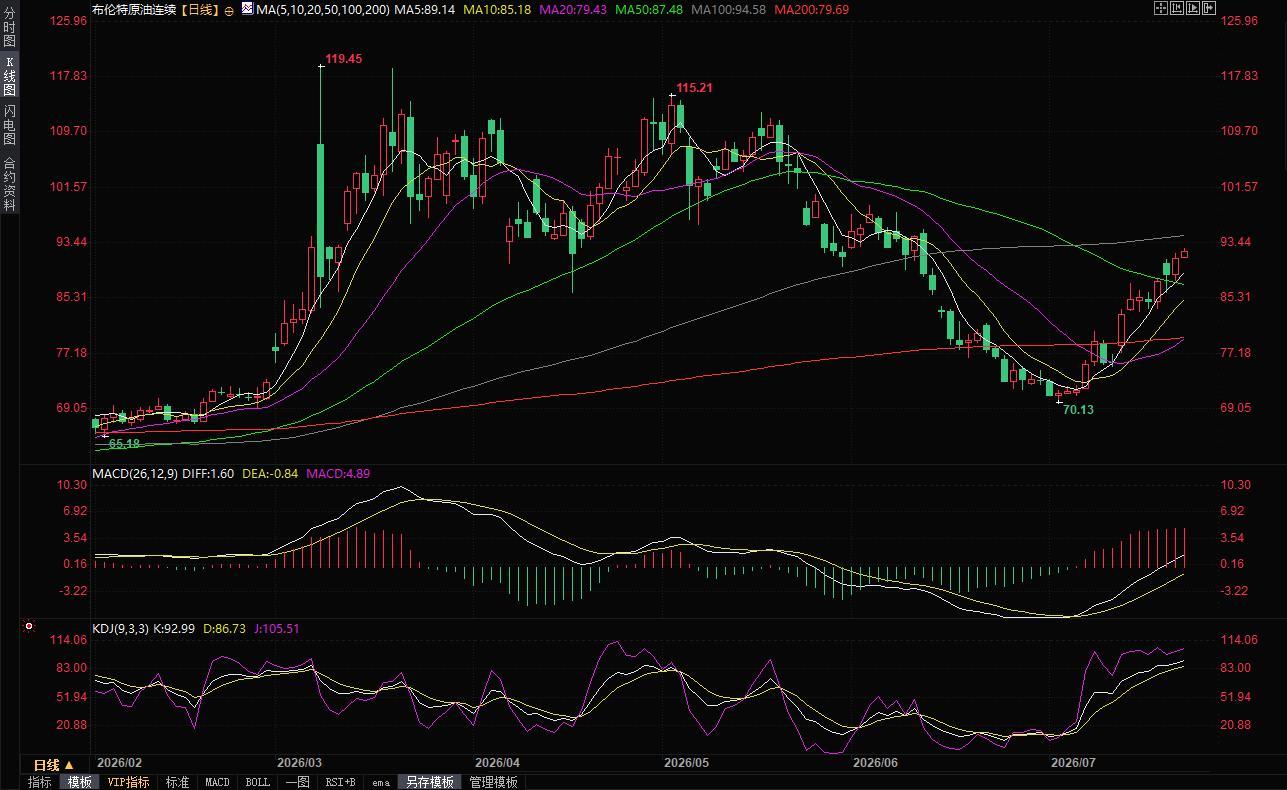 (Brent crude oil daily chart, source: EasyTrade) At 09:45 Beijing time, Brent crude oil is currently trading at $92.45 per barrel.
The conflict continues to escalate: US airstrikes enter their 11th night, with Bushehr and other locations attacked.
On July 21, the U.S. Central Command announced on social media that the U.S. military began strikes against military targets in Iran at 7:00 PM Eastern Time (7:00 AM Wednesday Beijing Time) that day, aimed at "continuously weakening Iran's ability to threaten commercial shipping in the Strait of Hormuz." This marks the 11th consecutive night of U.S. military strikes against Iran since July 11. According to Iran's Tasnim News Agency on July 22, the city of Bushehr was attacked by U.S. airstrikes in the early hours of that day. Earlier that day, the Kangar region was also attacked by U.S. missiles. Bushehr province, located on Iran's southern coast, is one of the key bases for Iran's nuclear energy industry. The attacks on this region signify that the U.S. strike range has expanded from the southeastern provinces of Hormozgan and Sistan-Baluchistan to the south-central coastal region of Iran. The continued U.S. airstrikes have caused serious damage to military facilities in Iran. U.S. President Trump stated that the U.S. has caused "serious damage" to Iran, and that "it will take them 20 to 25 years to recover from this offensive." Meanwhile, the U.S. maritime blockade of the Strait of Hormuz continues to tighten. Trump stated, "The lockdown is in effect. It's a complete lockdown—in other words, nobody can get through. Nobody can break through the lockdown. It's like a wall of steel."U.S. casualties continue to rise: 447 wounded, 18 dead.
The ongoing conflict has also inflicted heavy losses on the US military. According to a Pentagon report disclosed by Russia's Sputnik News Agency on July 22, the number of US military personnel wounded in the military operations against Iran has increased from 427 to 447. Of the 447 wounded US personnel, the Army suffered the most injuries with 306, followed by the Navy with 68, the Air Force with 54, and the Marine Corps with 19. The number of US military deaths is also rising. The US Department of Defense issued a statement on July 21 stating that a US soldier went missing on July 17 during Iran's attack on the Mowofiq Salati airbase in Jordan, and that he is "believed to be dead." This brings the total number of US military deaths in the conflict to 18. The US Department of Defense previously confirmed that Iran's attacks on multiple US military bases in the Middle East this month have resulted in the deaths of at least three US soldiers and injuries to nearly 100 US personnel. Since July 7, multiple Iranian attacks on US military bases in the Middle East have resulted in injuries of varying degrees to nearly 100 US personnel.Shipping in the Strait of Hormuz is in crisis: Kuwaiti oil tanker attacked, Iran summons special envoy.
Shipping safety in the Strait of Hormuz is facing a serious threat. On the evening of July 20, the Kuwaiti oil tanker "Kaivan" was attacked while transiting the Strait of Hormuz, resulting in injuries to several crew members. On July 21, the Kuwaiti Ministry of Foreign Affairs summoned the Iranian Ambassador to Kuwait, Mohammad Totongchi, to deliver a protest note regarding the attack. Kuwaiti Deputy Foreign Minister Hamad al-Mashan stated that the attack was a "blatant violation" of Kuwait's sovereignty, territorial integrity, and interests, a threat to international navigation safety and freedom of navigation, and a violation of international law and the UN Charter. Masahan reiterated Kuwait's demand that Iran immediately cease its illegal attacks and emphasized that Kuwait reserves the right to take necessary measures. Kuwait pointed out that this blatant attack occurred against the backdrop of Iran's continuous "aggression" against Kuwait since February 28, 2026, including inflammatory and provocative statements made by Iran.Trump threatens to strike the "Gaoshan" nuclear facility; Iran responds strongly.
While continuing airstrikes, Trump further escalated his threats against Iran. On July 21, during a meeting with visiting Lebanese President Joseph Aoun at the White House, Trump told the media that the United States "may soon" strike Iran's underground nuclear facility at Ghoshul. Ghoshul, located about 1.6 kilometers south of the Natanz nuclear facility in Isfahan province in central Iran, has two deep underground tunnel complexes and is considered one of Iran's most fortified underground nuclear facilities. Trump stated, "We're tracking the materials, that's the key," and "We may soon strike the area, and it will be very powerful." The Khatham Anbia Central Headquarters of the Iranian Armed Forces issued a statement early on July 22 responding to the US threat to attack Iranian nuclear facilities and other sensitive sites. Iran stated that if the US military takes such action, it will consider it an escalation of regional conflict, and all interests belonging to the United States, its allies, and its supporters will become targets of a strong retaliatory strike by the Iranian armed forces.Negotiation prospects are bleak: Trump says Iran is "eager to meet" but the US is "not interested."
Despite the escalating conflict, diplomatic channels have not been completely closed. According to media reports, mediators including Qatar, Egypt, and Pakistan have proposed a 10-day temporary ceasefire to the United States and Iran. Reports indicate that if the US and Iran reach a 10-day ceasefire agreement, they will negotiate a long-term arrangement for the Strait of Hormuz during this period. However, on July 21, Trump clearly stated that Iran was "eager to meet," but "we have no interest in even talking until they are ready for a meaningful meeting." Trump stated that the struggle between the US and Iran is "not over at all," and the US will not leave Iran. Iran, on the other hand, maintains its position that it "will not return to the negotiating table while under military attack." Iranian Foreign Minister Abbas Araqchi stated that Iran's actions in the Strait of Hormuz and the Persian Gulf have had a global impact, and "we have become a global player."International oil prices surged to a five-week high, with Brent crude breaking through $92.
Tensions in the Strait of Hormuz have directly impacted global energy markets. On July 21, international oil prices rose by about 2%, reaching their highest level in five weeks, influenced by escalating attacks between the US and Iran and threats from the Houthi rebels in Yemen to block Saudi Arabia's shipping routes. On Tuesday, Brent crude futures rose $1.79, or 2%, to settle at $91.01 per barrel, the highest closing price since June 10. West Texas Intermediate (WTI) crude futures rose $1.68, or 2%, to settle at $84.91 per barrel, the highest since June 11. On Wednesday in Asian trading, international oil prices continued to rise by more than 1%, with WTI crude hitting a new high of $85.75 per barrel and Brent crude hitting a new high of $92.66 per barrel. Market concerns remain about further disruptions to energy transport from the Middle East. An analyst from ANZ Bank's research department noted, "A Kuwaiti oil tanker was attacked by unidentified projectiles in the Strait of Hormuz, northeast of Oman." UBS analyst Giovanni Stawunovo stated that reduced exports via the Strait of Hormuz, coupled with concerns about potential supply disruptions to oil transported via the Red Sea, are supporting oil prices. Scott Shelton, an energy expert at TP ICAP Group, warned that Brent crude prices could break through $100 per barrel if tensions persist for several more weeks. Goldman Sachs offered a more severe scenario: if supply disruptions continue, Brent crude prices could surpass $120 per barrel by the fourth quarter.Regional risks spillover: Houthi rebels threaten to blockade the Red Sea, Iraqi militias prepare to join the fight.
The risk of conflict is spreading from the Gulf region to the Red Sea. On July 20, the Houthi rebels in Yemen announced a maritime embargo against Saudi Arabia, effective immediately. The Houthis sent emails to ship owners advising them not to dock at Saudi Arabian ports, and at least three oil tankers have already turned back in the southern Red Sea. On July 20, the Iraqi militia group Islamic Resistance stated that it would directly intervene if the United States continued to expand its military operations against Iran. Analysts point out that the situation in the Middle East is becoming increasingly complex, and the regional conflict may become a protracted stalemate. On July 21, Trump stated that the United States would take action if the Houthi rebels in Yemen blockaded the Red Sea.[Editor's Summary]
The current situation in the Middle East is at its most tense since the large-scale military action launched by the US and Israel against Iran in late February 2026. Eleven consecutive nights of US airstrikes, a de facto blockade of the Strait of Hormuz, international oil prices exceeding $91 per barrel, and statements of intervention from regional armed forces—multiple risks are converging and resonating. From a military perspective, the continuous US airstrikes have caused widespread damage to targets within Iran, but Iran's retaliatory strikes have also resulted in 447 US casualties and 18 deaths, escalating the war of attrition. From an energy security perspective, the Strait of Hormuz is the world's most important oil shipping route, handling approximately one-third of global seaborne oil trade daily. The current de facto blockade has pushed oil prices to a five-week high; if the situation continues to deteriorate, Brent crude breaking through $100 or even $120 per barrel is not out of the question. From a diplomatic perspective, although the mediators have proposed a 10-day ceasefire, significant differences remain between the US and Iran—the US demands substantial concessions from Iran before considering negotiations, while Iran insists on not returning to the negotiating table if attacked. From a regional perspective, the Houthi threat to blockade the Red Sea and the statements from Iraqi militias indicating their willingness to participate suggest a risk of the conflict spreading from the Gulf region to the wider Middle East. In the short term, the three key variables determining the course of events are whether ceasefire negotiations can achieve a breakthrough, whether oil prices will rise further, and whether regional armed groups will substantially intervene. (Brent crude oil daily chart, source: EasyTrade) At 09:45 Beijing time, Brent crude oil is currently trading at $92.45 per barrel.
- Risk Warning and Disclaimer
- The market involves risk, and trading may not be suitable for all investors. This article is for reference only and does not constitute personal investment advice, nor does it take into account certain users’ specific investment objectives, financial situation, or other needs. Any investment decisions made based on this information are at your own risk.