Tensions in the Middle East have driven safe-haven flows back into the market, pushing gold back above $4,100 and continuing its bullish trend.
2026-07-22 10:26:16
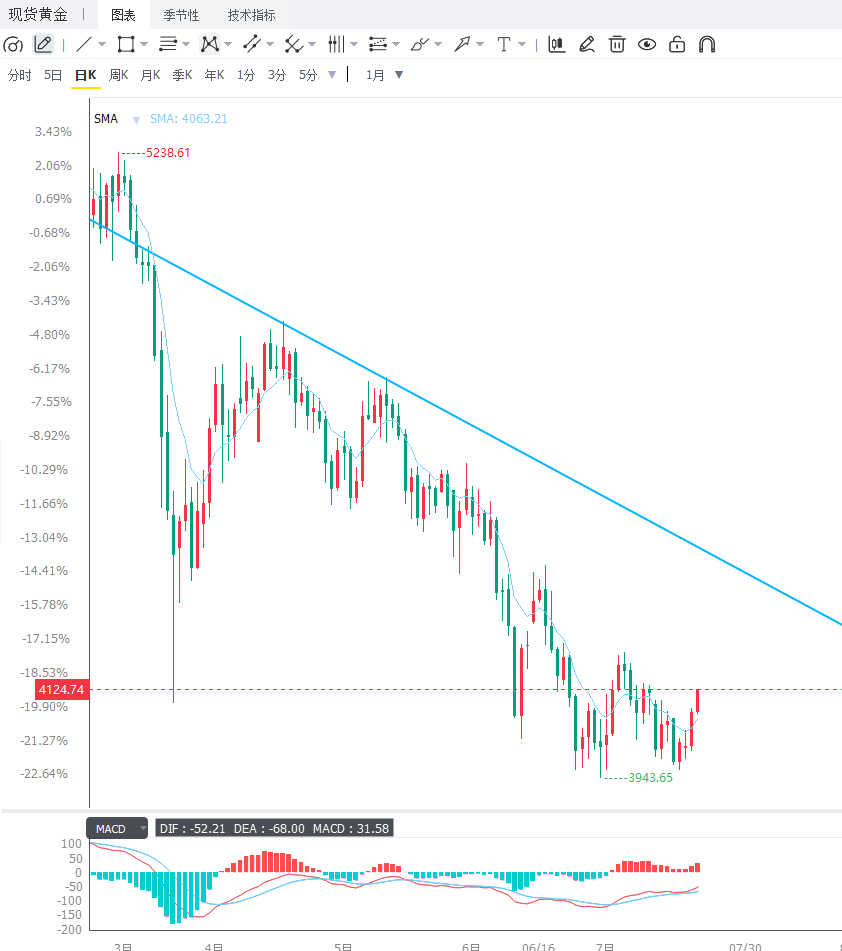
International gold prices resumed their upward trend during Asian trading hours on Wednesday, with spot gold (XAU/USD) rising to around $4,120. This followed a rebound after falling to near the psychological level of $4,000 in the previous session, primarily due to deteriorating global risk sentiment, prompting investors to increase their allocation to safe-haven assets. The core driver of the recent gold market remains the interplay between geopolitical risks and macroeconomic policy expectations. Renewed tensions between the US and Iran have significantly increased volatility in commodity markets, leading some funds to flow back into gold, a traditional safe-haven asset.  Analysts point out that this round of gold price increases reflects more of a return of buying interest after price adjustments than a new major news-driven surge. Eva Mante, a commodities strategist at ING, stated that the current gold price increase "is more like buying on dips than a direct market reaction to new news." This means that investors still recognize the long-term value of gold, but short-term trading logic is mainly influenced by changes in risk sentiment. Currently, the market continues to focus on developments in the US-Iran situation. The US Central Command has recently continued to take action against Iranian targets, while Iran has indicated it will expand its countermeasures, and related armed forces have announced possible restrictions on some maritime transport activities. The escalating situation in the Middle East increases global energy supply risks and drives renewed demand for gold as a safe haven . Since gold is generally considered an asset for hedging against geopolitical risks and financial uncertainty, funds often flow into the precious metals market when the market is concerned about disruptions to energy supplies. At the same time, the potential inflationary impact of rising energy prices is also a key factor for the gold market. If oil prices continue to rise due to supply risks, global inflationary pressures may resurface, affecting the future policy direction of major central banks. For the Federal Reserve, the market is weighing the relationship between inflation risks and economic data performance. Recent US inflation data has shown some easing pressure, reducing the market's expectation of a rate hike at the Fed's July meeting. However, traders still anticipate at least one more rate adjustment by the Fed before the end of the year. The Fed's interest rate path remains a crucial factor influencing gold's medium-term trend, and a high-interest-rate environment may limit gold's upside potential . Since gold itself does not generate interest income, the opportunity cost of holding gold increases when the market expects interest rates to remain high. Furthermore, the dollar's performance will continue to affect gold's performance. If global risk events drive increased safe-haven buying of the dollar, it could put downward pressure on gold prices; however, if the market focuses more on geopolitical risks and inflation uncertainty, gold may still receive financial support. Currently, the market is awaiting further guidance on the Middle East situation, energy price changes, and policy signals from Fed officials. In the short term, gold remains in a phase influenced by both safe-haven demand and monetary policy expectations. From a daily chart perspective, spot gold recently found support near the psychological level of $4,000 and has resumed its rebound. Prices remain above major moving averages, and the medium-to-long-term upward structure remains intact. Although the MACD indicator previously showed signs of slowing momentum, bullish forces are recovering as safe-haven funds return. The upside resistance level to watch is the $4150 area; a decisive break above this level could lead to a further test of the $4200 area. Downside support is first at the $4000 psychological level, followed by the $3960 area. Overall, the daily chart still leans towards an upward trend with some volatility, but short-term profit-taking pressure at higher levels needs to be monitored. Looking at the 4-hour chart, gold prices rebounded after a technical correction near $4000, forming a short-term consolidation and upward structure. Moving averages are gradually turning upwards, indicating renewed buying pressure. The RSI indicator has rebounded from its lows, suggesting improved short-term momentum, but it has not yet entered clearly overbought territory. A break above the $4150 resistance level could open up further upside potential; a break below $4040 could lead to a retest of the $4000 support level. Currently, the 4-hour chart shows the bulls have a slight advantage, but the market remains highly dependent on developments in geopolitical risks.
  Editor's Summary: The recent rebound in gold prices has been primarily driven by safe-haven demand. Increased uncertainty surrounding the US-Iran situation has led the market to refocus on global energy supply risks and financial market volatility. However, the potential for further gains in gold still depends on expectations regarding Federal Reserve policy and the performance of the US dollar. In the medium to long term, gold continues to benefit from increased global uncertainty and investors' demand for safe-haven assets. However, if energy risks ease while US economic data remains resilient and the Federal Reserve extends its high interest rate policy, gold may face some downward pressure. The current market is in a phase where risk premiums and interest rate expectations are intertwined; close attention should be paid to whether the price breaks through the $4150 level and whether the key support level of $4000 can hold.
Analysts point out that this round of gold price increases reflects more of a return of buying interest after price adjustments than a new major news-driven surge. Eva Mante, a commodities strategist at ING, stated that the current gold price increase "is more like buying on dips than a direct market reaction to new news." This means that investors still recognize the long-term value of gold, but short-term trading logic is mainly influenced by changes in risk sentiment. Currently, the market continues to focus on developments in the US-Iran situation. The US Central Command has recently continued to take action against Iranian targets, while Iran has indicated it will expand its countermeasures, and related armed forces have announced possible restrictions on some maritime transport activities. The escalating situation in the Middle East increases global energy supply risks and drives renewed demand for gold as a safe haven . Since gold is generally considered an asset for hedging against geopolitical risks and financial uncertainty, funds often flow into the precious metals market when the market is concerned about disruptions to energy supplies. At the same time, the potential inflationary impact of rising energy prices is also a key factor for the gold market. If oil prices continue to rise due to supply risks, global inflationary pressures may resurface, affecting the future policy direction of major central banks. For the Federal Reserve, the market is weighing the relationship between inflation risks and economic data performance. Recent US inflation data has shown some easing pressure, reducing the market's expectation of a rate hike at the Fed's July meeting. However, traders still anticipate at least one more rate adjustment by the Fed before the end of the year. The Fed's interest rate path remains a crucial factor influencing gold's medium-term trend, and a high-interest-rate environment may limit gold's upside potential . Since gold itself does not generate interest income, the opportunity cost of holding gold increases when the market expects interest rates to remain high. Furthermore, the dollar's performance will continue to affect gold's performance. If global risk events drive increased safe-haven buying of the dollar, it could put downward pressure on gold prices; however, if the market focuses more on geopolitical risks and inflation uncertainty, gold may still receive financial support. Currently, the market is awaiting further guidance on the Middle East situation, energy price changes, and policy signals from Fed officials. In the short term, gold remains in a phase influenced by both safe-haven demand and monetary policy expectations. From a daily chart perspective, spot gold recently found support near the psychological level of $4,000 and has resumed its rebound. Prices remain above major moving averages, and the medium-to-long-term upward structure remains intact. Although the MACD indicator previously showed signs of slowing momentum, bullish forces are recovering as safe-haven funds return. The upside resistance level to watch is the $4150 area; a decisive break above this level could lead to a further test of the $4200 area. Downside support is first at the $4000 psychological level, followed by the $3960 area. Overall, the daily chart still leans towards an upward trend with some volatility, but short-term profit-taking pressure at higher levels needs to be monitored. Looking at the 4-hour chart, gold prices rebounded after a technical correction near $4000, forming a short-term consolidation and upward structure. Moving averages are gradually turning upwards, indicating renewed buying pressure. The RSI indicator has rebounded from its lows, suggesting improved short-term momentum, but it has not yet entered clearly overbought territory. A break above the $4150 resistance level could open up further upside potential; a break below $4040 could lead to a retest of the $4000 support level. Currently, the 4-hour chart shows the bulls have a slight advantage, but the market remains highly dependent on developments in geopolitical risks. Editor's Summary: The recent rebound in gold prices has been primarily driven by safe-haven demand. Increased uncertainty surrounding the US-Iran situation has led the market to refocus on global energy supply risks and financial market volatility. However, the potential for further gains in gold still depends on expectations regarding Federal Reserve policy and the performance of the US dollar. In the medium to long term, gold continues to benefit from increased global uncertainty and investors' demand for safe-haven assets. However, if energy risks ease while US economic data remains resilient and the Federal Reserve extends its high interest rate policy, gold may face some downward pressure. The current market is in a phase where risk premiums and interest rate expectations are intertwined; close attention should be paid to whether the price breaks through the $4150 level and whether the key support level of $4000 can hold.
- Risk Warning and Disclaimer
- The market involves risk, and trading may not be suitable for all investors. This article is for reference only and does not constitute personal investment advice, nor does it take into account certain users’ specific investment objectives, financial situation, or other needs. Any investment decisions made based on this information are at your own risk.