With 1.3400 within reach, can the pound bulls break through the dual blockade of Middle East conflict and cooling inflation?
2026-07-23 12:22:14
On Thursday (July 23) during Asian trading hours, the pound sterling rebounded slightly against the dollar, trading around 1.3390, a gain of approximately 0.1%. However, the sustainability of this upward movement faces two headwinds: UK June inflation data came in below expectations across the board, reducing the urgency for the Bank of England to raise interest rates further; meanwhile, the situation in the Middle East continues to escalate—the US military has launched airstrikes against Iranian targets for the 12th consecutive night, Iran has threatened to expand its strike range, and Kuwait has begun intercepting hostile drones. Under the dual pressure of "cooling interest rate hike expectations" and "strengthening safe-haven dollar," the pound's upside potential is being substantially squeezed. The market is awaiting the UK retail sales data to be released on Friday for further directional guidance. 
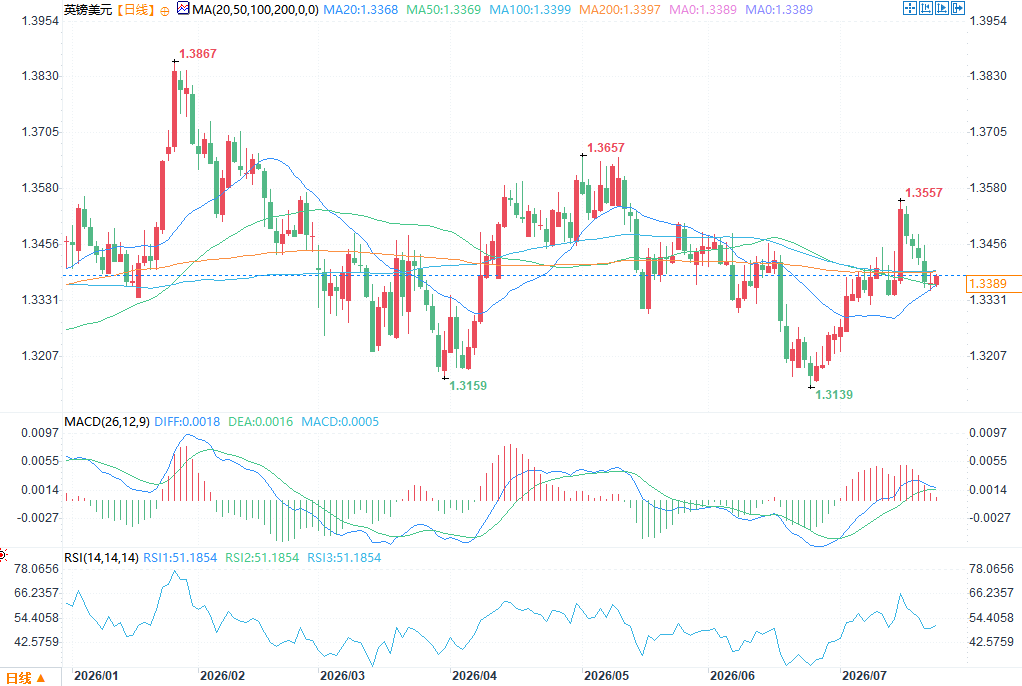 (GBP/USD daily chart, source: FX678) At 12:19 Beijing time on July 23, GBP/USD was trading at 1.3388/89.
Inflation "cools" – 2.6% CPI disrupts Bank of England's interest rate hike schedule
Data released by the UK Office for National Statistics on Wednesday showed that the Consumer Price Index (CPI) slowed to 2.6% year-on-year in June, the lowest level since March 2025, down from 2.8% in May and market expectations of 2.7%. This data marks the third consecutive month of decline in UK inflation, bringing it one step closer to the Bank of England's 2% target. More noteworthy is the performance of core inflation. Excluding volatile food and energy items, the core CPI rose 2.6% year-on-year in June, unchanged from the previous month but higher than the market expectation of 2.5%. On a month-on-month basis, the CPI growth rate fell to 0.1% from 0.2% in May, in line with market consensus. This data requires careful interpretation: the larger-than-expected decline in overall inflation provides the Bank of England with a reason to remain on hold; however, core inflation remains sticky, and the 2.6% year-on-year growth rate indicates that underlying price pressures have not completely subsided, and the transmission effect of service sector price and wage growth continues. The market's pricing of the Bank of England's policy path has adjusted accordingly. Traders generally expect the Bank of England to keep its benchmark interest rate unchanged at 3.75% next week to further assess the impact of the Middle East conflict on the economy. Financial market pricing indicates that there may still be one or two 25-basis-point rate hikes before the end of 2026, but this expectation is largely unchanged from Tuesday and has not eased significantly due to declining inflation—indicating that the market remains wary of the stickiness of core inflation.The conflict escalates in the Middle East – US airstrikes continue for 12 nights, drawing Kuwait into the conflict.
Parallel to the UK's domestic inflation data is the continuously deteriorating situation in the Middle East. The US military has launched airstrikes against targets in Iran for the 12th consecutive night, and US President Trump threatened to "bomb a bridge or a power plant for every ship targeted" if Iran continues to attack ships in the Strait of Hormuz. This strong statement marks a further escalation of US military pressure on Iran. Iran's response has been equally forceful. Iranian media reported that a location near Ahvaz was attacked by US missiles. Meanwhile, Iran has launched strikes against Kuwait for several days, and the Kuwaiti military announced on Thursday that it was intercepting hostile drones. This means the conflict has expanded from a bilateral confrontation between the US and Iran to a broader Gulf region, and the regional situation is evolving towards a "full-scale confrontation." From the perspective of the transmission logic in the foreign exchange market, the continued escalation of the Middle East conflict usually benefits safe-haven assets. The US dollar, as the world's primary safe-haven currency, receives structural support in this environment. The pound faces dual pressure against the dollar: on the one hand, cooling UK inflation reduces expectations of interest rate hikes, weakening the pound's interest rate advantage; on the other hand, rising geopolitical risks increase demand for the dollar as a safe haven. The combined effect of these two forces has significantly limited the upside potential of the GBP/USD exchange rate.The tug-of-war between bullish and bearish logic will be a key variable, with Friday's retail data becoming crucial.
The pound is currently trading around 1.3385 against the dollar, a relatively balanced position between bulls and bears. The core support for the bullish logic is that the decline in UK inflation does not necessarily mean the Bank of England will completely turn dovish. The sticky 2.6% core inflation rate indicates that service sector price and wage pressures have not fully subsided, and the central bank needs more evidence before cutting interest rates or completely halting rate hikes. Strong retail sales data on Friday, indicating continued resilience in consumption, could reignite market expectations for further rate hikes by the Bank of England, thus pushing the pound higher. The core driver of the bearish logic is the continued escalation of the Middle East conflict, which is currently the most direct headwind for the pound. Continuous US airstrikes, Iran expanding its strike range, and Kuwait's involvement in the conflict—geopolitical risks are evolving from "local conflicts" to "regional confrontation." In this environment, safe-haven buying of the dollar will continue to flow in, putting systemic pressure on the pound. Furthermore, weak retail sales data on Friday will further reinforce the narrative of a "cooling UK economy," exacerbating downward pressure on the pound.The pound stands at a crossroads – a dual game of inflation and geopolitics.
The British pound is currently in a typical "tug-of-war" pattern against the US dollar. Domestically, the unexpectedly weak inflation data has reduced the urgency for the Bank of England to raise interest rates, but the stickiness of core inflation means a policy shift will take time. Internationally, the Middle East conflict continues to escalate, with the US launching consecutive airstrikes, Iran expanding its strike range, and Kuwait becoming involved in the conflict, leading to a steady increase in demand for the US dollar as a safe haven. In the coming week, two key variables will influence the pound's movement: first, whether Friday's UK retail sales data can provide evidence of economic resilience; and second, whether the situation in the Middle East will further deteriorate—any signal of escalation will strengthen safe-haven buying of the US dollar, putting downward pressure on the pound. Against this backdrop of intertwined bullish and bearish factors, the 1.3400 level will be a crucial test for short-term direction. (GBP/USD daily chart, source: FX678) At 12:19 Beijing time on July 23, GBP/USD was trading at 1.3388/89.
- Risk Warning and Disclaimer
- The market involves risk, and trading may not be suitable for all investors. This article is for reference only and does not constitute personal investment advice, nor does it take into account certain users’ specific investment objectives, financial situation, or other needs. Any investment decisions made based on this information are at your own risk.