Rising oil prices boosted the Canadian dollar, causing the USD/CAD exchange rate to fall below 1.4100.
2026-07-23 11:16:16
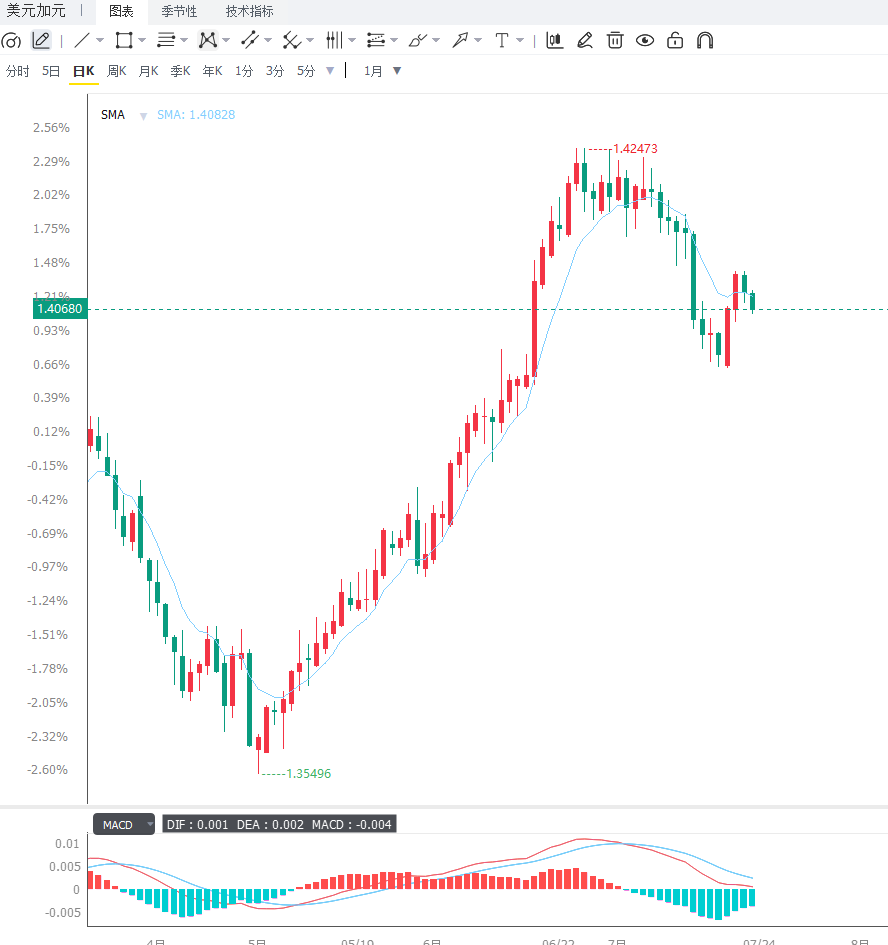
The US dollar continued to weaken against the Canadian dollar in early Asian trading on Thursday, hovering below 1.4100 as the market assessed the impact of rising oil prices, the dollar's performance, and expectations for North American monetary policy. Although the pair has recently corrected after rebounding from the psychological level of 1.4000, the lack of significant sustained selling pressure suggests investors should remain cautious in determining whether this week's rally has ended.  A key factor contributing to the recent weakening of the USD/CAD exchange rate is the oil market. As tensions escalate in the Middle East, global energy supply risks have once again come under scrutiny, with WTI crude oil prices rising to their highest level since June 11. Market data shows a significant decline in shipping activity in the Strait of Hormuz, raising concerns among investors about potential disruptions to global oil supplies and driving up energy prices. Meanwhile, risks in the Red Sea region have further increased. The Houthi rebels in Yemen, closely linked to Iran, announced a blockade of Saudi ports, raising concerns about the impact on another crucial energy transport route. If shipping pressure in the Red Sea continues to escalate, the global oil supply chain may face greater uncertainty, further pushing up energy prices. Given Canada's heavy reliance on energy exports, the Canadian dollar is generally considered a typical commodity currency. When oil prices rise, expectations for Canadian export revenue improve, often leading to increased demand for Canadian dollar assets. Rising oil prices have been a significant factor supporting the Canadian dollar recently, putting downward pressure on the USD/CAD exchange rate . Furthermore, the recent relative weakness of the US dollar has also exacerbated the downward pressure on the USD/CAD exchange rate. The US dollar had previously strengthened due to safe-haven flows, but as the market readjusted its positions, the dollar index retreated somewhat, limiting further upside potential for the USD/CAD pair. However, rising oil prices have also brought new inflationary pressures, potentially altering market expectations regarding the Federal Reserve's policy path. Continued increases in energy prices could put renewed pressure on US inflation, prompting investors to increase their bets on future Fed rate hikes. According to the CME FedWatch Tool, the market currently expects a greater than 90% probability of a Fed rate hike by the end of this year . Rising interest rate expectations have pushed US Treasury yields to multi-month highs, providing some support for the dollar. Therefore, while the USD/CAD pair is affected by oil prices and a stronger Canadian dollar, the dollar's interest rate advantage still limits its decline. Meanwhile, the market expects the Bank of Canada to maintain stable interest rates for the remainder of 2026, an expectation that also limits further upside for the Canadian dollar. If Canadian monetary policy remains relatively loose while the Fed continues to maintain high interest rates, the interest rate differential between the dollar and the Canadian dollar could still provide support for the dollar. Furthermore, the trade relationship between Canada and the United States is also a significant factor influencing the Canadian dollar's performance. US President Donald Trump's recent announcement of a 50% tariff on Canadian goods has sparked market concerns about the outlook for Canadian exports. Trade concerns may weaken bullish sentiment towards the Canadian dollar and limit further declines in the USD/CAD pair. Future market focus will be on Canadian retail sales data, US initial jobless claims, and the latest geopolitical developments. If Canadian economic data is strong and oil prices remain high, the USD/CAD pair may continue to face pressure; however, if trade concerns escalate or expectations of a Fed rate hike strengthen further, the USD/CAD pair may gain upward momentum. The daily chart for USD/CAD shows that the pair recently rebounded from around 1.4000 before falling back again, currently retesting the area below 1.4100. Overall, the short-term trend leans towards consolidation, with resistance at the 1.4150-1.4200 area. A break above 1.4200 could signal a resumption of the rebound structure. Support levels are first at 1.4050, followed by the psychological level of 1.4000. From a technical perspective, the MACD bullish momentum is weakening, and the price has fallen back to near the short-term moving average, indicating that the market's bullish and bearish forces are entering a rebalancing phase. Looking at the USD/CAD pair on the 4-hour chart, the price is showing a downward trend with short-term moving averages gradually turning towards resistance. The RSI indicator is falling, suggesting a decrease in short-term buying momentum. However, the exchange rate has not yet formed a clear breakout. If it can hold the support around 1.4050, there is still a possibility of a rebound to the 1.4150 area. A break below 1.4000 could open up further downside potential, with a target around 1.3950.
  Editor's Summary: The current USD/CAD exchange rate movement reflects the complex interplay of energy markets, monetary policy, and trade factors. Rising oil prices have strengthened the Canadian dollar, which is the main reason for the short-term downward pressure on the exchange rate; however, expectations of a Fed rate hike and uncertainties surrounding Canadian exports have limited further downside for USD/CAD. In the short term, oil price movements and Middle East supply risks will continue to determine the direction of the Canadian dollar. If energy transportation risks continue to escalate and oil prices remain high, the Canadian dollar may receive further support, and USD/CAD may test the 1.4000 area further. However, if the market refocuses on Fed tightening expectations or trade concerns intensify, the exchange rate may rebound. Currently, USD/CAD is in a key technical zone, with neither bulls nor bears having a clear advantage. Future movements will depend on changes in the energy market, North American economic data, and global risk sentiment.
A key factor contributing to the recent weakening of the USD/CAD exchange rate is the oil market. As tensions escalate in the Middle East, global energy supply risks have once again come under scrutiny, with WTI crude oil prices rising to their highest level since June 11. Market data shows a significant decline in shipping activity in the Strait of Hormuz, raising concerns among investors about potential disruptions to global oil supplies and driving up energy prices. Meanwhile, risks in the Red Sea region have further increased. The Houthi rebels in Yemen, closely linked to Iran, announced a blockade of Saudi ports, raising concerns about the impact on another crucial energy transport route. If shipping pressure in the Red Sea continues to escalate, the global oil supply chain may face greater uncertainty, further pushing up energy prices. Given Canada's heavy reliance on energy exports, the Canadian dollar is generally considered a typical commodity currency. When oil prices rise, expectations for Canadian export revenue improve, often leading to increased demand for Canadian dollar assets. Rising oil prices have been a significant factor supporting the Canadian dollar recently, putting downward pressure on the USD/CAD exchange rate . Furthermore, the recent relative weakness of the US dollar has also exacerbated the downward pressure on the USD/CAD exchange rate. The US dollar had previously strengthened due to safe-haven flows, but as the market readjusted its positions, the dollar index retreated somewhat, limiting further upside potential for the USD/CAD pair. However, rising oil prices have also brought new inflationary pressures, potentially altering market expectations regarding the Federal Reserve's policy path. Continued increases in energy prices could put renewed pressure on US inflation, prompting investors to increase their bets on future Fed rate hikes. According to the CME FedWatch Tool, the market currently expects a greater than 90% probability of a Fed rate hike by the end of this year . Rising interest rate expectations have pushed US Treasury yields to multi-month highs, providing some support for the dollar. Therefore, while the USD/CAD pair is affected by oil prices and a stronger Canadian dollar, the dollar's interest rate advantage still limits its decline. Meanwhile, the market expects the Bank of Canada to maintain stable interest rates for the remainder of 2026, an expectation that also limits further upside for the Canadian dollar. If Canadian monetary policy remains relatively loose while the Fed continues to maintain high interest rates, the interest rate differential between the dollar and the Canadian dollar could still provide support for the dollar. Furthermore, the trade relationship between Canada and the United States is also a significant factor influencing the Canadian dollar's performance. US President Donald Trump's recent announcement of a 50% tariff on Canadian goods has sparked market concerns about the outlook for Canadian exports. Trade concerns may weaken bullish sentiment towards the Canadian dollar and limit further declines in the USD/CAD pair. Future market focus will be on Canadian retail sales data, US initial jobless claims, and the latest geopolitical developments. If Canadian economic data is strong and oil prices remain high, the USD/CAD pair may continue to face pressure; however, if trade concerns escalate or expectations of a Fed rate hike strengthen further, the USD/CAD pair may gain upward momentum. The daily chart for USD/CAD shows that the pair recently rebounded from around 1.4000 before falling back again, currently retesting the area below 1.4100. Overall, the short-term trend leans towards consolidation, with resistance at the 1.4150-1.4200 area. A break above 1.4200 could signal a resumption of the rebound structure. Support levels are first at 1.4050, followed by the psychological level of 1.4000. From a technical perspective, the MACD bullish momentum is weakening, and the price has fallen back to near the short-term moving average, indicating that the market's bullish and bearish forces are entering a rebalancing phase. Looking at the USD/CAD pair on the 4-hour chart, the price is showing a downward trend with short-term moving averages gradually turning towards resistance. The RSI indicator is falling, suggesting a decrease in short-term buying momentum. However, the exchange rate has not yet formed a clear breakout. If it can hold the support around 1.4050, there is still a possibility of a rebound to the 1.4150 area. A break below 1.4000 could open up further downside potential, with a target around 1.3950. Editor's Summary: The current USD/CAD exchange rate movement reflects the complex interplay of energy markets, monetary policy, and trade factors. Rising oil prices have strengthened the Canadian dollar, which is the main reason for the short-term downward pressure on the exchange rate; however, expectations of a Fed rate hike and uncertainties surrounding Canadian exports have limited further downside for USD/CAD. In the short term, oil price movements and Middle East supply risks will continue to determine the direction of the Canadian dollar. If energy transportation risks continue to escalate and oil prices remain high, the Canadian dollar may receive further support, and USD/CAD may test the 1.4000 area further. However, if the market refocuses on Fed tightening expectations or trade concerns intensify, the exchange rate may rebound. Currently, USD/CAD is in a key technical zone, with neither bulls nor bears having a clear advantage. Future movements will depend on changes in the energy market, North American economic data, and global risk sentiment.
- Risk Warning and Disclaimer
- The market involves risk, and trading may not be suitable for all investors. This article is for reference only and does not constitute personal investment advice, nor does it take into account certain users’ specific investment objectives, financial situation, or other needs. Any investment decisions made based on this information are at your own risk.