Falling oil prices eased concerns about interest rate hikes, and silver rebounded to near $60.
2026-07-27 15:43:03
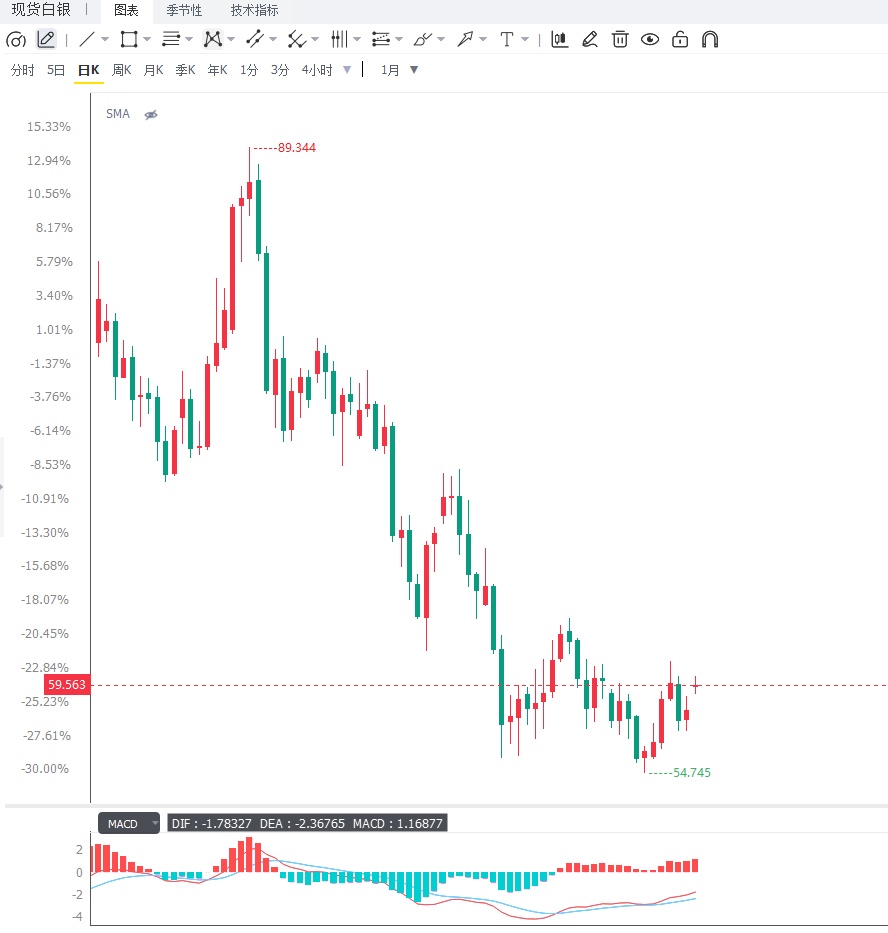
Spot silver (XAG/USD) performed strongly in Asian trading on Monday, rising to around $60 and continuing its rebound at the start of the new week. The main driver of the silver rally was the rapid decline in oil prices following the suspension of further military action between the US and Iran, which eased market concerns about long-term inflationary pressures and continued interest rate hikes by global central banks.  Previously, tensions in the Middle East had driven oil prices higher, with markets worried that energy costs could reignite global inflation and force major central banks to maintain high interest rates. However, with the US suspending related military operations, market risk sentiment improved, and WTI crude oil fell by about 5.6% in Asian trading, retreating to around $84. The rapid decline in oil prices lowered inflation expectations, significantly easing investors' concerns about further interest rate increases . US Ambassador to the UN Mike Walz stated that the US president wanted more time for a diplomatic solution and therefore suspended further action. This news helped the market reduce geopolitical risk premiums and prompted some funds to flow back into the precious metals market. However, silver had previously lagged behind during the escalating Middle East tensions. As the conflict drove up oil prices and intensified inflationary pressures, the market increased its expectations for the duration of high interest rates, and a high-interest-rate environment typically reduces the attractiveness of silver, a non-interest-bearing asset. Therefore, silver's recent performance has been significantly suppressed by interest rate factors. With the decline in oil prices, the market has begun to readjust its expectations for global monetary policy. If inflationary pressures continue to decline in the future, expectations for a policy shift by major central banks may strengthen, which will support silver. Meanwhile, silver possesses both precious metal and industrial attributes, and changes in global economic growth expectations will also affect its demand. The current market focus has shifted to the Federal Reserve's monetary policy meeting. The Fed is expected to announce its latest interest rate decision on Wednesday, with the market widely expecting policy to remain stable. Investors will pay attention to the Fed's statements regarding inflation trends, economic growth, and the future path of interest rates. If the Fed releases a dovish signal, the dollar and real interest rates may come under pressure, thereby increasing the attractiveness of silver; however, if the policy statement emphasizes that inflation risks remain and maintains expectations of high interest rates for an extended period, the rebound in silver may be limited. Furthermore, global economic data will also influence silver's price movement. The market will focus on US inflation indicators, economic growth data, and changes in demand from major economies. If economic data shows a decline in growth resilience, it may increase market expectations for easing policies, providing further support for precious metals. From a daily chart perspective, XAG/USD has currently rebounded to around $60, and the price is attempting to regain its position near the 20-day exponential moving average. The 20-day EMA is currently located in the $59.35 area. If silver can effectively break through and close above this level, short-term downward pressure will be significantly alleviated, and it may further test the resistance area of $61 to $62. The key support level to watch is around $54.77, the low from July 17th. A break below this level could reopen room for further correction. Overall, the daily chart structure is in a rebound and repair phase, but the validity of the moving average breakout still needs to be monitored. Looking at the 4-hour chart, silver's short-term momentum has improved, with prices rebounding and approaching the $60 mark again. The MACD indicator shows a gradual recovery in short-term momentum, and the RSI indicator has risen above 40, indicating that selling pressure has eased, but it has not yet entered a clearly strong range. If the price breaks through and holds above $60, it may further challenge the $61.00 to $62.00 resistance level in the short term; if the upward move fails, the support area of $58.50 to $59.00 needs to be watched. Currently, the 4-hour trend leans towards a volatile rebound, and the market awaits confirmation of direction from the Federal Reserve's policy signals.
  Editor's Summary: The recent rebound in silver prices was mainly driven by falling oil prices, reduced inflation concerns, and improved interest rate expectations. The temporary easing of tensions between the US and Iran has lowered market risk premiums, bringing precious metals back into the spotlight. However, silver's future performance still depends on the Federal Reserve's policy signals, changes in the US dollar, and the level of real interest rates. If the Fed releases dovish signals, silver may continue its upward correction; if the US dollar strengthens again and reinforces high interest rate expectations, silver's upside potential may be limited. In the short term, the $60 level and the 20-day moving average will be important indicators for judging silver's next trend.
Previously, tensions in the Middle East had driven oil prices higher, with markets worried that energy costs could reignite global inflation and force major central banks to maintain high interest rates. However, with the US suspending related military operations, market risk sentiment improved, and WTI crude oil fell by about 5.6% in Asian trading, retreating to around $84. The rapid decline in oil prices lowered inflation expectations, significantly easing investors' concerns about further interest rate increases . US Ambassador to the UN Mike Walz stated that the US president wanted more time for a diplomatic solution and therefore suspended further action. This news helped the market reduce geopolitical risk premiums and prompted some funds to flow back into the precious metals market. However, silver had previously lagged behind during the escalating Middle East tensions. As the conflict drove up oil prices and intensified inflationary pressures, the market increased its expectations for the duration of high interest rates, and a high-interest-rate environment typically reduces the attractiveness of silver, a non-interest-bearing asset. Therefore, silver's recent performance has been significantly suppressed by interest rate factors. With the decline in oil prices, the market has begun to readjust its expectations for global monetary policy. If inflationary pressures continue to decline in the future, expectations for a policy shift by major central banks may strengthen, which will support silver. Meanwhile, silver possesses both precious metal and industrial attributes, and changes in global economic growth expectations will also affect its demand. The current market focus has shifted to the Federal Reserve's monetary policy meeting. The Fed is expected to announce its latest interest rate decision on Wednesday, with the market widely expecting policy to remain stable. Investors will pay attention to the Fed's statements regarding inflation trends, economic growth, and the future path of interest rates. If the Fed releases a dovish signal, the dollar and real interest rates may come under pressure, thereby increasing the attractiveness of silver; however, if the policy statement emphasizes that inflation risks remain and maintains expectations of high interest rates for an extended period, the rebound in silver may be limited. Furthermore, global economic data will also influence silver's price movement. The market will focus on US inflation indicators, economic growth data, and changes in demand from major economies. If economic data shows a decline in growth resilience, it may increase market expectations for easing policies, providing further support for precious metals. From a daily chart perspective, XAG/USD has currently rebounded to around $60, and the price is attempting to regain its position near the 20-day exponential moving average. The 20-day EMA is currently located in the $59.35 area. If silver can effectively break through and close above this level, short-term downward pressure will be significantly alleviated, and it may further test the resistance area of $61 to $62. The key support level to watch is around $54.77, the low from July 17th. A break below this level could reopen room for further correction. Overall, the daily chart structure is in a rebound and repair phase, but the validity of the moving average breakout still needs to be monitored. Looking at the 4-hour chart, silver's short-term momentum has improved, with prices rebounding and approaching the $60 mark again. The MACD indicator shows a gradual recovery in short-term momentum, and the RSI indicator has risen above 40, indicating that selling pressure has eased, but it has not yet entered a clearly strong range. If the price breaks through and holds above $60, it may further challenge the $61.00 to $62.00 resistance level in the short term; if the upward move fails, the support area of $58.50 to $59.00 needs to be watched. Currently, the 4-hour trend leans towards a volatile rebound, and the market awaits confirmation of direction from the Federal Reserve's policy signals. Editor's Summary: The recent rebound in silver prices was mainly driven by falling oil prices, reduced inflation concerns, and improved interest rate expectations. The temporary easing of tensions between the US and Iran has lowered market risk premiums, bringing precious metals back into the spotlight. However, silver's future performance still depends on the Federal Reserve's policy signals, changes in the US dollar, and the level of real interest rates. If the Fed releases dovish signals, silver may continue its upward correction; if the US dollar strengthens again and reinforces high interest rate expectations, silver's upside potential may be limited. In the short term, the $60 level and the 20-day moving average will be important indicators for judging silver's next trend.
- Risk Warning and Disclaimer
- The market involves risk, and trading may not be suitable for all investors. This article is for reference only and does not constitute personal investment advice, nor does it take into account certain users’ specific investment objectives, financial situation, or other needs. Any investment decisions made based on this information are at your own risk.