Geopolitical risks are manageable, and interest rate suppression coexists, leading to a rebound in gold prices.
2026-07-27 16:07:02
On Monday (July 27), during the Asian and European sessions, spot gold gapped down before rebounding sharply, currently trading around 4100, up 1.2%. Previous articles emphasized the existence of underwater communication between the US and Iran, and a ceasefire indeed occurred over the weekend. While the US-Iran dispute over control of the Strait of Hormuz cannot be resolved quickly, the US's attrition and containment of Iran is real, and the US military still holds the initiative. Therefore, Iran immediately followed suit with a ceasefire. The US military's previous series of airstrikes achieved its goal of securing congressional approval for increased military spending and threatening Iran to come to the negotiating table. However, neither side has explicitly expressed a ceasefire negotiation. Iran stated that it has not requested a resumption of negotiations with the US, and the mediator conveyed a message from the US: "We are not currently negotiating with Washington." 
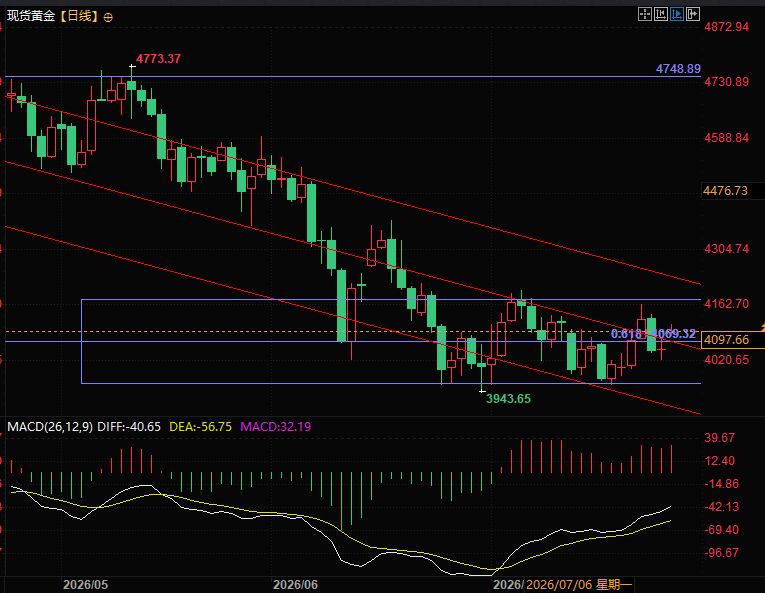 (Spot gold daily chart, source: FX678) At 16:00 Beijing time, spot gold is currently trading at $4091 per ounce.
Current situation in the US-Iran conflict: Conflict paused, but core strategic maneuvering remains deadlocked.
Following the continued escalation of tensions in the Middle East, the United States and Iran entered a temporary military ceasefire window, with both sides suspending mutual military strikes for the second consecutive day. Multinational mediation efforts continue, attempting to push the two countries back to negotiations and implement a temporary ceasefire framework. However, previous rounds of clashes have severely undermined the foundation for the ceasefire agreement's implementation, and the regional situation has not truly de-escalated. This round of US-Iran standoff has lasted nearly two weeks. The US attributes the conflict to Iran's harassment of merchant ships in the Strait of Hormuz, using this as a pretext to launch military strikes against Iran's coastal areas and core infrastructure. However, the Pentagon has consistently remained ambiguous, failing to explain the true considerations behind this proactive ceasefire. US Ambassador to the United Nations, Josh Walz, publicly stated that the Trump administration is deliberately leaving room for diplomatic negotiations, with Oman, Qatar, Pakistan, and other mediating countries leading the effort in recent weeks to facilitate multi-level, end-to-end indirect communication between the US and Iran. Walz also refuted market rumors of insufficient US interceptor missile reserves, but industry experts generally question the sustainability of a prolonged retaliatory confrontation between the US and Iran.The Iranian military simultaneously announced a ceasefire, following the lead of the United States and ending retaliatory strikes.
Previously, Iran launched a retaliatory attack against Middle Eastern countries hosting US troops, resulting in the deaths of three US soldiers at a US base in Jordan and one US soldier in Iraq. The 60-day temporary ceasefire agreement signed by the US and Iran in mid-June has entered its second half. Although all parties are making every effort to maintain dialogue channels, the Iranian nuclear issue, the root cause of the conflict, remains unresolved, and the focus of the dispute has shifted entirely to the issue of control over shipping in the Strait of Hormuz. Currently, the differences between the two sides are difficult to reconcile. Although indirect negotiations have made some progress, Iran's position remains firm: it insists on retaining the authority to collect "service fees" for shipping in the strait and maintaining absolute control over the waterway. Oman, the mediator, proposed a compromise, suggesting the establishment of a regional joint agency to jointly manage the waterway and eliminate all passage fees, which fundamentally contradicts Iran's core demands. Iranian Foreign Ministry spokesman Bagae clearly stated that Iran has fully fulfilled its obligations to ensure the safe passage of merchant ships, and that the US unilaterally violated previous agreements; therefore, the US should bear full responsibility for the current regional tensions. Meanwhile, Trump released contradictory signals. On the one hand, he claimed that the situation in Iran was progressing smoothly and that dialogue had resumed between the two sides. On the other hand, he emphasized that now was not the time to reach a final agreement, and stated firmly that if Iran could not fully meet the US demands, he would resume military operations with all his might. Israeli Prime Minister Netanyahu is about to travel to the US to meet with Trump, fully supporting the US strategy of pressuring Iran to abandon its nuclear program, and warning that Iran would pay a heavy price if it attacked Israel directly or through proxies. Regional risks continue to spread. The Houthi rebels in Yemen threatened to block Saudi shipping in the Bab el-Mandeb Strait, and coupled with the lowest traffic volume in the Strait of Hormuz in three weeks, uncertainty in the global energy supply chain has increased significantly. The US military has not relaxed its deterrent, continuing to advance its maritime blockade. Many merchant ships have been forced to divert or have been boarded and inspected, and US forces have maintained a state of high readiness.The core of the US's strategic maneuvering: seizing control militarily and seizing the power to define responsibility for war through public opinion.
This protracted tug-of-war has thoroughly demonstrated the core logic of modern great power geopolitical competition: the struggle for actual control through military force, and the struggle for the right to define responsibility through the power of public opinion. The United States has long recognized that it cannot completely control the Strait of Hormuz or completely suppress Iran's countermeasures through physical military means. A prolonged, all-out war would only drive up global oil prices, exacerbate domestic inflation, and impact public opinion and the political landscape. Therefore, "intermittent fighting and negotiations" has become the optimal strategy for the United States. Intermittent military strikes preserve its deterrent power and the leverage to restart hostilities at any time, while phased ceasefires demonstrate diplomatic goodwill and lay the groundwork for building public opinion. Compared to the military battlefield, where a complete victory is impossible, the public opinion battlefield is the lowest-cost and highest-return arena for the United States.American narrative: Deliberately severing causality and shifting blame in all directions.
The United States, through mainstream Western media and official rhetoric, systematically distorted the causal chain of the conflict, achieving precise public opinion whitewashing and blame-shifting. The US deliberately downplayed its own initiative in launching the military strikes against Iran and provoking the conflict, severing the root cause of the war and focusing global public opinion solely on "Iran's control of the Straits, collection of fees, disruption of shipping, and driving up oil prices." This carefully constructed narrative successfully shaped a completely reversed public perception: the US is the "righteous party" promoting peace negotiations, upholding global freedom of shipping, and stabilizing international oil prices; while Iran is the "disruptor" controlling vital energy routes, threatening the global economy, and creating an inflation crisis.This public opinion strategy serves three core political goals of the United States:
First, the US aims to weaken Iran's regional influence and international credibility by using a prolonged negative narrative to diminish its geopolitical power and continuously pressure it to abandon its nuclear program, thus achieving its ultimate strategic objective. Second, domestically, the US seeks to capitalize on the midterm elections by shifting public discontent over high oil prices and inflation onto Iran, avoiding the risk of being held accountable for its own war-making decisions. Third, the US aims to seize the moral high ground globally ; even without physical control of the Strait of Hormuz, it can completely distance itself from the US's role in energy inflation, diverting global attention from blame and maintaining its image as a global leader. Conversely, Iran lacks the equivalent long-range military capability to counter the US and can only rely on the Strait of Hormuz as its core geopolitical leverage for self-defense. However, this tactic directly impacts global energy supply, making it easily labeled by public opinion and leaving it in a passive and defensive position.Summary and Technical Analysis:
First, the United States has never had the strategic intention to launch a full-scale war. Its long-term strategy has been maximum pressure, simultaneous fighting and negotiations, and media dominance. The risk of a full-scale war is extremely low, and the market need not panic excessively about extreme geopolitical crises. Meanwhile, the continued slowdown in global economic growth has reduced demand for oil. Therefore, the oil price increases, inflation rebounds, and rising interest rate expectations brought about by this round of geopolitical conflict are generally within a controllable range and are unlikely to trigger a sustained and malignant global inflationary resurgence. However, core market risks remain: the rapid expansion of the global AI industry brings continuous financing demand, supporting the long-term high yields of global long-term government bonds, and continuously suppressing global risk assets and non-interest-bearing assets. In the context of gold, on the one hand, the repeated geopolitical frictions between the US and Iran are generally controllable, and overall controllable inflation means that the Fed's interest rate hike expectations are also controllable, which is beneficial to gold prices. On the other hand, the high yields of global long-term US Treasury bonds continue to raise the holding cost of gold, greatly limiting the upside potential of gold prices. Technical Analysis: Spot gold is currently in a downtrend that has transitioned into a range-bound trading pattern. Although it has not completely broken free from the downtrend, it shows signs of stabilizing. As long as the gold price remains above 4050, it is favorable for the bulls. (Spot gold daily chart, source: FX678) At 16:00 Beijing time, spot gold is currently trading at $4091 per ounce.
- Risk Warning and Disclaimer
- The market involves risk, and trading may not be suitable for all investors. This article is for reference only and does not constitute personal investment advice, nor does it take into account certain users’ specific investment objectives, financial situation, or other needs. Any investment decisions made based on this information are at your own risk.