Eurozone data unexpectedly improved, but why is the euro still stuck below the Bollinger Middle Band?
2026-07-27 17:56:02
On Monday, July 27, the euro was trading around 1.1400 against the dollar, rebounding slightly from the previous trading day, but still within the medium-term downtrend range formed since April. Furthermore, the Federal Reserve will hold its policy meeting on July 28-29. Energy prices, inflation risks, and employment data are all increasing policy uncertainty, causing the euro/dollar exchange rate to shift from simple data-driven trading to a multi-faceted pricing strategy considering policy path, energy shocks, and term spreads. 
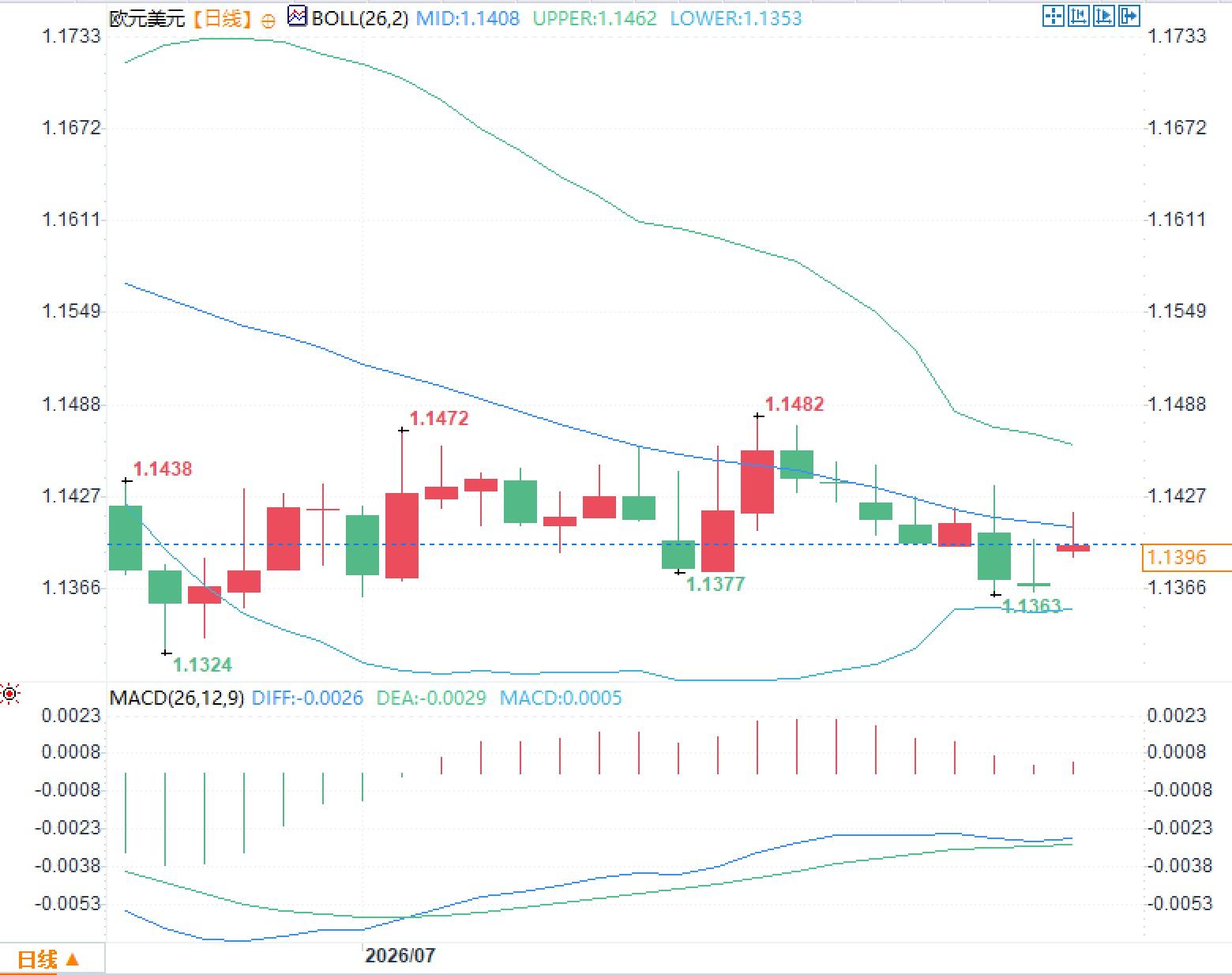 The MACD indicator remains below the zero line, with DIFF at -0.0026 and DEA at -0.0029. Although the histogram has slightly turned positive, it's more likely that the downward momentum has temporarily weakened than that the trend has reversed. The key focus now is not on judging a single bullish or bearish candlestick, but rather on observing whether the exchange rate can break out of the high-frequency trading range of 1.1350 to 1.1480.
The exchange rate is approaching a key range, and the rebound has not yet changed the medium-term structure.
From a daily chart perspective, the euro/dollar exchange rate has been declining since its April highs, with recent rebounds repeatedly encountering resistance in the 1.1470-1.1485 range. Recent highs were at 1.1472 and 1.1482, before the price fell back towards 1.1360, indicating that the selling pressure above is not solely due to technical resistance, but rather a result of combined factors including interest rate expectations and energy risks. Currently, the price is approaching the Bollinger Band middle line at 1.1408, but the middle line remains downward sloping, suggesting that a stable trend reversal has not yet formed. The 1.1353-1.1360 range corresponds to the lower Bollinger Band. If this area is repeatedly tested, the market will focus more on whether the lows continue to decline, rather than the magnitude of single-day rebounds. The 1.1472 and 1.1482 levels form a continuous resistance zone; only a sustained upward shift in the price fluctuation center can allow the technical structure to shift from weak consolidation to equilibrium. The MACD indicator remains below the zero line, with DIFF at -0.0026 and DEA at -0.0029. Although the histogram has slightly turned positive, it's more likely that the downward momentum has temporarily weakened than that the trend has reversed. The key focus now is not on judging a single bullish or bearish candlestick, but rather on observing whether the exchange rate can break out of the high-frequency trading range of 1.1350 to 1.1480.Risks surrounding the Fed meeting have increased, but a rate hike is still not a certainty.
The Federal Reserve maintained the target range for the federal funds rate at 3.50% to 3.75% at its June meeting, and explicitly stated that inflation remained above the 2% target, with energy supply shocks pushing up some prices. Ahead of the July meeting, the interest rate market's pricing in policy tightening intensified significantly, but no consensus was formed. Based on the latest data from federal funds futures, the market estimates the probability of maintaining the current rate at this meeting at approximately 65.7%, corresponding to a probability of a rate hike of approximately 34.3%. Therefore, the "decline in expectations for an immediate rate hike" can only explain short-term fluctuations and cannot indicate that policy risks have disappeared. Initial jobless claims in the US fell to 187,000 in the week ending July 18, a decrease of 22,000 in a single week, with the four-week moving average falling to 207,500. The resilience of the labor market means that the Fed lacks pressure to quickly ease policy, but the large fluctuations in weekly data cannot be directly equated with sustained overheating. Its more important market implication is to reduce policymakers' concerns about the economy's ability to withstand higher interest rates.Energy shocks have once again dominated inflation trading, and the euro's fundamentals have begun to recover.
Energy remains the most non-linear variable in the euro-dollar exchange rate. Brent crude recently surged above $100 a barrel, reflecting the impact of the US-Iran conflict and shipping risks in the Persian Gulf and Red Sea on supply chain expectations. Even if energy prices experience a single-day decline, as long as the absolute level remains high, transportation, chemical, and end-fuel costs are likely to continue to be passed on to core prices. This shock does not have a one-way impact on the euro. Rising energy import costs typically worsen terms of trade and compress corporate profits, putting pressure on the euro; however, if the European Central Bank maintains a tight policy to control a second round of inflation, short-term interest rates may provide some support. On July 23, the ECB kept its deposit facility rate at 2.25%, its main refinancing rate at 2.40%, and its marginal lending rate at 2.65%, emphasizing that the full inflationary impact of the energy shock has not yet materialized. The policy focus has gradually shifted from slowing growth to whether energy prices can sustainably transmit to the euro. The Eurozone's composite Purchasing Managers' Index rose to 51.9 in July from 50.0 in June, with private sector activity expanding again, new orders improving, and both manufacturing and services recovering. The US composite purchasing managers' index rose to 53.6 in July from 51.9, indicating a faster pace of economic expansion, while sales price growth reached near a four-year high. These two sets of data suggest that the euro's fundamentals are not continuously deteriorating, but the combination of US growth and price pressures still allows the US dollar to maintain a relative advantage in interest rates.- Risk Warning and Disclaimer
- The market involves risk, and trading may not be suitable for all investors. This article is for reference only and does not constitute personal investment advice, nor does it take into account certain users’ specific investment objectives, financial situation, or other needs. Any investment decisions made based on this information are at your own risk.