RBA Governor's Speech + Inflation Data + FOMC Decision: Three Key Events to Determine the Australian Dollar's Fate
2026-07-28 09:54:04
The Australian dollar traded in a narrow range against the US dollar in early Asian trading on Tuesday (July 28), currently hovering around 0.6990. Over the past two weeks, the market has repeatedly attempted to break through the 0.7000 level, but each attempt has failed. Notably, while crude oil prices have plummeted and iron ore prices have remained under pressure, the Australian dollar has been largely unaffected – commodity currencies are trading on "risk appetite," rather than the commodities themselves. 
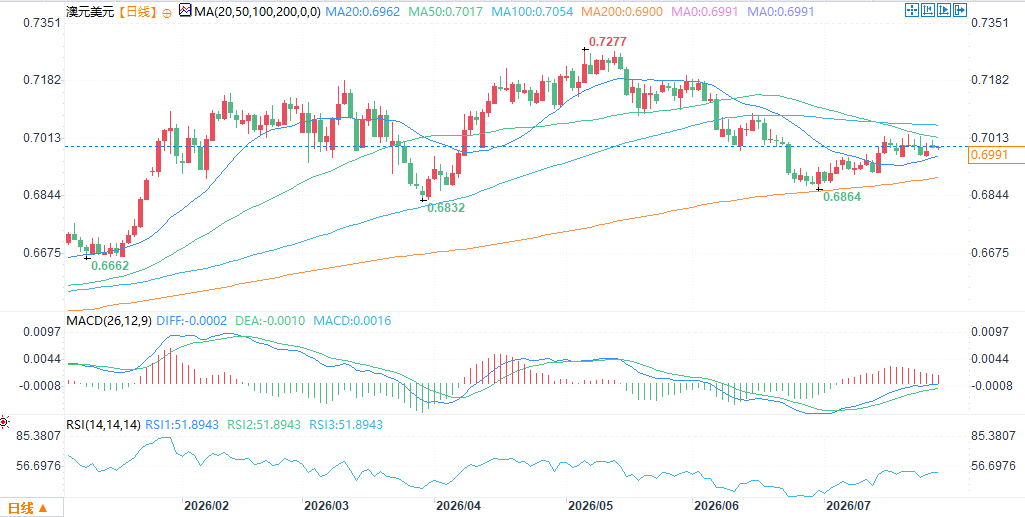 (Australian dollar against US dollar daily chart, source: EasyForex) At 9:53 AM Beijing time on July 28, the Australian dollar was trading at 0.6987/88 against the US dollar.
The plunge in crude oil prices and the slump in iron ore prices were completely ignored.
On Monday, news of a ceasefire between Washington and Tehran triggered a sharp drop in crude oil prices, dragging down the entire energy sector and directly impacting liquefied natural gas and coal revenues, which are on par with mining exports. Iron ore, Australia's largest export commodity, has been stuck below $100 per tonne since late June. Asian production declined by about 5-6% year-on-year in the middle of the year, with steel mill inventories accumulating rather than decreasing. However, these factors are not reflected in the exchange rate. The Australian dollar is currently not traded as a "claim" on Australian output, but rather as a proxy indicator of global risk appetite—Monday's diplomatic efforts boosted risk sentiment enough to offset losses in terms of trade. The pricing logic for the Australian dollar has shifted from a "commodity currency" to a dual-driven model of "risk sentiment + interest rate expectations."A number, and one that has already been fully priced in.
All that remains is the interest rate story, which narrows to Wednesday. The Reserve Bank of Australia (RBA) has raised rates three times this year to 4.35%, and when it held rates steady in June, it clearly left open the option of further tightening. The market consensus for the June inflation report is: overall CPI up 0.2% month-on-month (previous -0.7%), cut-off mean up 0.4% month-on-month, and annual rates of 4% and 3.6% respectively. The problem is: these figures are already fully priced in by the market. Swaps have already priced in a further 25 basis point rate hike over the next six months, and most economists surveyed expect at least one more rate hike this year, with most believing it will occur at the August meeting. A meeting-of-expectations inflation report would have a very limited impact on the Australian dollar; while a lower-than-expected report could remove the only support for the Australian dollar. This asymmetry is the core of the current trading. There is a second reason why the ceasefire trade is beneficial rather than harmful to the Australian dollar: Australia's inflation problem this year is largely imported, and the continued decline in energy costs will alleviate the pressure that pushed the electricity and fuel sub-index to its highest level since 2023 in March. This has a two-sided impact on the Australian dollar – it eases the pressure of the cost of living, but also subtly weakens the rationale for raising interest rates that the Australian dollar relies on.Three important events
The Reserve Bank of Australia (RBA) Governor's speech at 11:05 AM on Tuesday is the last official statement before the data release and a natural window for setting the tone. June inflation data will then be released at 9:30 AM on Wednesday, accompanied by a quarterly table; the interest rate decision on August 11th will essentially depend on this. Building permits will be released at 9:30 AM on Thursday, with an expected month-on-month decrease of 0.5% (previous value -1.1%). In the US, the Federal Reserve's decision at 2:00 AM on Thursday is expected to maintain the interest rate at 3.75% for the fourth consecutive time (without quarterly economic forecasts), although a minority still price in a rate hike. The data package at 8:30 PM on Thursday includes: Q2 GDP growth of 2.1%, core PCE of 0.2% month-on-month and 3.3% year-on-year, and initial jobless claims expected to rebound from 187,000 to 204,000. The Australian Producer Price Index and China's official manufacturing and non-manufacturing PMIs will be released on Friday.Data quality adjustments have diminished the perceived "hot" employment data.
June's employment data provided a headline for hawks—76,300 new jobs were added, far exceeding the consensus expectation of 15,000. However, the Bureau of Statistics noted that adjustments to the data quality in two states should be treated with caution regarding this unexpected increase. July's business surveys showed that both manufacturing and services were in expansion territory. The US domestic fundamentals are solid enough to support interest rate hikes, but far from strong enough to "force" them—this is the fundamental reason why the Australian dollar has remained stagnant.The Australian dollar's "inflation data game"
The Australian dollar is no longer trading on Australian commodity exports, but on a single number – Wednesday's inflation data. The impact of the plunge in crude oil and the slump in iron ore prices on the exchange rate has been offset by improved risk appetite, and the only support for the Australian dollar comes from expectations of a rate hike by the Reserve Bank of Australia (RBA). The core issue is asymmetry: if the inflation data meets expectations, the Australian dollar will receive almost no boost (it's already fully priced in); if the data falls short of expectations, it could remove the only support for the Australian dollar – a clear downside asymmetry. Meanwhile, while lower energy costs have eased cost-of-living pressures, they have also weakened the case for a rate hike. Three key events – the RBA governor's speech, Australia's June inflation data, and the Federal Reserve's decision – will collectively determine whether the Australian dollar can break through 0.7000 or remain trapped below this level. (Australian dollar against US dollar daily chart, source: EasyForex) At 9:53 AM Beijing time on July 28, the Australian dollar was trading at 0.6987/88 against the US dollar.
- Risk Warning and Disclaimer
- The market involves risk, and trading may not be suitable for all investors. This article is for reference only and does not constitute personal investment advice, nor does it take into account certain users’ specific investment objectives, financial situation, or other needs. Any investment decisions made based on this information are at your own risk.